Broad Consent vs. Tiered Consent for Biobanking
By Dr. Zubair Khalid, DVM, MS, PhD ·

Broad consent asks a donor to approve long-term storage and future use of their biological samples and data for a wide range of research that has not yet been defined. Tiered consent presents the donor with a menu of options, from a single study only up to unlimited future use, so the donor decides how far each permission extends. The rule of thumb for choosing between them is simple. Use broad consent when a biobank has durable governance, ongoing donor communication, and research goals that cannot be specified at collection time. Use tiered consent when donor control, community trust, or laws that require defined purposes are the deciding constraints. This guide explains each model on its own terms, compares them on the criteria that decide real choices, and walks through worked scenarios drawn from the research ethics literature.
Why Biobanking Needs More Than Study-Specific Consent
The classic informed consent model was built for interventional clinical trials. A researcher describes one protocol, the participant weighs the risks, and consent covers that protocol alone. Biobanking breaks this model. Samples and linked data are often stored for decades, and nobody at collection time can say which studies will use them, in which countries, or with which technologies such as whole-genome sequencing. Requiring a fresh consent signature for every future study is expensive, slows science, and becomes impossible once donors lose contact or die.
For the sake of feasibility, study-specific consent has gradually given way to alternative models that do not require consent for every new study. Besides broad consent, these alternatives include tiered consent, dynamic consent, and meta-consent, in which donors set general preferences for how they are asked in the future [1]. Critics of moving away from study-specific consent argue that a truly informed consent requires knowing how samples will be used, and that this knowledge simply does not exist at enrollment [1]. The debate between broad and tiered consent is the practical center of this larger argument, and the answer a biobank chooses shapes its relationships with donors, ethics committees, and downstream research partners for years.
A useful frame from the ethics literature is to judge any consent model by how well it protects donors against two things: the risk of informational harm and the violation of participants' personal values. Applying these criteria across consent models, one comparative analysis concluded that broad consent can serve donors best, provided it is also deep, meaning that the consent process genuinely informs donors about the biobank's purpose, safeguards, and governance rather than collecting a signature on a long form [1].
What Broad Consent Is
Broad consent is permission for a biobank to store a donor's biological material and associated data and to use them for future research within a broadly described scope, such as "genetic and biomedical research," without asking the donor again for each individual project. The scope may be unlimited, or it may be limited to a disease area, a research type, or a geographic region. In one hospital-based model from Norway, for example, patients consent to storage and use for "specific, broadly defined research purposes" within a specified medical research area, and they are asked for new consent if researchers want to use the material in a different research area [2].
Broad consent is now the dominant or recommended approach in many systems. A template developed by the biobank task force of the Working Party of German Medical Ethics Committees, updated in 2016, permits long-term storage and multi-purpose research use of human biological material and related data, including cross-border exchange, and was designed to comply with recommendations of the Organisation for Economic Co-operation and Development and the World Medical Association [3]. Surveys of practice show the same pattern elsewhere. In Malaysia, interviews with biobank key informants found that broad consent is the main approach used for research biobanking, alongside persistent gaps in understanding of the ethical and legal aspects among staff [4].
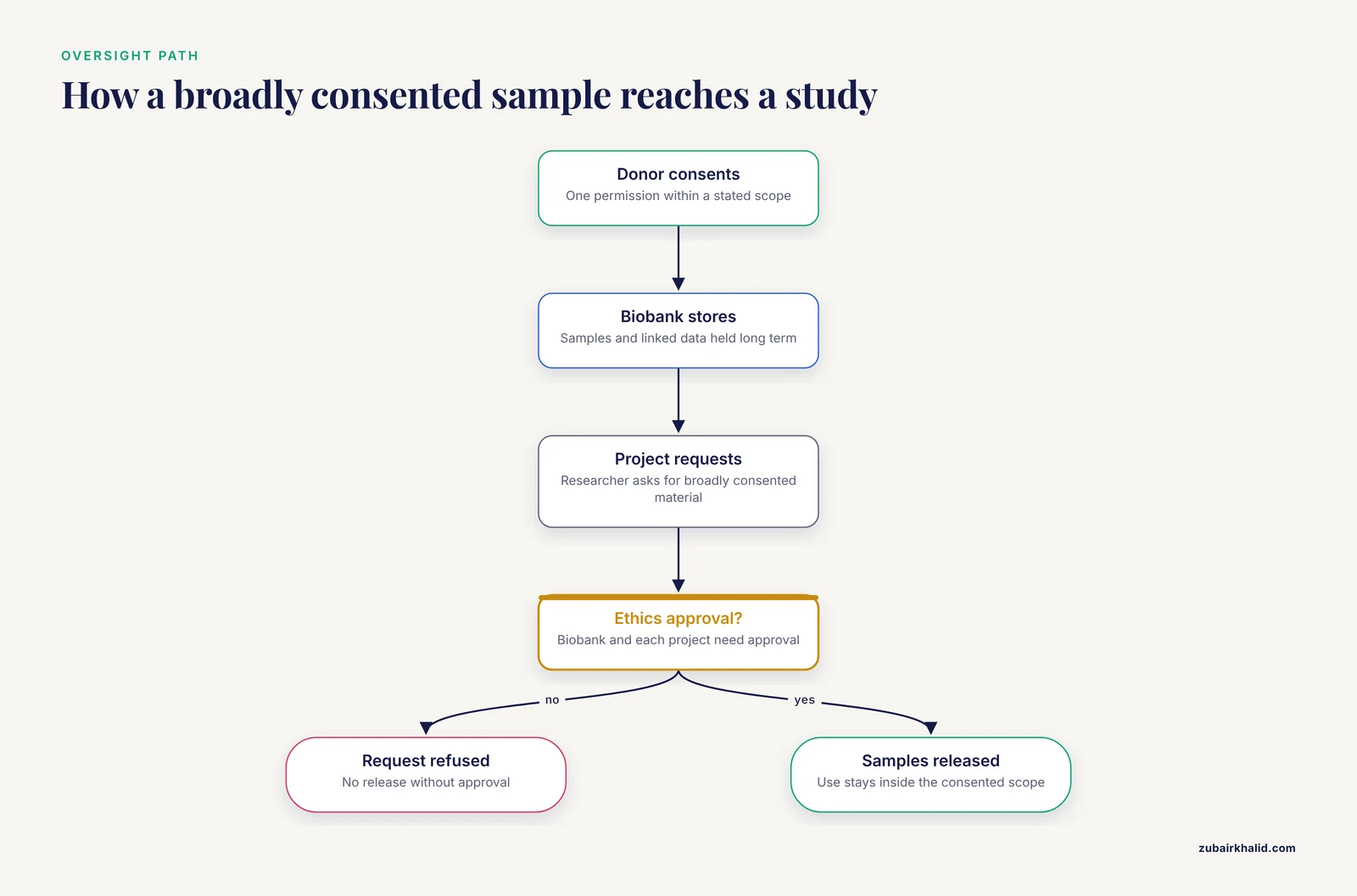
Two features of legitimate broad consent deserve emphasis. First, the biobank itself and every research project requesting broadly consented samples generally require ethics approval, and the consent arrangement should be reciprocated by transparent biobank processes and by fostering donor and public involvement [3]. Broad consent is not a waiver of oversight. Second, the consent must actually be understood. In a large study of patients recruited for health care-embedded biobanking, researchers examined what donors understood and why they chose to donate, and found that comprehension of broad consent was often partial even among willing donors [5].
Broad consent also comes in varieties. Public attitudes research in Japan distinguishes unlimited broad consent from narrower and limited forms that restrict the types of research or the categories of users, and found that the limited types were more accepted by the public [6]. This matters for design. A biobank does not have to choose between a single permission for anything and a fully specific consent. There is a spectrum in between.
What Tiered Consent Is
Tiered consent, sometimes called multi-layered or layered consent, presents donors with a structured set of choices rather than one accept-or-decline decision. A typical form offers checkboxes such as the following.
- Use my sample only in the current study.
- Also store my sample for future research on this same condition.
- Also use my sample for future research on other conditions.
- Also share my de-identified sample and data with other researchers, including commercial companies, or not.
The donor picks a level for each option. Tiered consent gives donors granular control and creates a documented record of exactly what each person agreed to, which is valuable when preferences differ sharply within a population. Its costs are also real. The form is longer, the consent conversation takes more time, every downstream use must be checked against each donor's selected tier, and donors who decline broad tiers may exclude their samples from much of the biobank's scientific value.
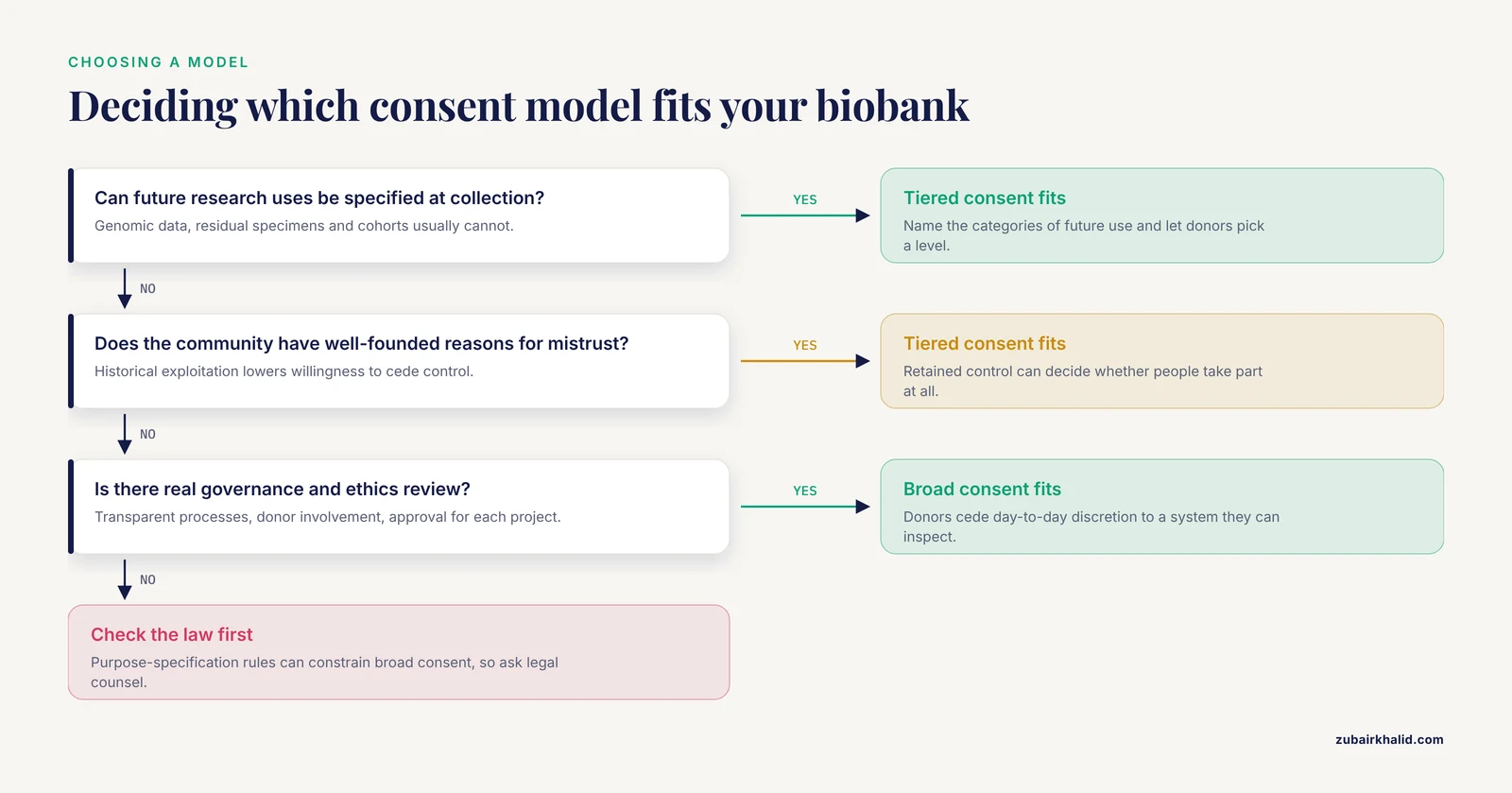
Tiered consent sits between study-specific consent and broad consent on the control spectrum. It keeps the donor's hand on the switch for categories of future use, while avoiding the impossible demand of re-consenting for every single study. For biobanks working with communities that have historical reasons for mistrust of research, that retained control can determine whether people participate at all.
Side-by-Side Comparison
| Feature | Broad consent | Tiered consent |
|---|---|---|
| What the donor approves | Storage and future use for a wide, often unspecified range of research within a stated scope | Separate permissions for defined categories of future use |
| Donor control over future studies | Low at the level of individual studies, higher when the scope is limited | High, the donor selects tiers |
| Consent form length and time | Typically shorter | Longer, more decisions to explain |
| Re-consent burden | None for studies within scope, though some models add re-consent for new research areas | None within the chosen tiers, re-consent needed for anything outside them |
| Downstream logistics | Simple, one permission governs the archive | Requires tracking per-donor permissions for every release |
| Ethics review | Still required for the biobank and for each requesting project [3] | Required, with easier mapping of use to stated permission |
| Best fit | Long-term archives, cross-border sharing, clinical leftovers, strong governance | Populations with trust concerns, communities that value granular control |
| Main ethical risk | Consent that is broad but shallow, meaning poorly understood | Samples excluded by tier choices, reducing scientific utility |
The difference between broad consent and tiered consent for biobanking, reduced to one line, is where discretion lives. Broad consent transfers discretion from the individual donor to the biobank's governance system. Tiered consent keeps discrete chunks of discretion with the donor.
When to Use Broad Consent
The strongest case for broad consent appears under four conditions.
First, the research future is genuinely unknowable. Genomic data, residual clinical specimens, and population cohorts are collected precisely because their value lies in studies that do not yet exist. When the biobank cannot describe future projects in any specific way, tiered options that name future studies become artificial.
Second, the biobank needs to move material across borders. Cross-border sharing of biosamples and data is a common requirement of modern collaborative research, and the German ethics committee template was written specifically to furnish a framework permitting long-term storage, multi-purpose use, and cross-border exchange under one consent instrument [3]. A patchwork of narrow, project-specific permissions makes international consortia slow and legally fragile.
Third, there is governance infrastructure to back the consent up. Broad consent only functions ethically when it is paired with transparent processes, ethics approval for each requesting project, and donor and public involvement [3]. Where those exist, donors cede day-to-day discretion to a system they can inspect.
Fourth, the local regulatory environment permits it. This cannot be assumed. In South Africa, broad consent is permitted by the National Department of Health ethics guidelines but appears to be constrained by purpose-specification requirements in the Protection of Personal Information Act, creating ambiguity that the authors argue should be resolved through clearer rules on data access and consent form content [7]. In Malawi, stakeholders in a qualitative study held contradictory readings of the national guidelines, with some believing reuse and sharing of samples were prohibited and others believing they were permitted, which left researchers without a clear framework for storage and future use [8]. Checking the law before choosing a consent model is part of responsible conduct of research, not an afterthought.
Choosing Between Them: The Criteria That Decide Real Choices
Donor autonomy and control. Tiered consent maximizes expressed control. Whether that control translates into real protection depends on whether donors understand what they are choosing. In the Norwegian patient survey, a majority of patient representatives, 66.2 percent, supported a general consent for medical research without limitation to specific purposes, and 63.7 percent supported use of surplus material for medical research in general, although only a minority, 35 percent, supported use of surplus material without being informed at all [2]. Control preferences are real but uneven, and many donors voluntarily give them up when they trust the system.
Feasibility and scientific yield. Broad consent keeps the whole donor pool available for future questions. Tiered consent fragments the pool, and the fragmentation is not random. Donors who decline broad tiers may differ systematically from those who accept, which can bias the archive. For large longitudinal cohorts and hospital biobanks where the whole point is reuse, broad consent is usually the workable default.
Population trust and history. Trust is not uniform. In a study of African American adults presented with hypothetical biobank scenarios, participants were largely willing to contribute but significantly preferred options where they had control over the use of their samples through tiered or study-specific forms of consent, and the authors warned that broad consent procedures, although common, may amount to an exclusionary practice for groups with lower trust in researchers [9]. Where a community has well-founded historical reasons for skepticism, tiered consent is both an ethical choice and a recruitment strategy.
Governance capacity. Broad consent places weight on the biobank's governance. Quantitative work in Japan found that public acceptance of broad consent rises with established measures of biobank governance, implying that a specific type of governance is critical in promoting trust, reciprocity, and solidarity between biobanks and the public, and that limited forms of broad consent should remain an important option [6]. A biobank without robust governance infrastructure should lean toward tiered consent, because tiered consent does not depend on donors trusting an institution they cannot see into.
The consent encounter itself. Empirical work in a hospital-based biobank in Lausanne showed that decisions about broad consent rely as much on intuition as on reasoning, that conditional trust in the recruiter plays a significant role, and that contextual and relational factors shape the practice of broad consent in ways a consent form alone cannot capture [10]. Interviews and focus groups at the same institution found that patients were sensitive to the quality of information, the timing of the request, and the recruiter's attitudes, including something as concrete as the presence of the white coat, and that participation was often motivated by existential goals such as feeling useful while ill [11]. The model you pick has to be deliverable by real staff in real clinical settings.
What Participants Actually Prefer
The evidence on donor preferences is mixed, and pretending otherwise is a mistake biobanks make often.
A systematic literature review of 48 studies on attitudes toward biobanking, broad consent, and data sharing in the United States found that although some participants objected, broad consent was often preferred over tiered or study-specific consent, particularly when broad consent was the only option offered, when samples were de-identified, when the logistics of biobanks were communicated, and when privacy was addressed. Willingness for data to be shared was high overall but lower among individuals from under-represented minorities, individuals with privacy and confidentiality concerns, and when pharmaceutical companies had access to the data [12].
On the other hand, the study of African American adults cited above found the opposite ordering, with significant preference for tiered and study-specific options [9]. In Uganda, a cross-sectional study of 500 health care users found that overall acceptability of broad consent for storage of biological materials and data was 86.2 percent, with a 95 percent confidence interval of 82.9 to 88.9 percent, and that understanding of the consent information was a key factor in acceptance [13]. In Norway, general consent for medical research drew majority but not universal support among patient representatives [2]. In Japan, the narrower and limited forms of broad consent outperformed the broader forms in public acceptance [6].
Three lessons follow. Preference data cannot be exported wholesale from one population to another. How the options are framed, including whether broad consent is the only option, changes what people pick. And concerns about privacy, commercial access, and control cluster in specific groups, which means a single consent design will leave some segment of the population under-served no matter which model anchors it.
Governance Safeguards That Make Either Model Work
Whichever model a biobank adopts, the consent form is the least important part of the ethical architecture. The safeguards around it carry most of the load.
Ethics review at every step. Both the biobank that stores broadly consented samples and each research project that requests them require ethical approval, and the consent arrangement should be matched by transparent biobank processes and by fostering donor and public involvement [3].
Ongoing communication with donors. A community advisory board study across three sites examined a proposal to notify contributors whenever their samples were distributed to researchers. The advisory board members saw advantages but also identified potential harms to both contributors and the biobank, and they understood biobank communication in terms of an ongoing relationship and a personal contribution to research rather than a one-time transaction [14]. Communication plans should be designed with communities, not announced to them.
Governance rules that stand in for missing detail. Interviews with members and representatives of German patient organizations found general agreement with broad consent, but on analysis the positive assessments related less to broad consent itself and more to overarching regulations on secondary data use that deviate from it [15]. Donors accept broad consent when they believe rules exist that limit what can be done. Publishing those rules is part of the consent.
Clear law and harmonized guidance. Where regulation is ambiguous or absent, both donors and researchers suffer. The South African analysis of the tension between ethics guidelines and data protection law proposed amendments to remove ambiguity, specify rules for data access and personal information processing, and incorporate consent form requirements into a national template [7]. The H3Africa ethics consultation meetings documented considerable evolution in the thinking of African research ethics committees about broad consent as an option for genomics research and biobanking, and closed with a call for broader engagement with policy makers to develop guidance and harmonization where frameworks do not exist [16]. Reviews of perspectives from low- and middle-income countries make the same point from the donor side, that consent model debates cannot be settled without attention to local regulatory and social conditions [17].
Worked Scenarios
Scenario 1. A hospital biobank collecting residual clinical samples. A university hospital wants to store leftover blood and tissue from diagnostic workups, plus linked electronic health data, for future genomic and translational research. The future studies are unknowable, donors are already patients in the building, and the institution has an ethics committee and a biobank governance board. This is a textbook case for broad consent, ideally with a limited scope such as biomedical research within defined areas, mirroring the Norwegian model in which new consent is sought if material moves to a different research area [2]. The hospital should also plan for the relational realities documented in qualitative work, in which recruiter behavior, timing, and conditional trust strongly shape whether patients feel their consent is genuine [10][11].
Scenario 2. A genomics study in a community with a history of research mistrust. A research team wants to collect samples from an African American community that has experienced exploitation in past medical research. Survey evidence shows this population significantly prefers tiered or study-specific control over samples, and that broad consent can function as an exclusionary practice [9]. The right design here is tiered consent with explicit choices about data sharing, including whether pharmaceutical companies may access the data, since commercial access lowers willingness to share in general population surveys as well [12]. Pair the tiered form with community advisory input on communication, because advisory board members evaluate biobank communication as an ongoing relationship and can flag harms designers do not anticipate [14].
Scenario 3. A multi-country consortium pooling samples and data. An international consortium needs to move biosamples and data across borders among partner institutions. Narrow project-specific consents from each site would create a legal patchwork. A harmonized broad consent template, such as the one produced by the German medical ethics committees' working party, which permits long-term storage, multi-purpose use, and cross-border exchange in compliance with OECD and World Medical Association recommendations, solves the structural problem [3]. Each site still needs its own ethics approval, and each downstream project needs approval as well [3].
Common Mistakes and Limitations
Treating the consent form as the safeguard. The most common failure in biobanking ethics is believing that a signed broad consent form replaces governance, transparency, and community engagement. Empirical work with patient organizations shows that support for broad consent is really support for the regulatory framework around secondary data use [15]. If your governance is weak, tiered consent will not fix it, and broad consent will not survive contact with scrutiny.
Assuming broad consent means no oversight. Both the biobank and every project requesting broadly consented samples generally require ethical approval [3]. Teams that treat a broad consent archive as an ethics-free zone are wrong, and ethics committees increasingly say so.
Exporting preference data across populations. Preference findings point in different directions across countries and communities, with majority support for broad consent in some settings [13] and clear preference for tiered control in others [9]. Run your own formative research with your own donor population.
Choosing broad consent in a setting where trust is conditional and relational. Hospital consent conversations run on trust in the recruiter, timing, and setting, not on careful reasoning about form language [10][11]. A broad consent obtained from a worried patient by a treating clinician in a corridor is fragile consent. Schedule the conversation, train the recruiters, and separate the research request from clinical care where possible.
Ignoring purpose-specification law. Data protection statutes that require clearly defined purposes can conflict with broad consent, as the South African analysis of the Protection of Personal Information Act illustrates [7]. Ask your institution's legal counsel before committing to a model, not after the first audit.
Writing shallow broad consent. A broad consent that is also deep, in the sense of genuinely informing donors about purposes, risks, and safeguards, outperforms other models on criteria of informational harm and respect for values [1]. A broad consent that is a dense legal paragraph plus a signature line is neither informed nor broad in any meaningful sense.
Forgetting withdrawal and communication logistics. Donors change their minds, move, and die. Decide at the outset how withdrawal requests are handled, how samples are flagged, and how donors will be told about notable uses of their material, and design those mechanisms with community input rather than assuming donors want or do not want notifications [14].
One general limitation applies to everything above. Consent model choices are institutional and legal decisions that depend on your specific population, jurisdiction, and governance capacity, so validate any design with your own ethics committee and legal counsel before implementation.
Frequently Asked Questions
What is the difference between broad consent and tiered consent in biobanking?
Broad consent gives a biobank one permission to store and use samples and data for a wide, often unspecified range of future research within a stated scope. Tiered consent breaks the permission into categories, such as the current study only, related future research, or any future research, and lets the donor choose a level for each. The core difference is who holds discretion over future uses, the biobank's governance system or the individual donor.
When should a biobank use broad consent?
Use broad consent when future research questions cannot be specified at collection, when samples or data need to move across borders, and when the biobank has real governance infrastructure including ethics review of every requesting project, transparent processes, and donor involvement. It is the practical default for large cohorts, residual clinical samples, and international consortia, provided the legal environment permits it.
Is broad consent ethically acceptable if donors cannot know future research uses?
Yes, most modern ethics frameworks accept it, but only under conditions. The consent must genuinely inform donors about the biobank's purpose, risks, and safeguards, governance must limit and oversee actual uses, and each downstream project should still receive ethics approval. Analysis applying the aims of informed consent to biobank conditions concluded that broad consent can best protect donors when it is also deep in information and backed by strong governance.
Do donors prefer broad or tiered consent?
It depends on the population and how the options are presented. A systematic review of 48 US studies found broad consent often preferred over tiered or study-specific consent when samples were de-identified and privacy was addressed, while a study of African American adults found significant preference for tiered and study-specific control, and surveys in Uganda, Norway, and Japan show high but incomplete acceptance of broad consent in various forms. There is no universal preference, so test with your own donor community.
Can a biobank combine broad and tiered consent?
Yes, and many do. A common design offers broad consent within a limited scope, such as one disease area or research type, with tiered choices layered on top for data sharing, commercial access, or recontact. Public attitude research in Japan found that narrower and limited forms of broad consent were more accepted than unlimited forms, which supports hybrid designs that pair broad storage permission with specific donor choices.
Does broad consent remove the need for ethics review of individual studies?
No. Both the biobank holding broadly consented samples and each research project requesting them generally require ethical approval. Broad consent simplifies the consent interaction, not the oversight system, and transparency about approved uses is part of the reciprocal obligation that makes broad consent legitimate in the first place.
Sources
- Broad consent for biobanks is best - provided it is also deep
- Toward a More General Consent for the Use of Patients’ Biological Material and Health Information for Medical Research-The Patient Perspective
- Broad donor consent for human biobanks in Germany and Europe: a strategy to facilitate cross-border sharing and exchange of human biological materials and related data
- A Preliminary Study to Explore the Informed Consent Approach and the Ethical Challenges in the Malaysian Biobanking for Research
- Broad consent for health care-embedded biobanking: understanding and reasons to donate in a large patient sample
- Public Perspectives on Consent for and Governance of Biobanking in Japan
- Broad consent for biobank research in South Africa - Towards an enabling ethico-legal framework
- A qualitative study exploring stakeholder perspectives on the use of biological samples for future unspecified research in Malawi.
- “My Blood, You Know, My Biology Being out There…”: Consent and Participant Control of Biological Samples
- Broad consent in practice: lessons learned from a hospital-based biobank for prospective research on genomic and medical data
- Patients’ decision to contribute to a biobank in the light of the patient-recruiter relationship-a qualitative study of broad consent in a hospital setting
- A systematic literature review of individuals' perspectives on broad consent and data sharing in the United States
- Health care users’ acceptance of broad consent for storage of biological materials and associated data for research purposes in Uganda
- At a Moment’s Notice: Community Advisory Board Perspectives on Biobank Communication to Supplement Broad Consent
- Critical consideration towards broad consent by patient experts: results of a semi-structured interview study on the secondary use of medical data
- Evolving perspectives on broad consent for genomics research and biobanking in Africa. Report of the Second H3Africa Ethics Consultation Meeting, 11 May 2015
- Broad Consent for Genomic Research and Biobanking: Perspectives from Low- and Middle-Income Countries.