Bridging the Terminology Gap in Research Teams
By Dr. Zubair Khalid, DVM, MS, PhD ·

By the end of this guide you will be able to run a terminology audit on your team's documents, build and maintain a shared glossary that survives contact with real projects, align conflicting metrics between disciplines, and set up meeting and onboarding practices that stop misunderstandings before they spread. To follow the walkthrough you need a folder of representative team documents (meeting notes, protocols, manuscript drafts), a spreadsheet program, a text editor, and optionally Python 3 with Git installed if you want the version-controlled glossary workflow.
A terminology gap is the mismatch between the words, units, and metrics different members of a team use for the same ideas. It shows up when a clinician and an engineer walk away from the same meeting with different action items, or when two labs report "the same" measurement in incompatible formats. Bridging the terminology gap is one of the cheapest, highest-leverage interventions a research group can make, because most of its costs are invisible until a project stalls.
Why Terminology Gaps Happen
Interdisciplinary teams form because the hard problems sit between fields. A patient safety research program that combines clinicians, engineers, and human factors specialists can follow a structured systems-engineering path through problem analysis, design, development, implementation, and evaluation, but the team still has to build a common language before any of those steps run smoothly [1]. Materials researchers using atomic force microscopy (AFM) face the same issue. AFM maps surface properties through controlled probe-sample interactions, and its expanding set of imaging modes enables collaboration across domains from electronic materials to energy storage, yet effective use is often challenged by technical complexity and varied domain expertise among collaborators [2].
Three mechanisms produce the gap repeatedly:
- Different training. A review of machine learning in nursing found that limited formal education leaves many clinicians hesitant to integrate computational tools into everyday practice, which is a language and confidence problem as much as a skills problem [3].
- Different metrics and definitions. In active matter and biomaterials research, inconsistencies in metrics, definitions, and analysis algorithms across research groups have hindered the identification of performance intersections between systems, even when the underlying data are compatible [4].
- Different professional constraints. Physician surveys on advance care planning in India illustrate a pattern that repeats in every field. Nearly all respondents agreed on the goal, but small fractions felt they had enough time or resources, and majorities cited missing institutional support and training [5]. Agreement on goals with disagreement on vocabulary and process produces the same friction in research teams.
Training structures are slowly catching up. Medical and engineering programs have begun building cross-disciplinary platforms, dual-degree tracks, and joint curricula so graduates arrive in teams already practiced at translating between fields [6]. Until that becomes universal, teams need their own process.
What the Gap Costs a Team
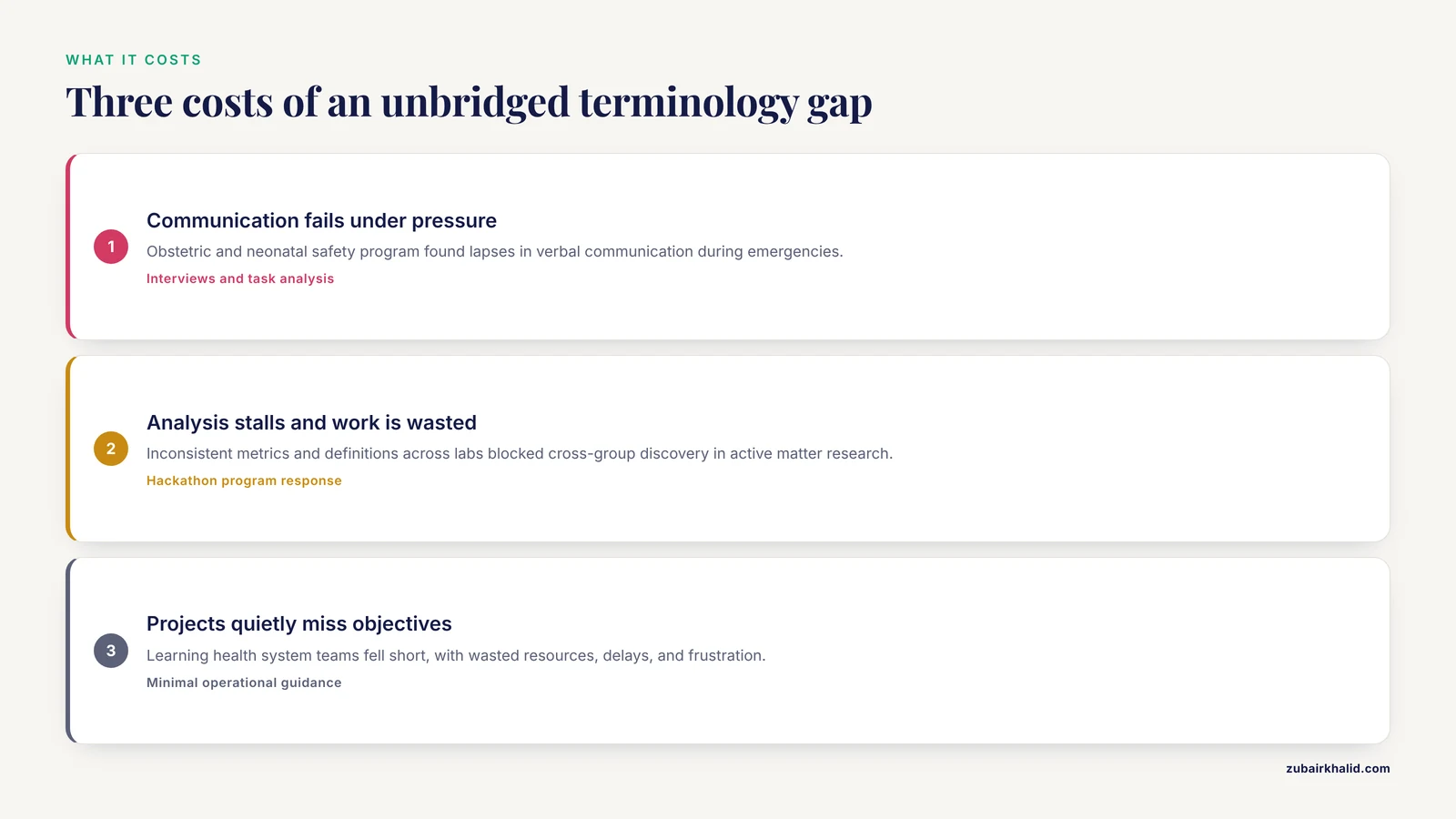
The costs fall into three buckets, and each is documented in real research settings.
Communication failures under pressure. A multidisciplinary obstetric and neonatal safety program using interviews, focus groups, direct observation, and task analysis identified common lapses in verbal communication during obstetric emergencies [1]. Emergency settings amplify any ambiguity. A word that two people interpret differently during a routine meeting becomes a hazard when the same word is spoken during a crisis.
Stalled analysis and wasted work. When groups define quantities differently, pooled data cannot be compared. The hackathon-based active matter program was created precisely because inconsistent metrics, definitions, and algorithms across labs blocked cross-group discovery, even as high-dimensional experimental data kept accumulating [4].
Projects that quietly miss their objectives. A study of interprofessional learning health system teams found that initiatives often fall short of their intended objectives, producing wasted resources, delays, and mounting frustration among stakeholders, partly because teams had minimal operational guidance for working together [7]. Ambiguous shared vocabulary is one of the most common forms that missing guidance takes.
Bridging the Terminology Gap in Research Teams Step by Step
This is a complete workflow. Steps 1 through 4 take one to two weeks for a typical team of five to fifteen people. Steps 5 through 10 become ongoing habits.
Step 1. Audit the words your team actually uses
Collect ten to twenty representative documents: meeting notes, protocols, analysis scripts, and manuscript drafts. Concatenate them and count acronym and key-term frequency.
mkdir terminology_audit
cp meeting_notes.md protocols/*.md manuscripts/draft.md terminology_audit/
cat terminology_audit/*.md > combined_docs.txt
Then run a short Python script to surface acronyms and candidate terms.
# audit_acronyms.py
import re
from collections import Counter

with open("combined_docs.txt", encoding="utf-8") as f:
    raw = f.read()

# Matches 2 to 7 uppercase letters, e.g. SOP, LIMS, AUROC
acronyms = re.findall(r"\b[A-Z]{2,7}\b", raw)
for term, n in Counter(acronyms).most_common(15):
    print(f"{term}: {n}")
Expected output looks like this:
SOP: 34
QC: 28
LIMS: 21
PI: 17
IRB: 14
RUO: 11
FDR: 9
CV: 8
LOD: 6
GMP: 5
The regex pattern \b[A-Z]{2,7}\b matches word boundaries around runs of two to seven capital letters. Adjust the upper bound if your field uses longer acronyms. The count tells you where to focus. Any acronym appearing more than about ten times across the corpus is load-bearing and needs an entry in your glossary.
Then run the same audit on lowercase candidate terms your fields fight over. A simple approach is a second pass with a keyword list you draft by hand: validation, validation set, cohort, sample, batch, run, replicate, threshold, endpoint, performance. For each candidate, grep the corpus and read the surrounding sentences to see whether usage is consistent.
grep -n -i "validation" combined_docs.txt | head -20Step 2. Interview each discipline for its definitions
Structured interviews work better than surveys for this task because definitions carry context. The patient safety program cited above used interviews, focus groups, direct observation, and task analysis to map where team performance broke down, and those same methods translate directly to terminology work [1].
Ask every member of each discipline the same four questions:
- How do you define the term "validation" (or whichever term is contested) in your daily work?
- What units and formats do you report that quantity in?
- What word do you use when talking to people outside your field for the same idea?
- Where has a word caused a misunderstanding in the last six months?
Write down answers verbatim. Disagreement between two members of the same discipline is itself a finding. It means the term is unstable even within a field, and your glossary entry needs to state the team's chosen definition explicitly.
Step 3. Build the shared glossary as a version-controlled file
A glossary only works if it has a single canonical copy, a clear owner for each entry, and a change history. A comma-separated values (CSV) file in a Git repository satisfies all three with near-zero setup. Research collaboration tools you already use, such as a shared repository, wiki, or document system, can host the file. What matters is the structure, not the platform.
term,field,definition,units_or_format,synonyms_to_flag,owner
throughput,genomics,"sequencing output per run",Gb per run,output,genomics lead
throughput,manufacturing,"samples processed per hour",samples per hour,capacity,process lead
validation,statistics,"performance measured on held-out data not used in fitting",accuracy or AUROC,test set,stats lead
validation,bioanalytics,"documented proof an assay measures its target within stated limits",per lab SOP,verification,bioanalytics lead
batch,cell culture,"cells passaged together on the same day",date code,lot,culture lead
batch,statistics,"a grouping factor in a model",categorical,batch effect,stats lead
Each column has a job:
- term: the headword exactly as it appears in documents.
- field: which discipline's definition this row records. Duplicate terms across fields are the point of the file.
- definition: one sentence, plain language, no nested jargon. If your definition needs another glossary term, define that term too.
- units_or_format: the unit, data type, or standard format. This column prevents more errors than the definition column.
- synonyms_to_flag: words that should trigger a pause and a check against this entry.
- owner: one named person authorized to update the row. Shared ownership means no ownership.
Initialize the repository so every change is tracked:
git init team-glossary
cd team-glossary
cp ../glossary.csv .
git add glossary.csv
git commit -m "Initial glossary: 14 contested terms from audit"
A simple linting check catches formatting drift:
# check_glossary.py
import csv, sys

with open("glossary.csv", encoding="utf-8") as f:
    rows = list(csv.DictReader(f))

problems = []
for i, row in enumerate(rows, start=2):
    if not row["definition"].strip():
        problems.append(f"Line {i}: empty definition")
    if not row["owner"].strip():
        problems.append(f"Line {i}: no owner assigned")
    if not row["units_or_format"].strip():
        problems.append(f"Line {i}: no units or format")

if problems:
    print("\n".join(problems))
    sys.exit(1)
print(f"OK: {len(rows)} entries pass checks")
Expected output on a clean file:
OK: 14 entries pass checksOn a broken file you get exact line numbers:
Line 9: no owner assigned
Line 12: no units or format
Step 4. Align metrics, units, and thresholds explicitly
Definitions alone do not close the gap. Numbers need shared conventions. Two classic failure patterns illustrate the work.
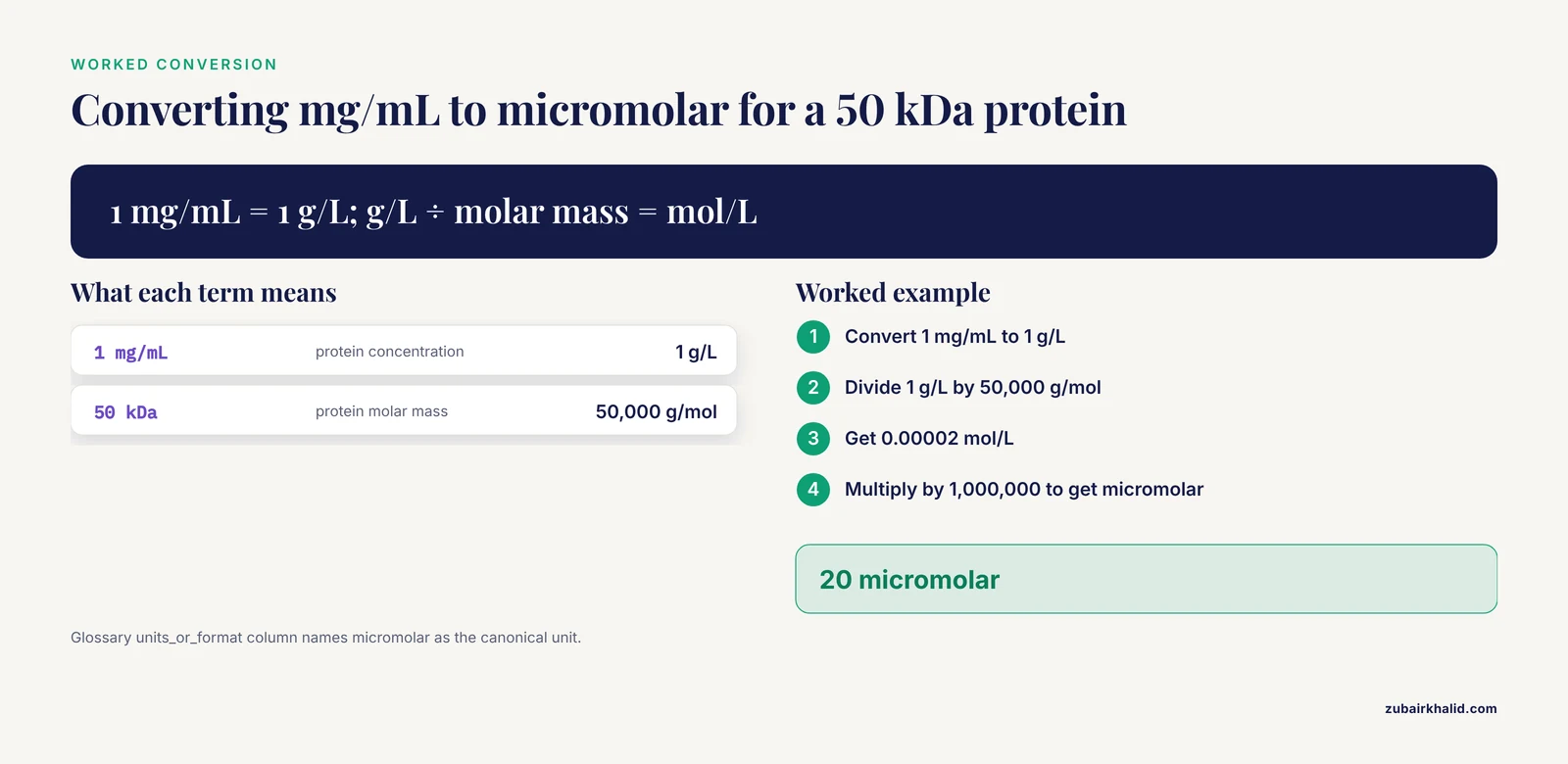
Unit conversion mismatches. A biochemistry subgroup reports protein concentration in mg/mL while a modeling subgroup expects molar concentration. For a 50 kDa protein, the conversion is:
1 mg/mL = 1 g/L
1 g/L ÷ 50,000 g/mol = 0.00002 mol/L = 20 micromolar
Neither group is wrong. The glossary's units_or_format column names the canonical unit (here, micromolar) and every data table going forward states both values at the point of measurement.
Performance metric mismatches. A clinical group and a data science group both say a model "works," but they mean different things. In the nursing machine learning literature, classification models were evaluated mainly with accuracy, area under the receiver operating characteristic curve (AUROC), precision-recall, and F1-score, while regression models used mean absolute or squared error [3]. Put those metric definitions in the glossary with worked statements of what counts as acceptable for your project, for example "a screening tool reports sensitivity at a fixed false-positive rate, so we agree on AUROC and the operating point, not raw accuracy." The vocabulary of evaluation is part of the terminology gap, and closing it early prevents a whole class of late-stage arguments.
Step 5. Write shared documents in neutral language
When the learning health system team co-developed an operational roadmap for interprofessional projects, they deliberately used clinically neutral terminology for all elements so the roadmap could generalize across settings and roles [7]. Apply the same rule to anything shared across the team. Project charters, analysis plans, and data dictionaries should use the glossary's canonical terms, with discipline-specific synonyms relegated to parenthetical notes. A data dictionary, which lists every column of a shared dataset with its units and allowed values, is the single highest-value neutral artifact for teams that exchange data.
Step 6. Scaffold cross-training instead of expecting osmosis
People do not absorb another field's vocabulary by sitting near it. Effective programs structure the learning. The medicine-engineering talent programs reviewed at Sichuan University built interdisciplinary project-based modules and cross-disciplinary platforms specifically so trainees practiced translation, not just parallel existence [6]. On your team, a workable format is a 30-minute rotating slot at the weekly meeting where one member explains one concept from their field using no unexplained jargon, then answers questions. Rotate through every discipline on a fixed schedule so the burden is shared and visible.
Step 7. Use structured team events with defined deliverables
Hackathon-style events, run with a flat hierarchy and clearly defined goals and deliverables, trained participants from high school students to faculty to contribute to data acquisition, coding, testing, and dissemination while beta-testing shared analysis workflows [4]. You do not need a formal hackathon to borrow the mechanics. A one-day "definitions sprint" where the whole team reviews every glossary entry, tests each definition against three real project documents, and marks conflicts produces more progress than a semester of casual corridor corrections. Pairing people across seniority levels, as the hackathon platform did deliberately, surfaces terminology problems that juniors would otherwise hide [4].
Step 8. Test communication under realistic conditions
A glossary that lives in a repository but fails in a live meeting has not done its job. The obstetric safety program tested processes and prototypes through simulation-based testing and found its communication lapses that way [1]. The research-team version is a role-played walkthrough: one member presents an analysis or protocol using only glossary-defined terms, and listeners flag any word they would interpret differently. Run this before high-stakes events such as grant reviews, cross-site data transfers, or protocol handoffs between labs.
Step 9. Self-assess on a fixed cadence
The interprofessional roadmap mentioned above includes a self-assessment tool that lets team members quantitatively evaluate progress, and it was refined through three design iterations with stakeholder feedback from twenty people before release [7]. A lightweight version for terminology health uses five questions, each scored 1 to 5 by every team member quarterly:
- I can define every term used in our shared documents.
- Our data tables state units and formats consistently.
- New members reach full comprehension of our vocabulary within two weeks.
- Disagreements about word meaning get resolved within one meeting.
- The glossary reflects the terms we currently use, not last year's terms.
Average the scores, log them with the date, and watch the trend rather than the absolute number. A score that drops between quarters is a signal that the glossary has gone stale or that a new subproject introduced unmanaged vocabulary.
Step 10. Maintain the glossary through change control
Add a glossary review to the close of every project milestone. New terms get proposed through your team's normal channel (a pull request if you use Git, a tracked-suggestion comment if you use a shared document), the term owner approves, and the change history shows who decided what and when. Discard entries that no longer appear in documents. A 30-entry glossary that matches reality beats a 200-entry glossary nobody trusts.
The table below summarizes the ambiguity patterns you will find in the audit and the standard fix for each.
| Pattern | Example | Fix |
|---|---|---|
| Same word, different meaning | "validation" in statistics versus assay development | One glossary row per field, canonical term chosen per document type |
| Same concept, different words | "cohort," "panel," "sample set" | List synonyms_to_flag and pick one canonical term |
| Hidden unit mismatch | mg/mL versus micromolar | units_or_format column with worked conversions where needed |
| Metric mismatch | accuracy versus AUROC versus F1 | Named metrics with agreed operating points per project [3] |
| Acronym collision | "CV" as coefficient of variation or curriculum vitae | Spell out at first use in every document, disambiguate in glossary |
| Algorithm inconsistency | Different groups compute a shared quantity differently | Document the exact formula or script in the glossary entry [4] |
Practical Tips for Everyday Scientific Collaboration
These habits keep the gap closed once the initial work is done.
Spell out every acronym at first use in every document, without exception. Documents get read out of order and excerpted into emails. The audit script from Step 1 can be rerun monthly. When its output shrinks, undefined acronyms are leaving your documents.
Put the glossary where the work happens, not where governance happens. Link it from your meeting agenda template and your analysis notebook header. A glossary buried in a quality system nobody opens has no effect.
Treat every new project as a terminology event. Before kickoff, add the project's candidate terms to the glossary as "proposed" rows with owners. Budget the first project meeting for definition-setting, because the cost of an hour spent agreeing on words is trivial compared with the cost of discovering a definitional conflict at analysis time.
Assign translation roles explicitly in cross-site work. When two labs or a lab and a vendor collaborate, name one person on each side responsible for confirming that shared terms carry the same meaning. This mirrors the institutional-support barrier seen in the physician survey, where most respondents named missing organizational scaffolding rather than missing knowledge as the obstacle [5]. Individuals cannot fix what the team structure does not support.
Keep a "disputed" column. Some terms will not resolve quickly, for example when a word is entrenched differently in each field and no neutral replacement exists. Record both definitions, mark the row disputed, and state in shared documents which definition applies to that project. Explicit disagreement is safer than hidden disagreement.
Match the tool to the change rate. For fast-moving computational subfields, glossary entries benefit from pointing to a canonical reference or method paper rather than freezing a prose definition that will age. The goal is a shared pointer, not a shared encyclopedia.
Common Mistakes and Limitations
Mistake 1. Writing definitions only experts can parse. A glossary entry that uses three undefined terms to define one term has moved the problem, not solved it. Test each entry on a member of a different discipline. If they cannot paraphrase it, rewrite it.
Mistake 2. Treating communication lapses as personality problems. The patient safety research program approached communication failures as system properties to be analyzed and redesigned, using task analysis and simulation rather than blame [1]. Teams that respond to a misunderstanding by telling one member to "be more careful" will see the same misunderstanding recur. Fix the vocabulary and the artifact, not the person.
Mistake 3. Skipping units while perfecting definitions. Teams invest effort in elegant conceptual definitions and then still exchange numbers without units. The units column and the worked conversions are where measurable errors actually get prevented.
Mistake 4. Building the glossary once and never revisiting it. Vocabulary drifts with every new instrument, dataset, and hire. Without the quarterly self-assessment and milestone reviews, the glossary becomes an artifact of a former version of the team.
Mistake 5. Assuming shared tools create shared meaning. Research collaboration tools such as shared repositories, wikis, and chat platforms move words around efficiently. They do not by themselves align definitions. The AFM review makes this point in a specific setting. Advanced instrumentation enabled cross-disciplinary work, but reproducibility depended on validated protocols and shared analytical conventions, not on access alone [2].
Mistake 6. Overstandardizing. Not every term needs a glossary row. Target the terms that appear in shared artifacts, cross discipline boundaries, or have caused an actual misunderstanding. Polishing internal jargon that never leaves one subgroup wastes the goodwill the glossary effort depends on.
Limitations. The evidence behind this workflow comes from specific settings, including patient safety laboratories in obstetrics and neonatology, AFM-based materials research, nursing informatics, hackathon-based biomaterials programs, and learning health system teams [1][2][3][4][7]. Transfer to your field is likely but not guaranteed. Audit your own documents rather than borrowing another field's term list wholesale, and adjust the cadence of reviews to your project tempo. In clinical or regulated environments, terminology standards may also be set by external bodies, and internal glossaries must defer to those requirements.
Frequently Asked Questions
What exactly is a terminology gap in a research team?
It is a mismatch between the words, definitions, units, or metrics that different members use for the same ideas. It appears when two people leave a meeting with different interpretations of the same phrase, or when datasets from two groups cannot be combined because the same quantity was recorded differently.
How do I start bridging the terminology gap in my team?
Start with the audit in Step 1. Collect ten to twenty representative documents, count acronym and contested-term frequencies, and interview one member per discipline with the four standard questions. You will have a concrete, prioritized list of problem terms within a week.
What research collaboration tools do we need?
You need one canonical, version-controlled location for the glossary, such as a CSV file in a Git repository or a table in a shared document system with change tracking. You also need your existing meeting and document tools, because the glossary only works when it is linked from the places people actually write.
Who should own and maintain the glossary?
Each term gets one named owner who approves changes to that row, and the team agrees on a review cadence, typically at project milestones plus a quarterly pass. A glossary owned by everyone is updated by no one.
How long does the whole process take?
The initial audit, interviews, and first glossary take one to two weeks for a team of five to fifteen people, mostly in short sessions. Alignment of metrics and the first definitions sprint add a focused day. Maintenance is ongoing but light, roughly an hour per milestone per person.
What if two fields use the same word for genuinely different things?
Keep both definitions as separate rows keyed by field, choose a canonical term for each document type, and state in the document header which definition applies. Do not force a single merged definition when the underlying concepts truly differ.
How do we handle fast-moving areas like machine learning where terms change quickly?
Define terms by pointing to a stable reference, such as the original method paper or a consensus standard, rather than freezing prose that will age. Add a "status" column marking entries as stable, evolving, or deprecated, and review evolving entries each quarter.
How do we know the terminology gap is actually closing?
Use the five-question self-assessment scored quarterly and watch the trend, plus two behavioral checks: rerun the acronym audit and confirm undefined high-frequency terms are declining, and ask a recent hire to explain a current project in their own words. Consistent scores above 4, a shrinking audit list, and a fluent new hire mean the process is working.
Sources
- The Value of a Cross-Disciplinary Approach to Human and System Performance Research in Obstetrics and Neonatology: AHRQ's Patient Safety Learning Laboratory.
- Atomic Force Microscopy for Cross-Disciplinary Materials Research.
- Machine Learning in Nursing: A Cross-Disciplinary Review.
- Hacktive matter: data-driven discovery through hackathon-based cross-disciplinary coding.
- Barriers and facilitators to advance care planning implementation for patients with neurodegenerative diseases among Indian physicians: a mixed-methods analysis.
- [[Exploration and Practice of Talent Cultivation in Allied Health in the Context of the Integration of Medicine and Engineering].](https://pubmed.ncbi.nlm.nih.gov/41113422/)
- Operationalizing a learning health system: A self-assessment tool for interprofessional teams.