The 15-Minute Dissertation Task Breakdown
By Dr. Zubair Khalid, DVM, MS, PhD ·

By the end of this article you will be able to take any dissertation, thesis, or long manuscript and turn it into a list of concrete tasks, each small enough to start and finish in a single work session. You will also be able to run a 15-minute planning session that produces that list on demand, check that your plan adds up, and fix the errors that most often derail dissertation planning.
Here is what you need on hand before you start:
- A timer. Your phone clock, a kitchen timer, or the
gnome-pomodoroandFocus Keeperapps all work. - Your institution's format requirements, which usually live in the graduate school's thesis and dissertation handbook on its website.
- Your current outline, proposal, or committee-approved plan, in whatever state it is in.
- A plain text editor or your usual word processor. Nothing else is required.
- Optional but useful: a reference manager such as Zotero, whose documentation explains how to attach notes and PDFs to each source, and a literature database such as PubMed when your field relies on indexed biomedical sources.
You do not need special software, a paid planner, or a perfect outline. You need fifteen minutes and the willingness to write down tasks that are smaller than they feel.
Why Dissertation Planning Fails
Doctoral attrition is a persistent problem in graduate education, and the Council of Graduate Schools has studied completion rates across US programs precisely because a large share of students who pass their coursework and qualifying exams still never finish the dissertation. The reasons vary by program and person, but one failure mode shows up again and again in writing-center guidance: the student's to-do list contains items like "work on chapter three" or "write results section."
Those are not tasks. They are projects wearing a task's clothes. "Work on chapter three" has no visible finish line, so starting it feels heavy, and avoiding it feels reasonable. The proposal document you defended already shows what a real deliverable looks like. Purdue OWL's graduate writing resources make the same structural point about theses and dissertations that composition instructors make about any long project: the document is a sequence of defined sections with defined jobs, not one giant undifferentiated mass.
The 15-minute dissertation task breakdown attacks this problem directly. You spend a short, bounded session converting vague goals into named, sized, ordered tasks. Then the writing itself happens in sessions that already have a defined shape.
The Core Rule of the 15-Minute Breakdown
One rule drives everything else:
A task goes on your list only if you can name its finished state and you believe one work session can reach that state.
A finished state is something you can verify by looking, not by feeling. Compare these pairs:
- Vague: "work on methods." Named: "draft the participant recruitment paragraph for section 3.2, roughly 300 words."
- Vague: "read papers." Named: "extract methods summary from the 2019 Andersson paper into the lit matrix, 10 rows."
- Vague: "fix references." Named: "resolve the three BibTeX warnings for chapter 2 keys."
The 15-minute timer is for the planning session itself, not for the work sessions. Fifteen minutes is long enough to produce a genuine task list and short enough that you cannot use planning as a sophisticated form of procrastination. If a breakdown session runs past 20 minutes, stop, ship what you have, and refine it tomorrow.
Breaking Down Dissertation Tasks Step by Step
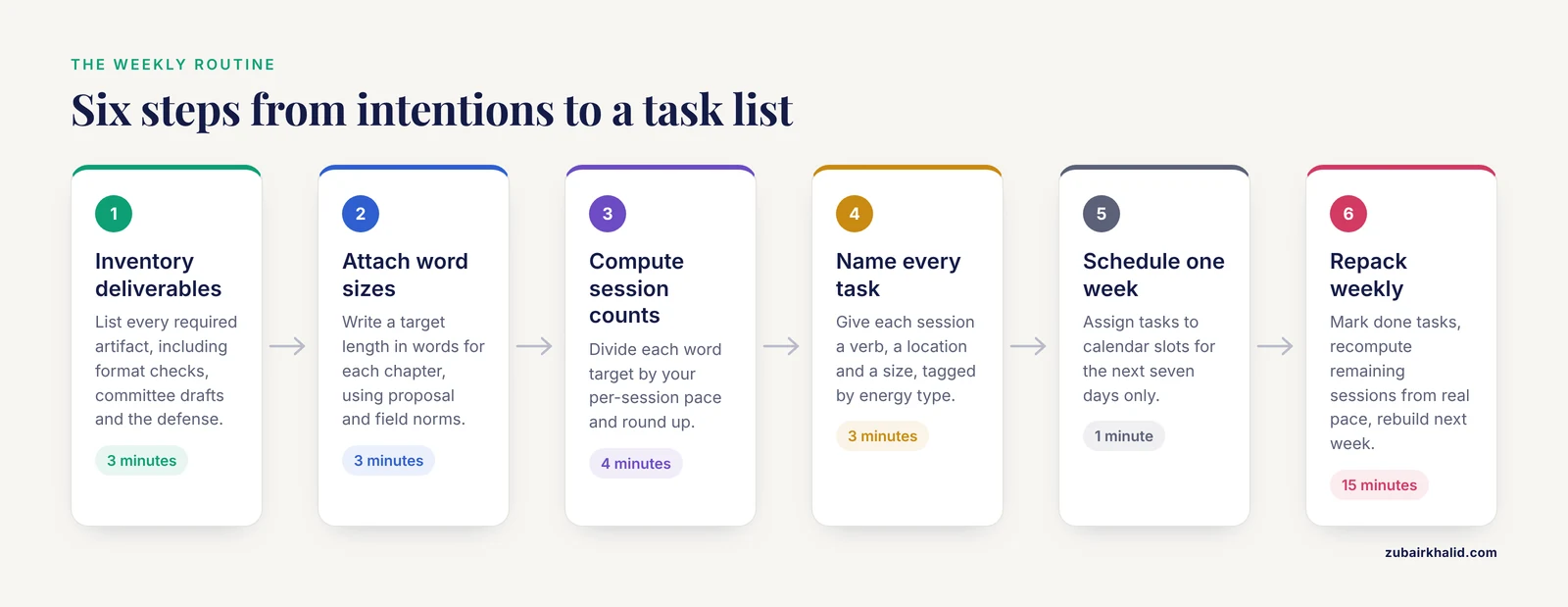
This walkthrough takes a dissertation from a pile of intentions to a session-sized task list. Run it once end to end, then repeat it weekly.
Step 1: Inventory the real deliverables (3 minutes)
List every artifact your degree requires, not just the manuscript. For most US PhD programs that list includes the dissertation itself, committee approval milestones, format checks, and the defense. Purdue OWL's graduate writing guidance treats the dissertation as a genre with institutional conventions, which is a reminder that the milestone list comes from your graduate school and your committee, not from a generic template.
Write the inventory as a plain list in a file called dissertation-inventory.md:
dissertation-inventory.md

1. Chapter 1: Introduction
2. Chapter 2: Literature Review
3. Chapter 3: Methods
4. Chapter 4: Results
5. Chapter 5: Discussion
6. Chapter 6: Conclusion
7. Front matter (title page, abstract, acknowledgments)
8. References and appendices
9. Format check submission to graduate school
10. Committee review drafts
11. Defense slides and defense itself
12. Post-defense revisions
Common mistake at this step: forgetting the non-writing deliverables. The format check alone, where the graduate school verifies margins, heading style, and citation format against its handbook, routinely takes longer than students expect.
Step 2: Attach a size to every writing deliverable (3 minutes)
For each chapter, write down a target length in words. If your institution publishes length guidance, use it. If it does not, use your proposal and your field's norms. Many science and social science dissertations in the United States land somewhere in the 15,000 to 40,000 word range for the core chapters, but your committee's expectations override any general figure, so treat this as a placeholder you will refine.
Record the numbers directly in the inventory file.
Step 3: Choose a session size and compute the session count (4 minutes)
Pick a realistic drafting pace for one work session. A defensible starting point for drafting prose is 300 to 500 words per focused session, with revising sessions often producing less because you are also cutting. Use the lower end of that range if your sessions compete with lab work or teaching.
Run the calculation with a script rather than in your head. This keeps the numbers auditable and lets you recompute when targets change. The full worked example appears in the next section, but the logic is a single line per chapter: divide the word target by your per-session pace, round up, and that is your number of drafting sessions for that chapter.
Step 4: Convert sessions into named tasks (3 minutes)
Each session becomes one task with a verb, a location, and a size. Write them in your planner or task manager in this format:
[DRAFT] Ch3 Methods, section 3.2 participant recruitment, ~350 new words
[REVISE] Ch2 Lit Review, tighten synthesis paragraphs in sections 2.3-2.4, cut 200 words
[CODE] Rerun Figure 4 analysis, export PNG at 300 dpi to figures/
[ADMIN] Email committee chair: defense date options for April
[READ] Andersson 2019, extract sampling design into lit matrix rows 14-16
The bracketed tag tells your future self what kind of energy the task needs. That matters more than it sounds. On a low-energy day you can filter for [ADMIN] or [READ] and still make progress, which is one of the most practical tips for anyone asking how to finish a dissertation without heroic work sessions.
Step 5: Schedule the next week only (1 minute)
Assign tasks to specific calendar slots for the next seven days. Do not schedule further out. Plans further than a week away decay, and re-planning weekly is cheaper than maintaining an elaborate semester-long Gantt chart that lies to you.
Step 6: Run the weekly repack (15 minutes, repeating)
Once a week, repeat the whole breakdown: mark completed tasks, recompute remaining sessions from your actual pace, and generate the next week's list. Over time your per-session pace estimate becomes accurate, which makes every later plan more reliable.
Worked Example: Computing Session Targets with a Script
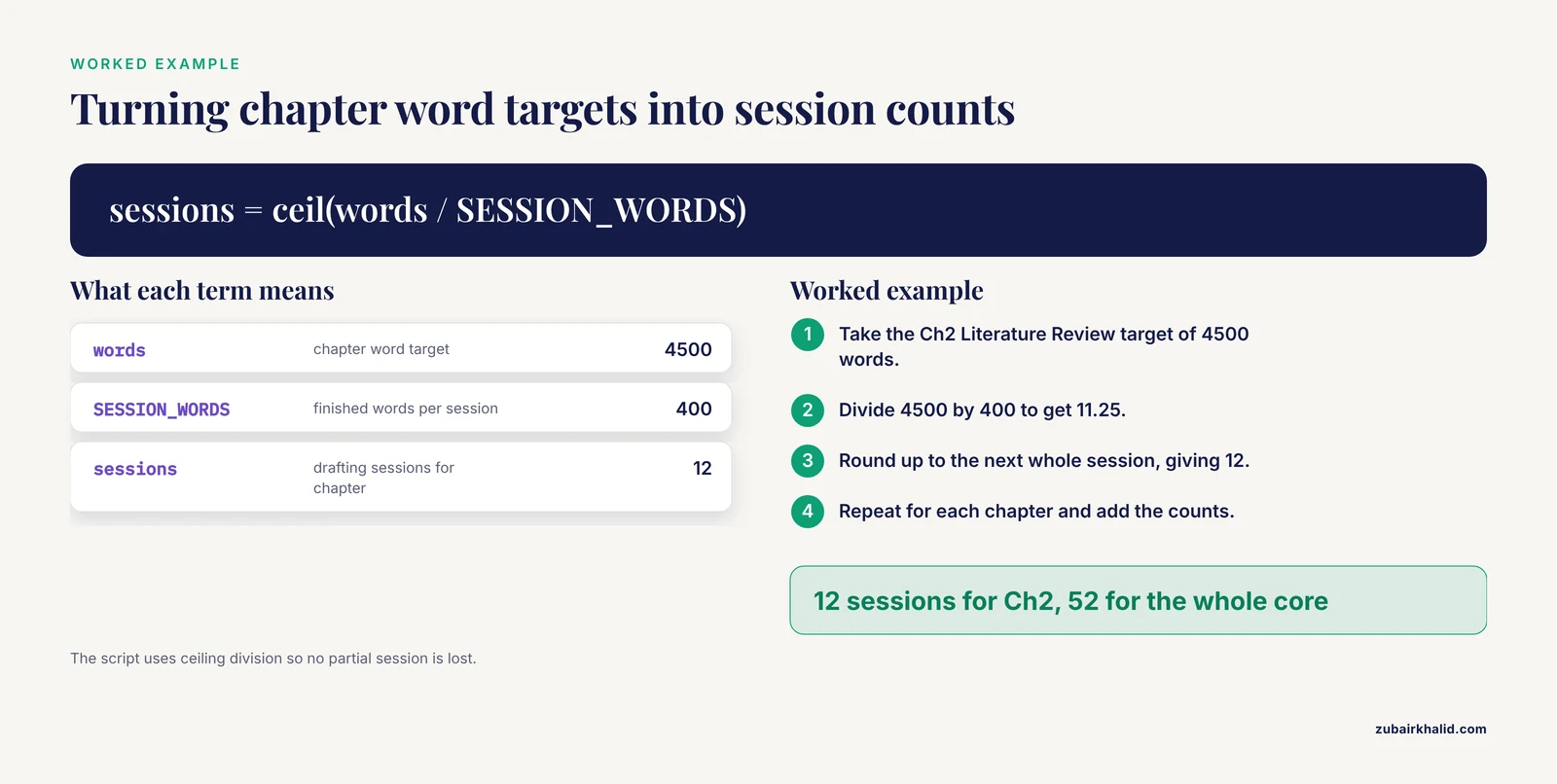
Here is a complete worked calculation for a hypothetical 20,000-word dissertation core, assuming 400 words of finished draft per session.
# dissertation_planner.py
CHAPTERS = {
    "Ch1 Introduction":      2000,
    "Ch2 Literature Review": 4500,
    "Ch3 Methods":           3500,
    "Ch4 Results":           5000,
    "Ch5 Discussion":        4000,
    "Ch6 Conclusion":        1000,
}
SESSION_WORDS = 400  # finished words per drafting session

total = sum(CHAPTERS.values())
print(f"Total core target: {total} words")
print(f"Pace: {SESSION_WORDS} words per session")
print("-" * 46)
for name, words in CHAPTERS.items():
    sessions = -(-words // SESSION_WORDS)  # ceiling division
    print(f"{name:22s} {words:>5d} words  {sessions:>2d} sessions")
all_sessions = sum(-(-w // SESSION_WORDS) for w in CHAPTERS.values())
print("-" * 46)
print(f"Drafting sessions needed: {all_sessions}")
Run it from your terminal:
python3 dissertation_planner.pyExpected output:
Total core target: 20000 words
Pace: 400 words per session
----------------------------------------------
Ch1 Introduction         2000 words   5 sessions
Ch2 Literature Review    4500 words  12 sessions
Ch3 Methods              3500 words   9 sessions
Ch4 Results              5000 words  13 sessions
Ch5 Discussion           4000 words  10 sessions
Ch6 Conclusion           1000 words   3 sessions
----------------------------------------------
Drafting sessions needed: 52
Interpretation. Fifty-two drafting sessions at three writing sessions per week is roughly seventeen weeks of drafting, before revisions, committee rounds, and formatting. That single number is the entire argument for breaking down dissertation tasks early. Seventeen weeks is manageable. "Write a dissertation" is not.
To check your actual pace, count the words you really produced last week. On a manuscript stored as plain text or Markdown, the shell gives you this instantly:
wc -w chapters/ch3-methods.mdExpected output:
3412 chapters/ch3-methods.mdIf that file held 3,062 words last Monday and holds 3,412 today, you produced 350 finished words per session average. Adjust SESSION_WORDS to 350 and rerun the planner. If you draft in a word processor, use its word count dialog on the same file at the start and end of the week instead. The important thing is that the estimate comes from measurement, not from how the week felt.
A Table of Breakdown Methods
Different dissertations reward different planning methods. This table summarizes the main options so you can pick a primary method and a fallback.
| Method | Best for | How it works | Watch out for |
|---|---|---|---|
| Word-count method | Chapters you are drafting from scratch | Divide each chapter's word target by your measured pace, round up to get session counts | Overestimating pace is the classic error. Measure, do not guess |
| Milestone method | Committee-driven programs with required checkpoints | List each required artifact, then list the tasks that produce it | Checkpoints drift. Ask your coordinator for real turnaround times |
| Time-blocking method | Fixed daily writing windows | Reserve the same slot daily, assign one named task per slot | A block without a named task becomes "work on chapter" again |
| Reverse scheduling | Hard deadlines such as defense dates | Start from the defense date, subtract each milestone's duration, mark the drop-dead start for each | Padding each step generously, which hides real schedule risk until it is too late |
| Revision passes | Finished drafts | Plan passes by concern: argument pass, citation pass, format pass | Mixing concerns in one pass slows every pass down |
Most students do well with the word-count method for drafting and the milestone method layered on top for administrative deliverables.
Common Errors and Their Exact Messages
Even a good plan collides with tooling errors. These are the messages graduate students hit most often, with the standard fixes.
LaTeX: ! Undefined control sequence. You used a command that LaTeX does not know, often because a package is not loaded in your preamble or the command name has a typo. Read the line number in the error, find the offending command, and either correct the spelling or add the required \usepackage{...} line. For example, \toprule fails until you load the booktabs package.
LaTeX: LaTeX Warning: Reference 'fig:growth-curve' on page 14 undefined on input line 322. A \ref points to a \label that does not exist yet, or the label name does not match. Fix the label or the reference, then recompile twice, because LaTeX resolves cross-references over two compilation passes.
BibTeX: Warning-I didn't find a database entry for "Andersson2019"..." A \cite{Andersson2019} key has no matching entry in your .bib file, or the key is misspelled in one of the two places. Open the .bib file, search for the exact key, and align the spelling in both the citation and the entry.
Git: fatal: not a git repository (or any of the parent directories): .git You ran a git command outside a repository, usually from your home directory instead of your dissertation folder. cd into the correct directory, or run git init inside your dissertation folder to start tracking it. Version-controlling your dissertation from day one protects you from the single most catastrophic file-loss scenario a graduate student faces.
Python: NameError: name 'CHAPTERS' is not defined You pasted the loop from the planner script without the dictionary definition above it, or you ran the file from the wrong directory. Make sure the whole script is in one file and run that file, as shown in the worked example.
Word processor: the built-in word count disagrees with wc -w. Word processors count differently than the shell. Microsoft Word, for example, counts a hyphenated pair such as "well-being" as one word in some versions and differently in others. Pick one counting method, document it in your planner file, and use it consistently for every pace calculation. The count you need for your graduate school's minimum or maximum is whatever their handbook specifies, so verify that count in the format they require.
Common Mistakes and Limitations
These are the mistakes that most often ruin an otherwise sound plan. Each one is fixable with a small change in procedure.
Mistake 1: Planning the whole dissertation in one sitting. A breakdown session produces one to two weeks of tasks, not a semester. Long plans feel thorough and rot quickly. The weekly repack in Step 6 exists because your pace, your committee's feedback timing, and your data will all change.
Mistake 2: Sizing tasks by optimism. Students consistently assume their best-day output is their average output. Measure your pace with wc -w or your word processor for two weeks before trusting any schedule built on it.
Mistake 3: Tasks with no visible finish line. If you cannot picture what the screen looks like when the task is done, the task is not broken down enough. "Clean the dataset" becomes "recode the 12 site labels in column B of visits.csv against the codebook."
Mistake 4: Ignoring the literature-management layer. Reference chaos multiplies late in the project. Zotero's documentation describes storing PDFs, notes, and citations per source in one library and generating formatted bibliographies from it, which prevents the endgame week of hand-fixing citations. Pair that with the citation style your program requires, such as APA style, whose official manual and website define the current rules for citation formatting.
Mistake 5: Treating reading as unbounded work. Literature review tasks get names like "read more on topic X." Bound them by artifact and output: one paper, one extraction pass, a fixed number of matrix rows. PubMed's indexed search and its filters help you define the candidate set before you start reading, so the reading task has a defined population.
Mistake 6: Planning revision like drafting. Revising 4,000 words takes longer per word than drafting them, because you are also deleting. Schedule fewer revised words per session than drafted words, or plan revision passes by section rather than by word count.
Mistake 7: Skipping the administrative tasks until they block everything. Committee review, format checks, and scheduling have turnaround times you do not control. Put them on the milestone list with the earliest reasonable start date.
Limitation. Every program, committee, and discipline handles milestones, lengths, and formats differently, and individual circumstances vary. Treat the numbers in this article as planning placeholders and confirm your binding requirements with your own graduate school handbook, your committee, and, where your work involves human or animal subjects, your institution's research compliance office.
How to Check That Your Breakdown Is Right
Run these four checks against any task list you produce.
- The finish-line check. Read each task aloud and ask what you will see when it is done. If the answer is a feeling rather than an artifact or a number, split the task.
- The session check. Each task should fit one work session. If you honestly estimate more than about two hours, it needs one more split.
- The reconciliation check. Your per-chapter session counts times your pace should approximately equal your word targets. Recompute after any chapter plan changes, the way the script does.
- The dependency check. For each week's tasks, confirm nothing scheduled early depends on a task scheduled later. Methods drafting should not sit before your protocol approval, for instance.
A plan that passes all four checks is good enough to start. Perfection is not the standard, momentum is.
Next Steps
Run your first 15-minute breakdown today, even if your outline is rough. Then measure your actual drafting pace this week, rerun the planner with the measured number, and book next week's sessions on your calendar. After two weeks of measured planning you will know your real completion date, which is the single most calming piece of information a dissertation writer can own. From there, the weekly repack becomes a habit, and finishing becomes a matter of arithmetic rather than willpower.
Frequently Asked Questions
What is the 15-minute dissertation task breakdown?
It is a short, timed planning session in which you convert vague dissertation goals into named tasks, each of which can be finished in a single work session. You repeat the session weekly, updating the plan with your measured writing pace.
How do I break down dissertation tasks step by step?
List your deliverables, attach a word target to each chapter, divide each target by your measured words per session, round up to get session counts, and convert each session into a task with a verb, a location, and a size. Schedule one week at a time and repeat weekly.
What are the best tips for breaking down dissertation tasks?
Use bracketed tags to sort tasks by energy level, measure your pace with a word count instead of guessing, bound every reading task to a specific paper and output, and schedule administrative tasks like committee reviews early rather than late.
What are the most common mistakes in dissertation task planning?
The biggest ones are planning a whole semester at once, sizing tasks by optimism instead of measurement, writing tasks with no visible finish line, treating revision like drafting, and postponing administrative milestones until they block the writing.
How long should each task be?
Short enough to finish in one work session, typically one to two hours of focused work. If a task honestly needs more, split it until the next piece has a defined finished state.
How many words should I write per session?
A realistic starting range for drafting finished prose is 300 to 500 words per focused session, but your own measured average over two weeks is the number that matters. Revise sessions usually produce fewer finished words because you are also cutting.
How far ahead should I plan my dissertation?
Plan administrative milestones against the full semester, but generate work tasks only one to two weeks ahead. Weekly repacking keeps the plan honest as your pace and committee feedback change.
How do I finish a dissertation when I keep stalling?
Filter your task list for low-energy tasks such as admin, reading, or formatting, complete one, and let momentum carry you back to drafting. If the stall comes from a task that feels heavy, it is usually still too big, so split it and restart with the smaller piece.