Biology Study Planner Template with Built-In Self-Assessment
By Dr. Zubair Khalid, DVM, MS, PhD ·
By the end of this guide, you will be able to build and run a biology study planner that grades itself as you go. The planner schedules what you study each week, and the built-in self-assessment tells you which topics to revisit before an exam or lab practical. You will finish with a working spreadsheet, a matching rating-scale form, and a repeatable weekly review routine.
To build it, you need three things on hand. First, a spreadsheet app such as Google Sheets or Microsoft Excel. Second, a form tool such as Google Forms if you want the self-assessment to run automatically on your phone. Third, your course syllabus, a list of your course topics, and, if you have them, your most recent quiz or assignment scores. If you prefer paper, the same template works in a notebook, and you can generate a lab notebook template PDF from the spreadsheet by exporting it as a print-ready file.
Why Pair a Planner with Self-Assessment
A planner without self-assessment is just a calendar. A self-assessment without a planner produces insight that never turns into scheduled action. Combining the two closes that loop, and the education research on biology learning supports the combination.
In a 2025 study of secondary biology students, researchers compared groups who studied with success criteria alone, checklists alone, both together, or neither. Success criteria are written statements of what a finished, correct piece of work looks like. Checklists break those criteria into yes-or-no items a student can verify independently. The groups using these supports outperformed the control group, and the effect on motivation and knowledge was measurable across all experimental conditions [1]. A related study focused on a cytology unit found that the strongest self-learning results came from the group that used both checklists and written success criteria for each topic, compared with checklists alone or no support at all [2].
The planner side of the equation matters too. In a pre-experimental study with junior high students, adding a text planner (a structured template for organizing written work) on top of self-assessment raised average scores from 67.27 to 80.08 between pretest and posttest, a difference the paired t-test confirmed as statistically significant with a p-value of 0.000 [3]. The general lesson transfers: structure plus self-evaluation beats either one alone.
Self-assessment also changes what students actually think with, not just how they feel. In a large intervention study with 730 German upper-secondary biology students, a formative, criteria-referenced self-assessment of their own conceptions about evolution led students to use more scientific conceptions afterward, compared with classmates who never self-assessed [4]. And among biology undergraduates, research on how students use tutor feedback found that self-assessment behavior separates high achievers from everyone else, because strong students read feedback against their own judgment of their work rather than passively receiving it [5].
Finally, feedback that shows you your own progress data builds confidence in a measurable way. In a ninth-grade biology classroom study, students who received a visual report tool as formative assessment showed a large increase in self-efficacy over time (Cohen's d = 1.793), far larger than students who only heard general verbal feedback from the teacher [6]. Your planner's self-assessment summary serves the same purpose on a small scale: it turns vague worry about a topic into a number you can act on.
What the Template Contains
A complete biology study planner with built-in self-assessment has five parts. Each part feeds the next.
- Topic schedule. Every topic in the course, broken into study sessions with dates. One session should cover one topic at one depth, such as "osmosis and tonicity problems" rather than "chapter 5."
- Success criteria. Two to four written statements per topic describing what you must be able to do. For osmosis, a criterion might read, "I can predict the direction of water movement across a membrane given solute concentrations on both sides."
- Study checklist. The concrete actions for the session, such as "rework three practice problems," "redraw the diagram from memory," and "explain active transport aloud in under two minutes."
- Self-assessment rating. A confidence or mastery score you assign yourself after the session, entered through a rating scale. Rating-scale self-assessment instruments in biology have been validated this way, with one Google Forms-based instrument for cell transport topics showing high reliability (a coefficient of 0.8667) and validity above the accepted threshold [7].
- Review trigger. A rule that automatically flags low-scoring topics and schedules them again.
The fifth part is what makes the template "built-in" rather than bolted on. When your rating drops below a threshold, the planner reschedules the topic on its own.
Choose a Self-Assessment Format
There is more than one biology study planner with self-assessment format, and the best choice depends on the topic and how honest you can be with yourself. The table below summarizes the main options and when each one earns its place.
| Format | What you record | Best for | Evidence note |
|---|---|---|---|
| Success criteria + checklist | Yes or no against each criterion | Fact-heavy units, cytology, anatomy terms | Best combined results in biology self-learning trials came from using both together [1][2] |
| Rating scale (1 to 5) | A number per learning objective | Conceptual topics, weekly reviews, Google Forms delivery | Validated rating-scale self-assessment improved understanding of diffusion, osmosis, and active transport [7] |
| Full rubric | Score against described performance levels | Open-ended answers, experimental design, data interpretation | Rubric use improved learning outcomes and made self-judgments more reliable in cell biology tasks [8] |
| Diagnostic quiz | Correct and incorrect answers on recall questions | Start of course, assumed-knowledge checks | A five-module diagnostic quiz helped first-year science students find their own knowledge gaps in biology, chemistry, and math [9] |
| Affective self-assessment | Ratings of attitude, anxiety, and engagement | Online or independent courses where motivation drifts | A developed affective instrument reached a reliability coefficient of 0.957 for online biology learning [10] |
Pick one primary format and one backup. Most students do best with success criteria plus a rating scale for weekly work, and a rubric for major written assignments or lab reports.
Build It Step by Step
This walkthrough builds the biology study planner template with built-in self-assessment in Google Sheets, with a Google Forms rating scale for the self-assessment step. The same steps work in Excel, and every instruction notes where the two differ.
Step 1: Create the Planner Sheet Skeleton
Open a blank spreadsheet. In row 1 of the sheet named "Planner," enter these column headers:
A: Topic
B: Session Date
C: Success Criterion 1
D: Success Criterion 2
E: Success Criterion 3
F: Checklist Item 1
G: Checklist Item 2
H: Checklist Item 3
I: Confidence (1-5)
J: Priority Score
K: Next Review Date
L: Status
Freeze row 1 by selecting View, then Freeze, then 1 row, so the headers stay visible while you scroll.
Step 2: Fill One Topic Row Completely
Work one row at a time so the template stays consistent. Here is a filled example for a cell transport topic, which is the same topic area used in a validated self-assessment study [7].
A: Osmosis and water potential
B: 2026-11-14
C: I can define osmosis in terms of water potential, not just solute concentration
D: I can predict water movement given two solutions and their tonicity
E: I can calculate water potential using the solute and pressure potential equations
F: Rework 3 practice problems from the problem set
G: Redraw the tonicity diagram from memory, then check it
H: Explain the difference between diffusion and osmosis aloud in 90 seconds
Notice what the success criteria do. "I can define osmosis" is checkable. "Understand osmosis" is not. Write every criterion so a stranger could verify it by watching you.
Step 3: Add the Confidence Rating and Priority Formula
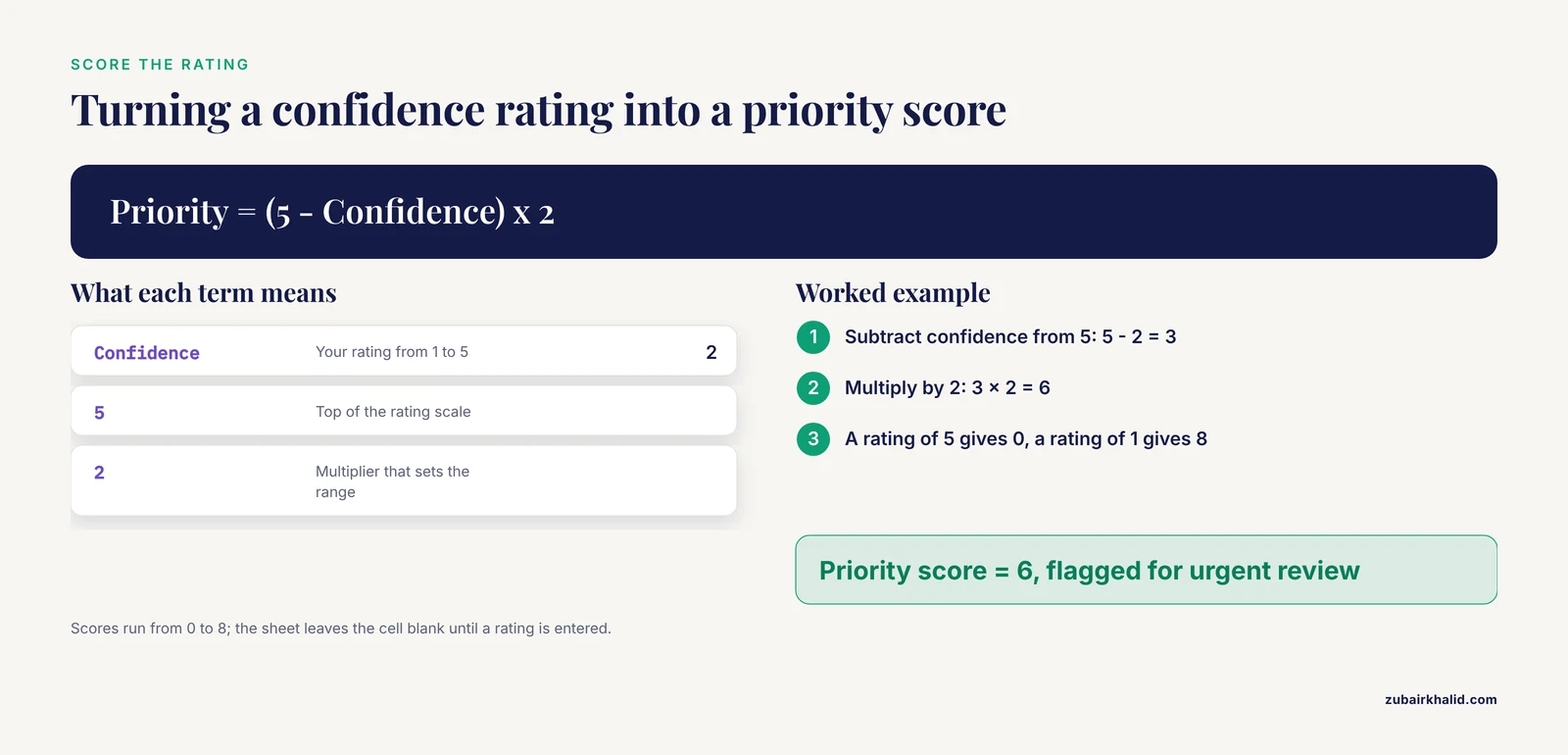
After each study session, enter a confidence rating from 1 to 5 in column I, where 1 means "I cannot do this yet" and 5 means "I can do this under exam conditions." Then put this formula in column J, row 2:
=IF(I2="","",(5-I2)*2)This converts confidence into a priority score from 0 to 8. A rating of 5 gives a priority of 0, meaning no scheduled review. A rating of 1 gives a priority of 8, the highest. The expected output for a confidence of 2 is 6, which flags the topic for urgent review.
Step 4: Automate the Review Trigger and Status
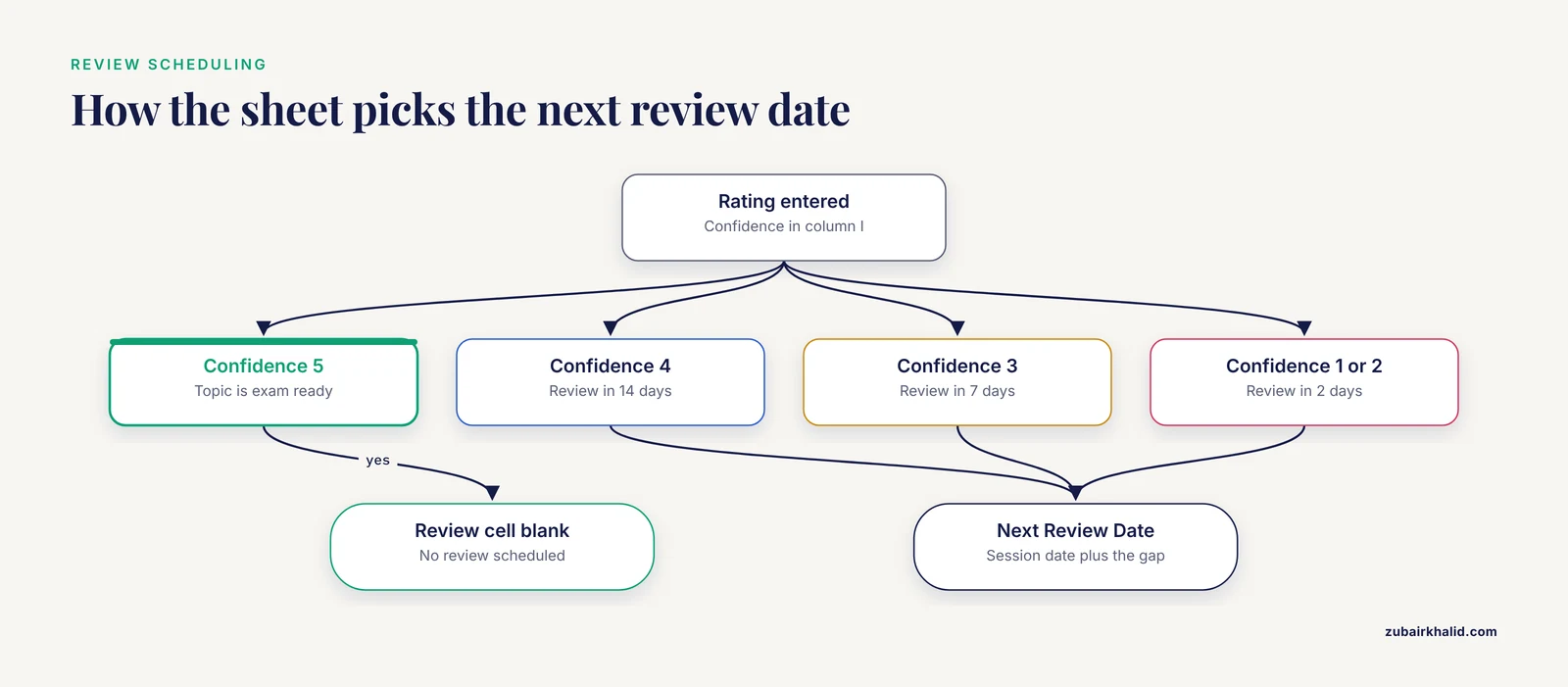
In column K, row 2, schedule the next review based on the confidence rating. Spacing reviews further apart as confidence grows is the standard logic of spaced repetition, and the formula below implements it:
=IF(I2="","",IF(I2>=5,"",B2+IF(I2>=4,14,IF(I2=3,7,2))))Reading the formula from the inside out: confidence of 4 or 5 schedules a review in 14 days, confidence of 3 schedules 7 days, and confidence of 1 or 2 schedules 2 days. A rating of 5 leaves the review cell blank because the topic is exam-ready. The expected output for a session dated 2026-11-14 with confidence 3 is 2026-11-21.
In column L, row 2, add a status label:
=IF(I2="","Not started",IF(I2>=4,"On track",IF(I2=3,"Revisit","Rebuild")))Then apply conditional formatting: select column L, open Format, then Conditional formatting, set "On track" to green, "Revisit" to yellow, and "Rebuild" to red. Your sheet now grades each topic visually the moment you enter a rating.
Copy the formulas in J2, K2, and L2 down the column for every topic row by selecting the cells and dragging the fill handle.
Step 5: Build the Google Forms Rating Scale
The spreadsheet rating works, but a form makes the self-assessment easier to complete honestly and gives you a data history. A Google Forms self-assessment built on a rating scale was shown in one study to be accessible, easy to use, and efficient to analyze for biology students [7], and affective-domain self-assessment instruments for online biology have reached strong validity and reliability with the same approach [10].
Create a new Google Form with one section per study session. For each topic, add these items:
- A short-answer question: "Which topic are you rating?" with the answer restricted to your topic list.
- Five linear-scale questions, one per success criterion, each scaled from 1 (cannot do it) to 5 (can do it under exam conditions). For osmosis, question one reads, "I can define osmosis in terms of water potential. Rate yourself from 1 to 5."
- A checkbox question: "Which checklist items did you complete?" listing the three items.
- A paragraph question: "What specifically went wrong on any item rated 3 or lower?"
Link the form to your spreadsheet by clicking Responses, then the Sheets icon. Each submission becomes a timestamped row you can average per topic. When you sit down to plan the coming week, sort your planner sheet by the priority score column and schedule the highest-priority topics first.
Step 6: Run the Weekly Review Loop
Once per week, do these five things in order:
- Open the planner and sort by column J, largest priority first.
- Read the paragraph answers from your form for any topic rated 3 or lower. The "what went wrong" answers are your study plan for that topic.
- Schedule the flagged topics into the coming week, using the Next Review Date column as a guide.
- Check off any success criterion you have now verified on a real quiz or problem set. When every criterion for a topic reads yes across two separate attempts, mark confidence as 5.
- Look at the week ahead and assign each scheduled topic a session block of 45 to 90 minutes.
The whole loop takes about fifteen minutes. That regularity is the point. Self-assessment changes outcomes when it happens repeatedly and against fixed criteria, not as a one-time reflection.
A Worked Example: Two Weeks on Cell Transport
Here is a complete biology study planner with self-assessment example over one unit. Suppose you are studying substance movement across cell membranes, a topic where a validated classroom self-assessment found that 9.1 percent of students faced challenges with the overall material and 3 percent struggled specifically with diffusion [7]. That pattern, a small number of students stuck on a specific subtopic, is exactly what your planner is designed to catch in yourself.
Week 1. You schedule three sessions: diffusion on Monday, osmosis and water potential on Wednesday, and active transport plus bulk transport on Friday. Each row has three success criteria and three checklist items. After the Monday session you rate diffusion honestly: you can define it (5) but you freeze on Fick's law calculations (2). Your priority score for diffusion jumps to 6 and the status turns red.
Weekend. Your weekly review shows diffusion as the only red topic. The paragraph answer from your form says, "I cannot convert concentration values into units before applying the equation." That single sentence tells you the gap is unit handling, not the concept. You schedule a twenty-minute unit-conversion drill and two Fick's law problems for Sunday.
Week 2. Monday, you re-rate diffusion after the drill. The rating rises to 4, the review date moves out two weeks, and the status turns green. Osmosis rates a 3, so it gets a seven-day review. By Friday you have a color-coded map of the whole unit showing exactly two yellow cells and one green cell, and you know what the yellow cells need.
This is the difference between the template and a plain calendar. The calendar said "study chapter 5." The planner said "your diffusion problem is units, drill it Sunday, recheck in two weeks."
Adapting the Template for Different Courses and Levels
The structure stays constant across levels. What changes is the criteria and the assessment format.
High school biology. Use success criteria and checklists as your primary format, since that combination produced the strongest self-learning results in secondary biology trials [1][2]. Keep confidence ratings on the 1-to-5 scale and review weekly.
Undergraduate lecture courses. Shift toward rubrics for anything involving written explanations, experimental design, or data analysis, because rubrics measurably improved the accuracy of self-judgment in upper-secondary cell biology tasks [8]. For survey-style courses with many topics, a diagnostic quiz at the start of the term identifies gaps early, an approach validated for first-year science students entering with assumed knowledge in biology, chemistry, and mathematics [9].
Undergraduate lab courses. Add a lab notebook column to the planner. Track which experiments have complete records, which calculations need a second check, and which techniques you have practiced. If your program requires a physical notebook, build the same checklist columns in your spreadsheet and print them, or export the sheet to a lab notebook template PDF so pages are consistent all semester. Argumentation and discussion skills respond to structured self-assessment too, and instruments designed for that purpose have shown strong internal consistency in e-learning biology settings [11].
Self-directed or online study. Add the affective self-assessment row, rating your motivation and anxiety each week alongside your confidence. Instruments built for online biology learning show that affective self-assessment can be both valid and highly reliable, which matters when no instructor is watching your progress [10]. If you teach or mentor others, structured self-assessment tools you build for yourself often become usable course materials, and community-driven assessment work in biochemistry and molecular biology education shows how those tools improve through peer review [12].
Topic selection. Ask your instructor which units historically cause the most trouble and weight your criteria toward them. In one survey of biology teachers, "Systematics Based on Evolutionary Relationships" ranked as the most challenging complex topic while "Genetics" ranked as the easiest, which tells you a generic hour of study time is not equally valuable across topics [13].
Common Mistakes and Limitations
Rating confidence without evidence. The most damaging error in any biology study planner with self-assessment is rating yourself on feeling rather than performance. Confidence and competence can come apart. In a validated assessment of engineering thinking in a biology context, ten elements showed only weak correlations between self-efficacy and actual performance, meaning many students were confident without being effective [14]. Always tie a rating to a completed checklist item or a problem you actually solved.
Skipping the rubric on open-ended work. Multiple-choice recall can hide overconfidence. In a rubric study with 230 upper-secondary students, the rubric group outperformed the non-rubric group on open-ended cell biology items, and rubric use significantly reduced overconfidence among male students [8]. If your self-assessment covers essay answers or lab interpretations, score against a written rubric, not a gut feeling.
Collecting feedback without using it. Self-assessment is most powerful when it sits between feedback and action. Research on biology undergraduates found that high-achieving students engage with tutor feedback differently, actively comparing it against their own evaluation of their work [5]. When your planner flags a weak topic, the next scheduled session must address the specific gap you wrote in the form, not just repeat the same reading.
Letting the loop raise pressure instead of clarity. Progress tracking helps most students, but monitoring can increase anxiety for some. In the visual-report study, the treatment group experienced a small but measurable increase in learning anxiety over time alongside its gains in self-efficacy [6]. If a red cell in your planner starts feeling like a verdict, shrink the review task until it is something you can finish in one sitting.
Writing vague success criteria. "I understand photosynthesis" cannot be rated. "I can explain how the light reactions drive the Calvin cycle" can. If you cannot imagine someone testing a criterion, rewrite it.
Over-building the template. A planner with twenty columns per topic will be abandoned by week three. Five columns of substance beat fifteen columns of decoration. Start with the skeleton above and add columns only when a real need appears.
Frequently Asked Questions
What is a biology study planner with built-in self-assessment?
It is a study schedule that includes a structured self-rating step after every session, so weak topics are automatically flagged for review. The planner handles when you study, and the self-assessment handles what you study next, using written success criteria, checklists, and a rating scale.
How do I score the self-assessment section?
Rate each success criterion from 1 to 5, then compute a priority score with the formula (5 minus confidence) times 2, which gives a value from 0 to 8. Any topic scoring above 3 gets rescheduled, with review gaps of 2 days at confidence 1 or 2, 7 days at confidence 3, and 14 days at confidence 4.
Can I make a printable version or a lab notebook template PDF?
Yes. Build the planner in Google Sheets or Excel, then export it through File and Download or File and Print as a PDF for a fixed, printable layout. For lab courses, add checklist columns for notebook completeness and technique practice before exporting, so each printed page matches the structure of your lab notebook.
How often should I complete the self-assessment?
Rate every topic once per study session and run the full weekly review once per week. Ratings take about two minutes per topic when they follow a session, and the weekly review loop takes about fifteen minutes.
What is the difference between success criteria and a checklist?
Success criteria describe the outcome you must achieve, such as "I can predict water movement given two solutions." A checklist describes the actions you take to get there, such as "rework three practice problems." Research in biology classrooms found the best self-learning results when students used both together rather than either one alone.
How do I keep myself from overestimating what I know?
Anchor every rating to a completed task, such as a problem solved without notes or a diagram drawn from memory. Overconfidence is a documented risk in biology self-assessment, and rubrics measurably reduce it on open-ended work, so reserve gut-feeling ratings for recall topics only.
Does this template work for exam revision as well as weekly study?
Yes. During revision, replace weekly sessions with topic-by-topic ratings across the whole syllabus, sort by priority score, and spend your hours on the red and yellow rows first. The same review-gap formula spreads final passes across the days before the exam.
Can I share the template with a study group or class?
Yes. Share the spreadsheet with view or edit access and distribute the Google Form link so each member submits ratings. Group members can also rate each other's explanations against the same success criteria, since peer assessment paired with shared rubrics has been shown to align closely with expert scoring in biology learning.
Sources
- Didactic Conditions for the Organization of Self-Study and Self-Assessment of Students in the Study of Biology
- Development of students' self-learning and self-assessment skills using checklists in biology classes
- Text Planner and Self-Assessment of Recount Writing Ability among Junior High School Students
- Influence of self-assessment and conditional metaconceptual knowledge on students' self-regulation of intuitive and scientific conceptions of evolution
- The importance of self-assessment in students’ use of tutors’ feedback: a qualitative study of high and non-high achieving biology undergraduates
- Design and implementation of an AI-enabled visual report tool as formative assessment to promote learning achievement and self-regulated learning: An experimental study
- Effectiveness of Self-Assessment with Google Forms to Improve Student Understanding in Biology Learning
- Using Rubrics to Enhance Accuracy of Peer Assessment and Self-Judgment in Biology Learning
- Online quiz for STEM assumed knowledge self-assessment by first year science students: a pilot study
- Development of Self-assessment Instruments to Measure Student Affective Domains on Online Biology Learning
- Examining students’ Self-Assessment of Digital Argumentation (SADA) in e-biology class: A Rasch analysis
- Evolution of a self-renewing, participant-centered workshop series in BMB assessment
- Teachers’ Experiences and Self-Assessment in Teaching Biology in Senior High School in the Philippines
- Assessing engineering thinking in the context of biology among senior high school students in mainland China: development and validation of a two-tier assessment scale and the relationship between self-efficacy and practical performance