Biology Root Words, Prefixes, and Suffixes: Complete Guide
By Dr. Zubair Khalid, DVM, MS, PhD ·

Biology root words, prefixes, and suffixes are the Greek and Latin building blocks that scientists combine to name organisms, structures, processes, and diseases. Once you know a few hundred of these word parts, you can decode thousands of unfamiliar terms without opening a dictionary, which is why mastering them is one of the fastest ways to improve how you study biology.
This guide explains what these word parts are, where they come from, and how they fit together. It also gives you concrete examples, a reference table, and study methods that turn vocabulary from a memorization burden into a skill you can apply on every exam and in every research paper you read.
What Biology Root Words, Prefixes, and Suffixes Actually Are
A root is the core of a word that carries the main meaning. A prefix is a short part attached to the front of a root, and a suffix is a short part attached to the end. Together they work like a simple assembly system.
Take the word hyperglycemia. Break it apart and you get three pieces:
- hyper-, a prefix meaning above or excessive
- -glyc-, a root referring to sugar or glucose
- -emia, a suffix meaning a condition of the blood
Assembled, hyperglycemia means high blood sugar. You did not memorize that word. You decoded it. That is the entire premise behind learning biology root words, prefixes, and suffixes, and it is the reason medical schools, nursing programs, and undergraduate biology instructors consistently recommend this approach over rote vocabulary lists.
The Greek and Latin Origins
Most biological vocabulary descends from two dead languages. Classical Greek supplied much of the vocabulary for anatomy, physiology, and medicine, largely through the works of Hippocrates and Galen and the scholars who preserved their tradition. Latin supplied the vocabulary of formal description and classification, a tradition cemented when Carl Linnaeus published Species Plantarum in 1753 and established binomial nomenclature, the two-name naming system still used for every species today.
Because of this split, some concepts have both a Greek and a Latin term. The heart, for example, appears in Greek-derived words like cardiology (heart study) and Latin-derived words like cardiovascular blends both. The kidney appears as Greek nephro- (as in nephron, nephrology) and Latin ren- (as in renal artery). Knowing both forms doubles the number of terms you can decode.
This is also why scientific names look the same in every country. A researcher in Japan, Brazil, and Germany can all read Canis lupus and know exactly which animal is meant, because Latin and Greekized Latin form a shared, stable language for science. International codes of nomenclature, such as the code maintained by the International Commission on Zoological Nomenclature, still require these names to be Latinized.
How the Three Word Parts Work Together
The pattern is predictable. Prefix modifies, root anchors, suffix finalizes.
Prefix + Root + Suffix = Term
| Word part | Role | Example | Meaning of example |
|---|---|---|---|
| Root alone | Core meaning | cephal | head |
| Root + suffix | A noun or condition | cephalalgia | headache |
| Prefix + root | A modified concept | macrocephaly | abnormally large head |
| Prefix + root + suffix | Full clinical term | encephalopathy | disease of the brain |
Two practical rules make the system even easier to use.
First, the root is often modified slightly to make pronunciation smoother. A connecting vowel, usually o and sometimes i, is inserted between parts. Oste (bone) plus -logy (study of) becomes osteology, not oste-log. Cardi plus -itis (inflammation) becomes carditis. The connecting vowel has no meaning. It exists purely for flow.
Second, when a prefix ending in a vowel meets a root starting with a vowel, one vowel usually drops. Anti- plus enzyme gives antienzyme or in practice often contracts, as in antibody from anti plus body in older hybrid formation. You will see this constantly, so do not be thrown when spelling seems to bend.
Essential Biology Root Words with Examples
The table below covers the roots that appear most often across anatomy, physiology, botany, zoology, microbiology, and medicine. Learning these roughly sixty roots gives you access to a very large share of introductory biology vocabulary.
| Root | Meaning | Example term | What the example means |
|---|---|---|---|
| bio | life | biology | study of life |
| zoo | animal | zoology | study of animals |
| phyto | plant | chlorophyll (phyto in photosynthesis-related terms) | plant-related |
| chloro | green | chlorophyll | green pigment |
| cyt | cell | cytoplasm | cell substance |
| nucle | nucleus, kernel | eukaryote | true nucleus |
| gen | produce, origin | genetics | study of heredity |
| carcin | cancer | carcinogen | cancer-causing agent |
| cardi | heart | myocardium | heart muscle |
| hemo / hemat | blood | hemoglobin | blood protein |
| myo | muscle | myocardium | heart muscle |
| osteo | bone | osteoblast | bone-forming cell |
| chondr | cartilage | mitochondrion (structure of the cell) | cartilage in original anatomical use |
| neur | nerve | neuron | nerve cell |
| derm | skin | epidermis | outer skin layer |
| hepat | liver | hepatitis | liver inflammation |
| nephr | kidney | nephron | kidney unit |
| gastr | stomach | gastric | stomach-related |
| enter | intestine | gastroenterology | stomach and intestine study |
| pneumon / pulmo | lung | pneumonia | lung condition |
| arthr | joint | arthritis | joint inflammation |
| myel | marrow, spinal cord | osteomyelitis | bone marrow infection |
| scler | hard | arteriosclerosis | hardening of arteries |
| vas | vessel | vascular | vessel-related |
| angio | vessel, container | angiogenesis | new vessel formation |
| cephal | head | encephalitis | brain inflammation |
| encephal | brain | encephalitis | brain inflammation |
| odont | tooth | orthodontics | straightening teeth |
| gloss / lingu | tongue | hypoglossal | under the tongue |
| ot | ear | otitis | ear inflammation |
| ophthalm | eye | ophthalmology | eye medicine |
| rhin | nose | rhinitis | nose inflammation |
| hepa / hepat | liver | hepatocyte | liver cell |
| ren | kidney | renal | kidney-related |
| ur | urine | diuretic | increases urine output |
| therm | heat | thermoregulation | heat control |
| phot | light | photosynthesis | building with light |
| chrom | color | chromosome | color-staining body |
| morph | form, shape | morphology | study of form |
| troph | nourish | autotroph | self-feeding organism |
| hetero | different | heterotroph | feeds on others |
| auto | self | autoimmune | immune against self |
| allo | other | allopatric | other homeland |
| sym / syn | together | symbiosis | living together |
| aero | air | aerobic | with air |
| hydro | water | hydrophilic | water-loving |
| lith | stone | lithotripsy | stone crushing |
| path | disease, suffering | pathology | study of disease |
| tox | poison | toxin | poisonous substance |
| sept | rot, infection | sepsis | blood infection |
| phag | eat | phagocyte | eating cell |
| lys | break apart | lysosome | breaker organelle |
| hypno | sleep | hypnotic | sleep-inducing |
| taxis | movement, response | chemotaxis | movement toward chemical |
| kines | move | kinesiology | study of movement |
| por | passage, pore | osteoporosis | porous bone |
| bacter | small rod, bacterium | bacteremia | bacteria in blood |
| myc | fungus | mycology | study of fungi |
| viro | virus | virology | study of viruses |
| plasm | formed substance | cytoplasm | cell substance |
| blast | bud, growing cell | fibroblast | fiber-forming cell |
A few of these deserve a note because their history surprises students. Chromosome literally means colored body, a name from the nineteenth century when early microscopists stained cells with dyes and noticed certain structures absorbing color intensely before anyone knew those structures carried heredity. Mitochondrion comes from Greek words for thread and granule, again a description of appearance under the microscope. These names preserve history, and remembering the history makes the terms easier to recall.
Essential Prefixes with Examples
Prefixes tell you number, position, degree, direction, or negation. They are the highest-value word parts to learn because a single prefix multiplies the meaning of every root it attaches to.
| Prefix | Meaning | Example | Meaning of example |
|---|---|---|---|
| a- / an- | without | anaerobic | without oxygen |
| ab- | away from | abduct | move away from the midline |
| ad- | toward | adduct | move toward the midline |
| amphi- | both, around | amphibian | lives both in water and on land |
| ana- | up, apart | anabolism | building up |
| ante- | before | antebellum, anterior | before, front |
| anti- | against | antibody | molecule acting against a target |
| bi- | two | bilateral | two sides |
| brady- | slow | bradycardia | slow heart rate |
| cata- | down, breakdown | catabolism | breaking down |
| circum- | around | circumnavigate | travel around |
| co- / com- / con- | with, together | codominance | joint dominance of alleles |
| de- | down, remove | dehydrate | remove water |
| di- / diplo- | two, double | diploid | double chromosome set |
| dis- | apart, undo | disaggregation | separation |
| dys- | abnormal, difficult | dysplasia | abnormal growth |
| ecto- | outside | ectoparasite | parasite on the outside |
| endo- | within | endocrine | internal secretion |
| epi- | upon, above | epidermis | layer upon the skin's base |
| ex- / exo- | out of | exocytosis | movement out of the cell |
| extra- | beyond | extracellular | outside the cell |
| hyper- | above, excessive | hypertension | high blood pressure |
| hypo- | below, deficient | hypotension | low blood pressure |
| inter- | between | intercellular | between cells |
| intra- | within | intracellular | within the cell |
| iso- | equal | isotonic | equal tension or concentration |
| macro- | large | macromolecule | large molecule |
| mega- | very large | megakaryocyte | very large nucleus cell |
| meso- | middle | mesoderm | middle germ layer |
| meta- | change, after | metastasis | change of place, spread |
| micro- | small | microscope | small-viewing instrument |
| mono- | one | monomer | single unit |
| multi- | many | multicellular | many cells |
| oligo- | few | oligosaccharide | few-sugar chain |
| pan- | all | pandemic | affecting all people |
| para- | beside, abnormal | parathyroid | beside the thyroid |
| per- | through | permeable | allows passage through |
| peri- | around | pericardium | around the heart |
| poly- | many | polymer | many units |
| post- | after | posterior | behind, toward the back |
| pre- / pro- | before | prokaryote | before the nucleus |
| sub- | under | subcutaneous | under the skin |
| super- / supra- | above | superficial | near the surface |
| syn- | together | synapse | joining point |
| tachy- | fast | tachycardia | fast heart rate |
| trans- | across | transcription | writing across, copying |
| uni- | one | unicellular | one cell |
Notice how many biology words become self-defining once the prefix is clear. Oligosaccharide stops being a mystery if you know oligo- means few and sacchar- means sugar. Dysplasia is simply abnormal growth. The prefix does the heavy lifting.
Essential Suffixes with Examples
Suffixes usually tell you what kind of word you are looking at, a condition, an agent, a process, or a field of study.
| Suffix | Meaning | Example | Meaning of example |
|---|---|---|---|
| -ology | study of | histology | study of tissues |
| -ist | person who practices | biologist | person who studies life |
| -itis | inflammation | dermatitis | skin inflammation |
| -osis | condition, usually abnormal | osmosis, osteoporosis | process or condition |
| -osis (pathologic sense) | disease condition | tuberculosis | a specific disease |
| -pathy | disease | neuropathy | nerve disease |
| -emia | blood condition | anemia | lack of blood quality |
| -uria | urine condition | hematuria | blood in urine |
| -algia | pain | neuralgia | nerve pain |
| -dynia | pain | gastralgia's cousin, gastrodynia | stomach pain |
| -ectomy | surgical removal | appendectomy | appendix removal |
| -ostomy | surgical opening | colostomy | opening into the colon |
| -otomy | surgical cut | tracheotomy | cutting into the trachea |
| -plasty | surgical repair | angioplasty | vessel repair |
| -therapy | treatment | chemotherapy | chemical treatment |
| -gram | record, image | electrogram | electrical recording |
| -graphy | process of recording | radiography | imaging with radiation |
| -scope | instrument for viewing | microscope | instrument for small things |
| -genesis | production, origin | spermatogenesis | sperm production |
| -lysis | breakdown, loosening | hydrolysis | breaking with water |
| -poiesis | formation | hematopoiesis | blood cell formation |
| -stasis | standing, stopping | homeostasis | staying the same |
| -trophic / -troph | nourishment | trophic level | feeding level |
| -cyte | cell | erythrocyte | red cell |
| -blast | immature, forming cell | osteoblast | bone-forming cell |
| -crine | to secrete | endocrine | secrete inward |
| -emia | blood state | bacteremia | bacteria in the blood |
| -oid | resembling | android, myxoid | resembling mucus |
| -ous / -ose | full of, relating to | glucose | sugar name ending |
| -ase | enzyme | polymerase | polymer-building enzyme |
| -oma | tumor, swelling | melanoma | pigment-cell tumor |
| -penia | deficiency | osteopenia | low bone density |
| -philia | attraction to | hydrophilia | attraction to water |
| -phobia | aversion to | hydrophobia | fear of water, rabies symptom |
| -ptosis | falling, sagging | nephroptosis | drooping kidney |
| -rrhea | flow, discharge | diarrhea | flow through |
| -sthenia | strength | myasthenia | muscle weakness |
| -trophy | nourishment | hypertrophy | overgrowth from nourishment |
Enzyme naming deserves special attention because it follows a clear modern convention. Scientists name most enzymes after their substrate or reaction plus the suffix -ase. DNA polymerase builds DNA polymers. Lactase breaks down lactose. Lipase breaks down lipids. The Joint Commission on Biochemical Nomenclature run through the International Union of Biochemistry and Molecular Biology maintains this system, so the pattern holds across thousands of enzymes.
Worked Examples: Decoding Unfamiliar Terms
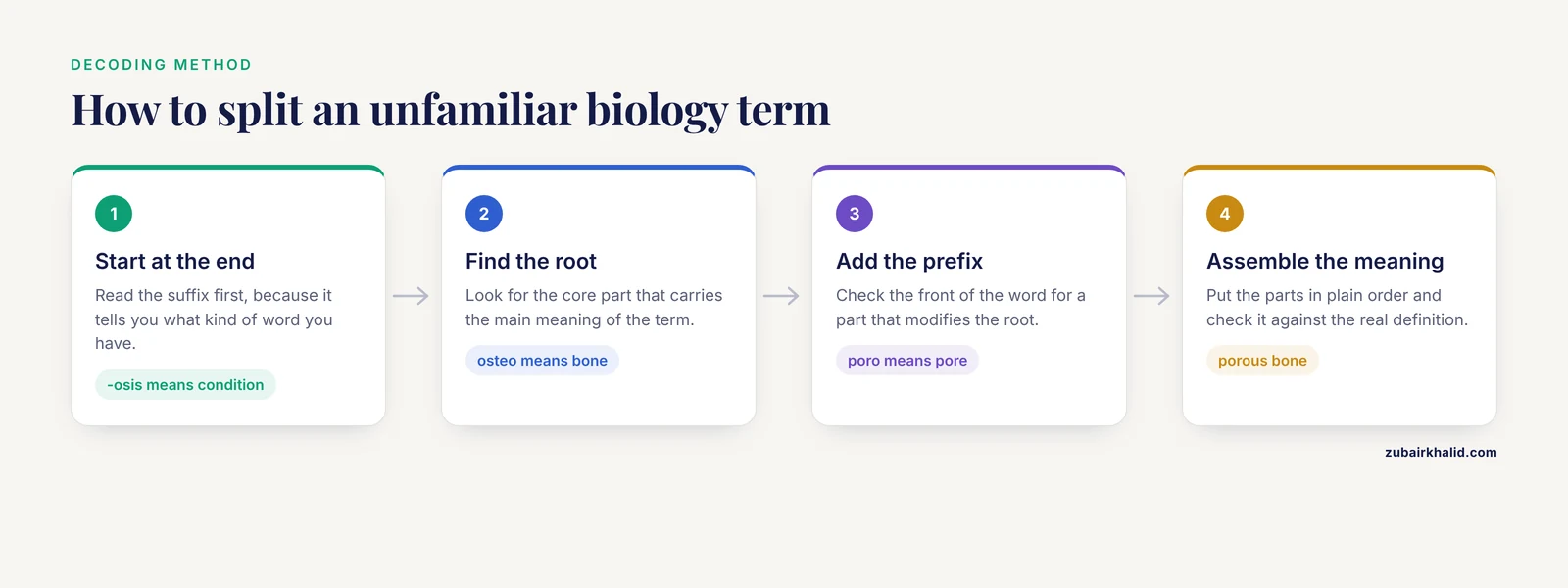
Here is the method applied step by step. When you meet a new term, split it from the back to the front.
Example 1: Osteoporosis
- Suffix -osis signals a condition.
- Root osteo means bone.
- Assembled meaning, a bone condition. In this case, porous bone, because poro refers to passage or pore.
Example 2: Erythrocytopenia
- Suffix -penia signals deficiency.
- Root erythro means red, and -cyt means cell.
- Assembled meaning, a deficiency of red cells. This is a formal way of describing what common language calls low red blood cell count.
Example 3: Antidiuretic hormone
- Root ur refers to urine, -etic relates to promoting, so diuretic promotes urine output.
- Prefix anti- means against.
- Assembled meaning, a hormone that works against urine production, meaning it concentrates urine. That is exactly what vasopressin does in the kidney.
Example 4: Cholecystokinin
This one intimidates students on sight. Split it.
- chole means bile.
- cyst means bladder or sac.
- kinin relates to movement.
- Assembled meaning, a mover of the bile bladder. The hormone cholecystokinin triggers gallbladder contraction, so the name is a literal description of its action.
Example 5: Endometriosis
- Suffix -osis signals a condition.
- Root metr refers to the uterus, and endo- means within.
- Assembled meaning, a condition of tissue like the uterine inner lining growing where it should not.
After enough repetitions, this decoding becomes automatic. You read a term like hepatomegaly and your brain assembles liver plus large before you consciously think about it.
Why This Matters for How You Study Biology
Students often treat biology vocabulary as a pile of arbitrary spellings. That mental model makes studying slow and fragile, because every term needs its own separate memory. The word-part model replaces it with a combinatorial system. Sixty roots, forty prefixes, and thirty suffixes combine to cover a vocabulary pool measured in the thousands.
This principle is supported by how the terms were built in the first place. Scientists constructing new names, whether for a newly discovered anatomical structure, a newly classified species, or a new enzyme, draw on the same small pool of Greek and Latin parts. So the system is not just a study trick. It reflects how the vocabulary was manufactured.
Here are concrete study methods that use this structure well.
Build Your Word Part Bank First
Spend your first study sessions on the tables above rather than on full terms. A word part bank of one hundred entries is learnable in a week or two of short daily sessions. Every full term you meet afterward gains three or four retrieval hooks instead of one.
Use Active Recall with Split Words
When you review flashcards, do not simply ask what a term means. Ask for the decomposition. A card for thrombocytopenia should prompt you to name thrombo (clot), cyto (cell), and -penia (deficiency) before giving the overall meaning. Active recall, the practice of pulling an answer from memory rather than rereading it, is among the best-supported techniques in cognitive psychology, and splitting words doubles the recall practice per card.
Space Your Reviews
Spaced repetition, reviewing material at increasing intervals, consistently outperforms cramming in controlled studies of memory. Free tools like Anki implement the scheduling automatically. Fifteen minutes a day on word parts beats a three-hour Sunday session, because sleep-dependent memory consolidation works on repeated spaced exposures.
Decode in Context While Reading
When a textbook sentence gives you phagocytosis, resist the urge to skim past it. Pause, split the word, and predict the meaning before checking. Phag means eat, osis is a process, so phagocytosis is the process of cellular eating. Context-embedded decoding builds transfer, meaning you can handle terms you have never seen because the parts are familiar even when the combination is new.
Watch for Tricky Lookalikes
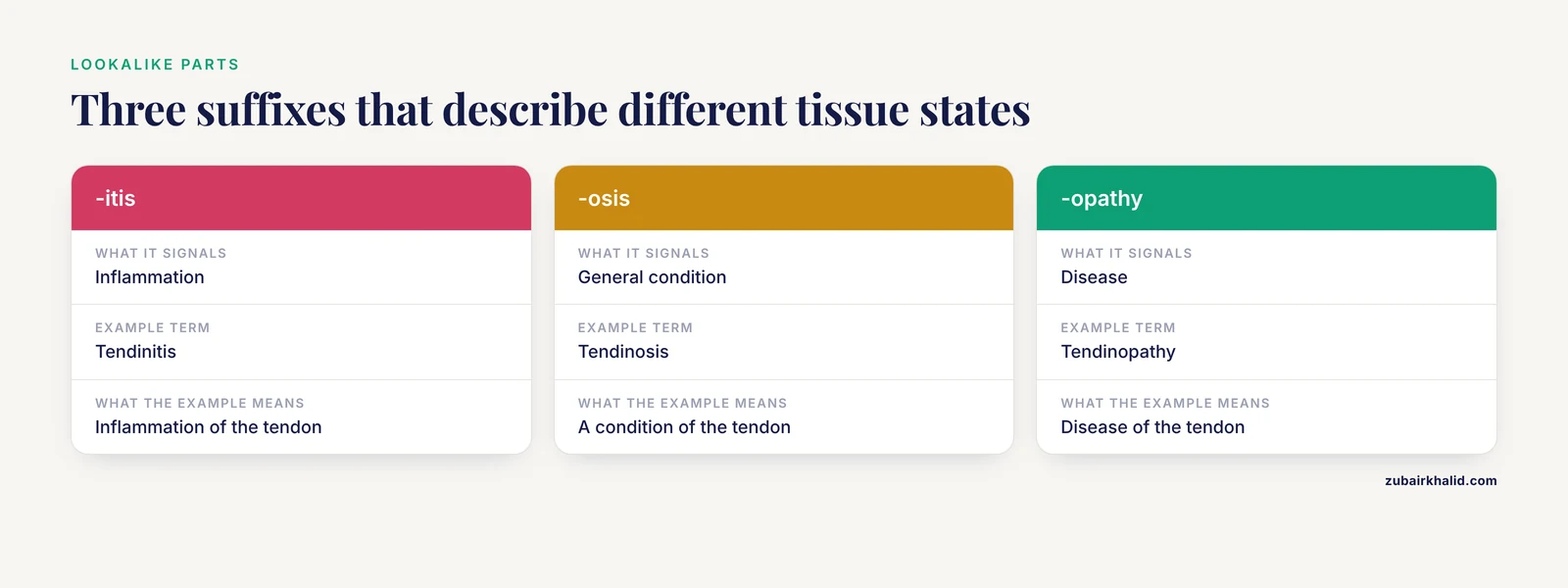
A small set of word parts look similar but mean different things, and these cause the most exam errors. Learn the confusable pairs deliberately.
- -itis (inflammation) versus -osis (general condition) versus -opathy (disease). Tendinitis, tendinosis, and tendinopathy describe different clinical states of the same tissue.
- hypo- (below, low) versus hyper- (above, high). Hypothyroid and hyperthyroid describe opposite conditions.
- -ectomy (removal) versus -otomy (cutting open) versus -ostomy (making an opening). Appendectomy removes the appendix, a tracheotomy opens the trachea, and a colostomy creates a new outlet.
- inter- (between) versus intra- (within). Intercellular means between cells, intracellular means inside one cell.
- ante- (before) versus anti- (against). Antebrachium is the forearm, an antibody is an immune protein.
Apply It to Species Names Too
Binomial names follow the same logic. Homo sapiens means wise human. Canis familiaris, the domestic dog, means familiar dog. Escherichia coli is named for the bacteriologist Theodor Escherich and describes its habitat in the colon. Tyrannosaurus rex means tyrant lizard king, which is accurate on its own terms. When you encounter a species name in a field guide or paper, decoding the Latin often tells you something real about the organism, its appearance, habitat, discoverer, or a person it honors.
Common Mistakes and Limitations
Assuming every word part has exactly one meaning. Many roots carry two related meanings depending on context. Myel refers to bone marrow in osteomyelitis and to spinal cord in myelogram. Cyst means bladder in cholecystokinin and a fluid sac in ovarian cyst. Context and the rest of the word resolve the ambiguity, but expect it.
Trusting word parts over established definitions. Etymology is a hint, not a definition. Some terms have misleading names for historical reasons. Influenza comes from the Italian word for influence, reflecting an old belief that the disease came from celestial influence. The term epidemiology contains demos, people, not epi upon a disease in the way a naive split suggests. When precision matters, always confirm the current accepted definition in an authoritative reference such as those maintained by NCBI's Bookshelf or a standard medical dictionary.
Skipping the connecting vowel. Students sometimes search for a root osteo and fail to recognize it inside osteoarthritis or the shortened form in osteofluorosis-style compounds. Learn roots in their common combined forms, oste(o), cardi(o), nephro(o), so recognition survives the vowel insertion.
Treating this as a substitute for subject study. Word parts get you in the door. They tell you what a term is roughly about, not how a process works. You still need to learn the physiology of the nephron, the mechanics of mitosis, and the logic of cladistics. Vocabulary decoding is a tool for learning content faster, not a replacement for it.
Overestimating how long mastery takes. Students sometimes try to learn all word parts at once and burn out. The effective approach is incremental. Pull the parts from whatever chapter you are currently studying, add them to your deck, and let the bank grow alongside your coursework. Within a semester the deck covers most of what you encounter.
Individual courses and exams vary in which word parts they emphasize, and professional programs such as nursing, medicine, and veterinary technology each maintain their own terminology requirements, so check the vocabulary expectations of your specific program when you plan your study list.
Frequently Asked Questions
What is a root word in biology?
A root word is the core element of a biological term that carries its central meaning, usually derived from Greek or Latin. In hepatomegaly, the root hepat means liver, and it is the anchor that every other word part modifies.
Why are so many biology terms Greek or Latin?
Greek and Latin became the shared scholarly languages of European science, and scientists kept using them so that names would be understood internationally. The system was formalized by Linnaeus in the eighteenth century and continues today under international nomenclature codes.
How many word parts do I need to learn?
Roughly one hundred to one hundred and fifty well-chosen roots, prefixes, and suffixes cover most introductory biology and anatomy vocabulary. Start with the high-frequency parts in this article and add new ones as you meet them in coursework.
Is medical terminology different from biology terminology?
No, they share the same system. Medical terms are simply biology terms applied to human health, built from the same Greek and Latin parts with the same combining-vowel rules. Learning one prepares you almost completely for the other.
What is the difference between a prefix and a suffix?
A prefix attaches to the front of a root and modifies its meaning, while a suffix attaches to the end and usually indicates what kind of thing the word describes. In nephrectomy, nephro is the kidney root and -ectomy is the removal suffix.
Can a root have more than one meaning?
Yes, several roots carry two related meanings that context resolves. Myel means bone marrow in some words and spinal cord in others, and cyst means bladder in some compounds and a sac-like lesion in others.
How long does it take to learn biology word parts?
Most students can absorb a working bank of one hundred word parts in two to four weeks of short daily spaced-repetition sessions. Fluency in decoding unfamiliar terms develops over a semester of practice with real textbook vocabulary.
Should I memorize word lists or learn terms in context?
Do both, with context as the priority. Memorize a core word part bank with flashcards, then reinforce it by decoding every new term you meet in readings, which builds the recognition speed that matters on exams and in research papers.