How to Write a Research Question for a Biology Research Proposal
By Dr. Zubair Khalid, DVM, MS, PhD ·
By the end of this article you will be able to take a broad biology topic, turn it into one focused research question, test that question against your available methods, and write the specific aims of a proposal around it. You do not need special software. Have on hand your broad topic of interest, five to ten recent papers on that topic, and a notebook or plain text file where you can draft and revise. The full biology research proposal research question template used throughout this article is free to copy and adapt, and every step shows a worked example so you can see exactly what a finished question looks like.
What a Research Question Does in a Biology Proposal
A research question is a single, answerable sentence that defines what your study will find out. Everything else in the proposal hangs off it. The hypothesis restates the question as a testable prediction. The specific aims break the question into steps. The methods section describes how each step will be carried out. If the question is vague, every downstream section inherits that vagueness.
The reverse is also true. A well-built question constrains the design in useful ways. In integrated gut microbiome and metabolome studies, reviewers have proposed a five-stage decision framework that starts by defining the intended scientific or clinical claim before any platform or analytical choice is made, and then limits interpretation to the level of validation actually achieved [1]. The same logic applies to any biology proposal. The question comes first because the question determines what counts as evidence.
A cautionary example shows what happens when the question itself is wrong. In septic shock research, thirteen comparative studies enrolling over 2,500 patients failed to settle whether norepinephrine or vasopressin should be weaned first, and later analysis argued the contradiction was methodological rather than biological, arising from how hypotension was defined, how withdrawal was performed, and uncontrolled steroid use [2]. The field did not lack data. It lacked a question precise enough for the data to answer it.
The Biology Research Proposal Research Question Template
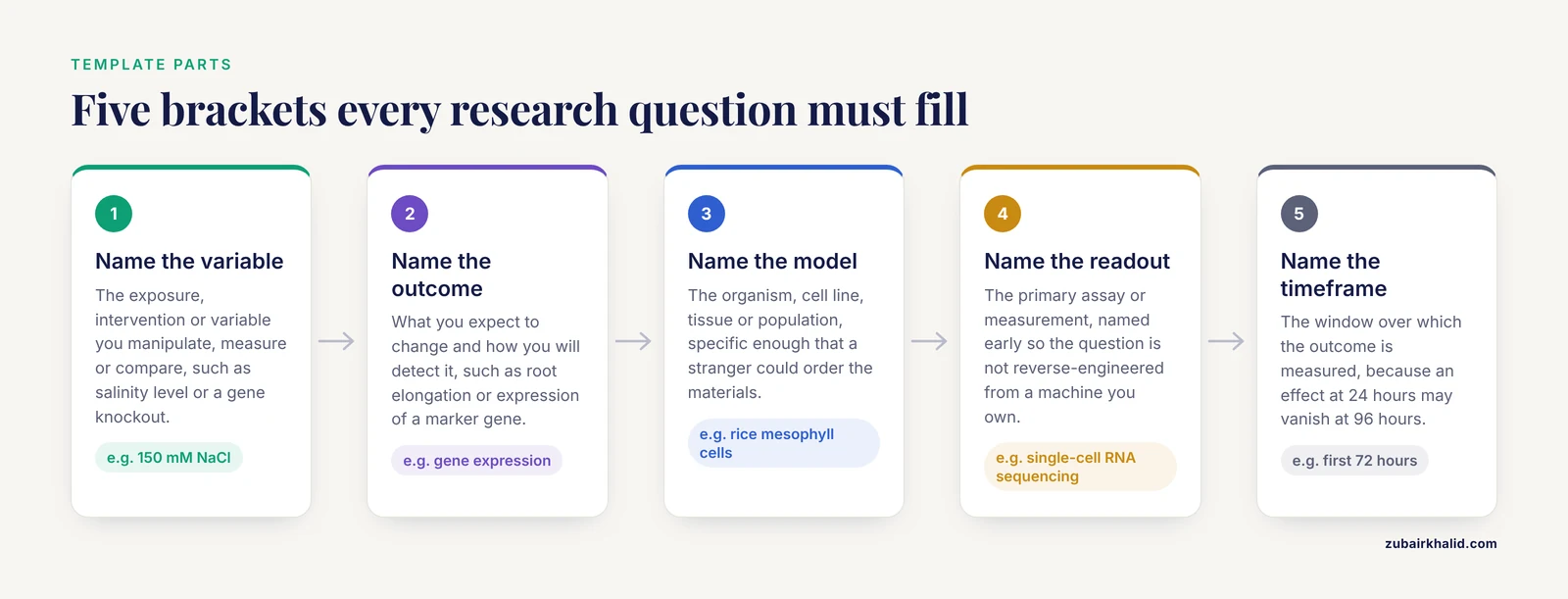
Here is the core template format. Copy it directly and fill each bracket.
RESEARCH QUESTION TEMPLATE (fill in every bracket)

How does [exposure, intervention, or variable of interest]
affect [biological outcome]
in [model organism, cell type, tissue, or population],
measured by [primary assay or readout],
over [timeframe or experimental window]?

Optional add-ons (use when relevant):

under [condition or context, e.g. drought, drug treatment,
a disease state]?
compared with [control or comparator]?
Each bracket forces a decision that would otherwise be deferred and later cause trouble.
- Exposure, intervention, or variable. What you manipulate, measure, or compare. Examples: salinity level, a gene knockout, a feeding regimen, a pesticide concentration.
- Biological outcome. What you expect to change and how you will detect it. Examples: root elongation, expression of a marker gene, tumor burden, heart rate.
- Model. The organism, cell line, tissue, or population. Specificity here protects you from reviewers who ask whether your results generalize.
- Primary assay or readout. The main measurement. Naming it early prevents method-first thinking, where a researcher owns a machine and reverse-engineers a question to fit it.
- Timeframe. The window over which the outcome is measured. Biology is rarely static, and an unstated window hides the fact that an effect at 24 hours may vanish at 96 hours.
A Filled Biology Research Proposal Research Question Template Example
Here is the template in use, at three levels of discipline, from molecular to ecological.
EXAMPLE 1 (molecular/plant biology)

How does 150 mM sodium chloride stress affect the expression
of the osmotic-responsive gene family in leaf mesophyll cells
of rice (Oryza sativa), measured by [single-cell RNA sequencing](/knowledge/bioinformatics/single-cell-rna-sequencing-from-bulk-to-resolution),
during the first 72 hours of stress exposure?
This example is deliberately method-rich. Single-cell and spatial omics approaches in rice stress biology are evaluated in the literature under a standard structure covering the measurement principle, the questions each platform can answer, its applicability to specific rice tissues, its dominant biases, and the inferences it cannot support [3]. Writing your question with the assay named lets you check it against exactly those categories before you commit.
EXAMPLE 2 (physiology/biomedical)

How does chronic restraint stress during the third trimester
affect placental corticotropin-releasing hormone trajectory
in a mouse model, measured by plasma and placental hormone
assays weekly across gestation?
This question borrows its logic from the human literature on prenatal stress, where elevated maternal cortisol, altered hypothalamic-pituitary-adaxis rhythms, and placental hormone trajectories are linked to neurodevelopmental outcomes, though results vary across populations and methods [4]. A proposal question does not have to solve the whole translational chain. It has to be clear about which link in that chain it addresses.
EXAMPLE 3 (ecology/field biology)

How does plot size affect estimates of tree species diversity
in a tropical seasonal forest, measured by repeated census
of permanent sample plots over ten years?
Field biology adds a wrinkle. In forest permanent sample plots, attributes such as plot shape, plot size, spatial arrangement, installation protocols, and remeasurement schedules vary widely across studies, and no widely accepted standard exists, which limits cross-study comparison [5]. If your question concerns how a design choice such as plot size affects inference, you have identified a genuine gap that a synthesis of 141 studies shows is underexamined.
What Reviewers Look For: The Claim Your Question Can Support
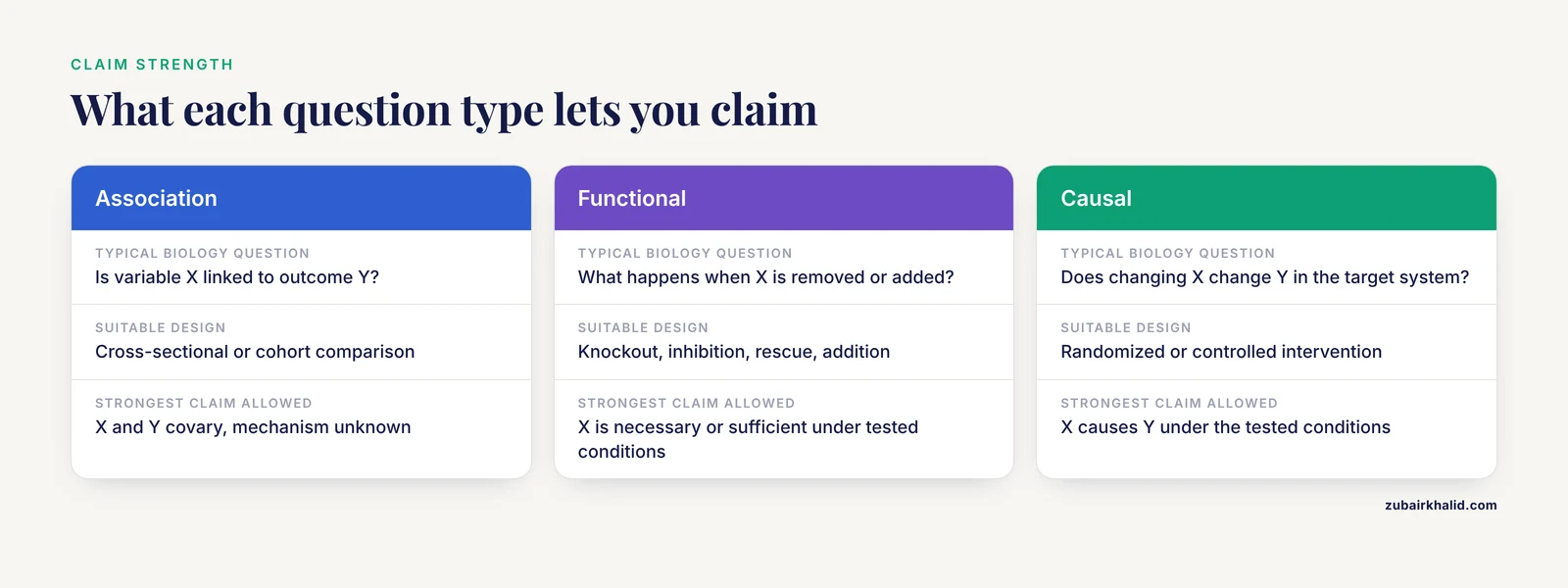
The most useful habit you can build is matching the strength of your question to the strength of the claim your design will allow. Modern methodological frameworks distinguish descriptive association, functional interpretation, clinical or predictive value, and causal evidence as different tiers of inference [1]. A question phrased as "is X associated with Y" supports one tier. A question phrased as "does X cause Y" supports a higher tier only if the design, controls, and validation reach that level. The weakest validated component of the analytical chain, rather than the fanciest technology, sets the ceiling on the claim you can make [1].
The table below summarizes the main question types and what each can support.
| Question type | Typical biology question | Suitable design | Strongest claim allowed |
|---|---|---|---|
| Descriptive or localization | Where and when does a process occur? | Observation, atlas building, mapping | A pattern exists in this system |
| Association | Is variable X linked to outcome Y? | Cross-sectional or cohort comparison | X and Y covary, mechanism unknown |
| Functional (perturbation) | What happens when X is removed or added? | Knockout, inhibition, rescue, addition | X is necessary or sufficient under tested conditions |
| Predictive | Can X improve prediction of Y? | Model with held-out validation | X adds information beyond existing predictors |
| Causal (intervention) | Does changing X change Y in the target system? | Randomized or controlled intervention | X causes Y under the tested conditions |
The distinction is not academic. Quantitative systems pharmacology models and causal inference frameworks answer different questions by design. Mechanistic simulation asks how a system behaves under intervention given specified assumptions, while causal inference asks what effect an intervention has in real-world data, and the two paradigms rest on different representations of biology [6]. Choose the question first and the framework follows. Choose the framework first and you may spend years answering a question nobody asked.
Step-by-Step Walkthrough: How to Write a Research Question
Work through the seven steps in order. Each step shows the draft text before and after, so you can see the revision process rather than only the polished result.
Step 1: Write the Broad Topic as a Sentence
Start with what genuinely interests you, stated in one plain sentence, with no pressure to sound scientific yet.
BEFORE:
"Something about how plants handle salt stress."
This sentence is your raw material. Do not polish it. Everything in the next six steps consists of cutting and specifying it.
Step 2: Find Where the Field Says the Question Is Open
Read your five to ten recent papers and write down, for each one, what the authors say remains unresolved. This step is where the biology research question earns its novelty. Review articles are efficient for this because they explicitly catalogue gaps.
Two patterns to look for. First, explicit gap statements. A review of the gut microbiota and nerve growth factor axis in postmenopausal bone homeostasis notes that existing findings come from independent experimental systems and that no study has simultaneously demonstrated that microbiota-induced changes in NGF signaling are necessary or sufficient for abnormal bone remodeling [7]. That single sentence contains a ready-made question template: connect two systems that have only been studied separately, and test necessity or sufficiency rather than mere coexistence.
Second, mismatch statements. A review of generative AI in cell biology observes that molecular-level successes are unclear in their translation to cellular and multicellular insights, and proposes fifteen grand challenges to focus community attention on critically relevant problems [8]. When a field publishes a list of open problems, each item is a candidate research question waiting for someone with the right model system.
AFTER STEP 2:
"Open question: single-cell resolution studies of salt
response in rice exist, but whether cell-type-specific
programs predict whole-plant tolerance is unresolved [3]."
Step 3: Apply the Template
Fill in the template brackets using what you learned in Step 2. Expect this draft to be rough.
DRAFT:
"How does salt stress affect [gene expression](/blog/guides/gene-expression) in rice,
measured by [RNA sequencing](/blog/guides/rna-sequencing), over the stress period?"
This draft satisfies the template structurally but fails on specificity. Which salt stress, meaning what concentration and which application schedule. Which gene expression, in which cells. Which rice tissues. Which part of the stress period.
Step 4: Specify Every Bracket with Concrete Values
Replace every general term with a concrete, measurable one. Use actual numbers where standard practice or published work supports them.
AFTER:
"How does 72 hours of 150 mM NaCl treatment affect
cell-type-specific expression of osmotic-stress-responsive
genes in leaf mesophyll cells of rice seedlings,
measured by single-cell RNA sequencing
compared with untreated controls?"
Compare this with the draft in Step 3. Every vague term now has a number, a tissue, a cell type, a comparator, and a readout. A reviewer can read this sentence and know exactly what experiment would answer it.
Step 5: Check the Question Against the Method
Now interrogate the question the way methodological reviews do. For each platform class in your plan, ask what questions it can answer, what biases dominate, and what inferences it cannot support [3]. Spatial transcriptomics in ovarian biology offers a worked version of this discipline, with reviews organizing platforms by resolution trade-offs and suitability, and cataloguing computational challenges specific to a structurally complex tissue [9].
Run this checklist against your question from Step 4.
METHOD-CHECK QUESTIONS (answer each in one sentence)

1. Can the named assay actually resolve the cell type
   or structure in my question?
2. What is the dominant bias of this assay in my tissue,
   and could that bias manufacture the result I predict?
3. What inference does this assay NOT support?
4. Does my question need spatial coordinates, or would
   dissociated single-cell data suffice?
5. What is my comparator, and is it the right negative
   or positive control?
If the honest answer to question 3 is "causation," and your design is observational, the question must be rephrased as an association question or the design must be upgraded. This single check prevents the most common fatal flaw in graduate proposals.
Step 6: Define the Estimand, Meaning Exactly What You Will Estimate
Top-tier frameworks now insist that a study define its estimand, the precise quantity to be estimated, before data collection. In a staged trauma video research framework, the authors specify that if Phase 2 proceeds, its primary predictive estimand is the incremental value of video among adults with usable video who undergo a clinically indicated head CT, with a defined endpoint [10]. Notice how much work that sentence does. It names the population, the condition, the added predictor, the baseline comparator, and the endpoint, all in one estimand statement.
Translate this into biology by writing one sentence under your question.
ESTIMAND STATEMENT:
"Primary estimand: the difference in mean expression of
the target gene family between salt-treated and control
mesophyll cells at 72 hours, adjusted for batch and
[sequencing depth](/knowledge/diagnostics/molecular/how-to-calculate-sequencing-depth-and-coverage-for-your-ngs-run)."
Step 7: Write the Specific Aims Around the Question
Break the question into two or three aims, each of which produces a result needed by the next. A well-formed aim is a sub-question with its own method.
SPECIFIC AIMS SKELETON

Aim 1: Establish the baseline.
   Sub-question: Which members of the gene family are
   expressed in unstressed mesophyll cells?
   Method: single-cell RNA-seq of untreated seedlings.

Aim 2: Apply the perturbation.
   Sub-question: Which members change expression after
   72 hours of 150 mM NaCl?
   Method: matched single-cell RNA-seq of treated seedlings.

Aim 3: Test the predictive claim.
   Sub-question: Do cell-type-specific response programs
   predict whole-plant tolerance phenotypes?
   Method: correlate cell-level responses with measured
   seedling growth under salt.
Note that Aim 3 claims prediction, not causation. That restraint is deliberate and mirrors the claim-ceiling discipline described earlier. A proposal that promises exactly what its design can deliver reads as rigorous. A proposal that promises causation from correlational data reads as naive.
Matching the Question to Design Choices in Practice
Beyond the core template, two design decisions interact directly with question phrasing and deserve their own attention.
First, biological compartment and resolution. Frameworks for integrated multi-omics work emphasize that the biological compartment, meaning the tissue, fluid, or cell type sampled, must be linked to the question, because peripheral measurements only imperfectly proxy central or local processes [1]. In depression biomarker research, a meta-research analysis found that a large fraction of recent records fail to register the compartment in which a marker was measured, with roughly one article in five from 2024 permanently absent from the structured indexed record, which weakens the entire evidence base [11]. Your proposal can avoid this fate by naming the compartment in the question itself.
Second, experimental design parameters in field and organismal work. In permanent plot ecology, design attributes must be tailored to research objectives and ecosystem context to support comparability and broader inference [5]. If your question involves longitudinal field data, the remeasurement schedule and inclusion thresholds belong in the question's timeframe bracket, not buried in methods.
A practical note on model systems. When designing experiments in fields such as mass spectrometry imaging, methodological guidance directs researchers to choose the model system deliberately, considering sample preparation requirements such as embedding and fixation before committing [12]. The lesson generalizes. Some questions are answerable only in systems compatible with your readout. Ask whether your question and your model system were made for each other.
Review-Style Proposals Use the Same Template with Different Brackets
If your proposal is a systematic or scoping review rather than a bench or field study, the template changes shape but not function. A scoping review of compassionate care in rehabilitation for people with traumatic brain injury in the criminal-legal system states its question verbatim: "To what extent is compassionate care considered or provided in rehabilitation for individuals who are involved with the criminal-legal system with TBI?" [13]. That is a model research question. It specifies the construct, the setting, the population, and the condition, in nineteen words.
Systematic reviews go further and convert the question into inclusion criteria. A systematic review of microplastics in colorectal cancer required studies to assess microplastics in human colorectal tumors or surrounding tissues and their associations with tumor biology markers, and predefined databases and date ranges before screening [14]. When you fill the template for a review proposal, the exposure bracket becomes the exposure of included studies, the model bracket becomes study population criteria, and the assay bracket becomes the inclusion criteria themselves.
Common Mistakes and Limitations
These are the errors that most often sink biology proposals at the question stage.
Mistake 1: Method-first thinking. You have access to a sequencer, an imager, or a model organism, so you build a question around the tool. The critique that methodological choices are often driven by technical availability rather than by the question and intended claim is now standard in methodology literature [1]. Reverse the order. Write the question, then justify the tool.
Mistake 2: A question the field has already answered. Skipping Step 2 is the most common cause. If recent reviews catalogue your question as settled, reframe toward the stated gap. If they catalogue it as methodologically tangled, as in the vasopressor weaning literature where thirteen studies produced contradictory results because of confounded definitions and procedures [2], your contribution can be the cleaner question rather than more data.
Mistake 3: Confusing association language with causal language. "Is linked to" and "causes" are different claims requiring different evidence. The claim hierarchy from association to causal inference exists precisely because the two are frequently conflated [1]. Match your verb to your design.
Mistake 4: Question sprawl. Three unrelated questions in one proposal means no question gets adequate power, sample size, or page space. One question, two or three nested aims.
Mistake 5: No falsifiable outcome. If every possible result could be narrated as consistent with your question, the question is not scientific in the operational sense. Add a comparator and a direction. "How does X affect Y" becomes falsifiable when you name the readout and comparator, because some results will go the other way.
Mistake 6: Ignoring the timeframe. Biological effects change over time. A stress response at 6 hours may reflect acute signaling while the same measurement at 7 days reflects adaptation. Omitting the window invites the reviewer question "when, exactly, did you measure this?"
Mistake 7: Overreaching past validation. Even careful proposals drift toward claiming more than the design delivers. The discipline of limiting interpretation to the achieved validation level, and treating the weakest validated component as the ceiling for the permissible claim, is the explicit recommendation of current frameworks [1]. Build that ceiling into the question wording from the start.
One limitation of this guidance deserves a plain statement. A template produces a well-formed question, not a guaranteed fundable one. Novelty, feasibility, and fit to the funding call all operate on top of question quality, and reviewers weigh them together.
Frequently Asked Questions
What is a biology research question?
A biology research question is a single, specific, answerable sentence that defines what a study will find out, typically naming the variable or intervention, the biological outcome, the model system, and the measurement approach. It is the sentence from which the hypothesis, aims, and methods of a proposal are all derived.
What is the difference between a research question and a hypothesis?
A research question asks, and a hypothesis answers in advance. The question "does salt stress change expression of gene family X in mesophyll cells" becomes the hypothesis "72 hours of 150 mM salt stress increases expression of gene family X in mesophyll cells." Write the question first, because the hypothesis is just the question with a predicted direction attached.
How long should a research question be?
One sentence, usually twenty to forty words for a laboratory proposal. If your question runs past fifty words, you are probably cramming in two questions, and each should be split out.
Can a proposal have more than one research question?
Yes, but each proposal should have one central question, with sub-questions appearing as specific aims. Multiple independent questions competing for the same resources signal to reviewers that the study is unfocused. If two questions genuinely require different designs, write two proposals.
What makes a research question feasible?
Feasibility means you have or can reasonably obtain the model system, the assay, the sample size, the time window, and the budget the question demands. Test feasibility by writing the experiment schedule implied by the question. If that schedule requires tissues, instruments, or timeframes you cannot access, the question must be scaled down, not abandoned.
How do I know if my research question is original?
Search for it. Read recent reviews in your subfield and look for explicit gap statements and open-problem lists, which often state exactly which questions remain unresolved. A question is original if no published study has answered it in your model system, or if existing answers conflict for identifiable methodological reasons.
How does the template change for a literature review proposal?
For a review proposal, the brackets change meaning. The exposure becomes the exposure studied in included papers, the model becomes the population criteria for inclusion, and the assay becomes the databases, date ranges, and inclusion criteria of the search. Reviews that state their question verbatim, such as scoping reviews asking "to what extent" a construct is addressed, demonstrate the format clearly.
How specific should the model organism be in the question?
Specific enough that a stranger could order the materials. Name the species, and where relevant the strain, cultivar, cell type, or developmental stage. Generalizing later is easy. Being forced to narrow after data collection is not.
Sources
- From Clinical Question to Defensible Inference: A Decision Framework for Integrated Gut Microbiome-Metabolome Studies.
- Vasopressor weaning in septic shock: Why the field has been asking the wrong question.
- Single-Cell and Spatial Omics Technologies in Rice Abiotic Stress Biology: A Methodological Review.
- Prenatal exposure to maternal stress hormones and the risk of autism: a neuroendocrine-epigenetic scoping review.
- Long-term permanent plots in silviculture and forest ecology research: a global systematic review of progress, challenges, and prospects.
- From Biological Mechanisms to Causal Inference: Quantitative Systems Pharmacology and Causal Frameworks in Drug Development.
- The potential role and research progress of the gut microbiota-NGF axis in postmenopausal bone homeostasis imbalance.
- Fifteen challenges for generative AI applications to cell biology.
- Spatial transcriptomics in ovarian biology technologies: computational challenges, and biological insights.
- Video of the inciting event in emergency trauma care: a narrative review and measurement framework.
- What the Controlled-Vocabulary Layer Cannot Say About Where a Depression Biomarker Was Measured: A Meta Research Analysis of MeSH Sampling-Compartment Coding, January 2024-June 2026.
- Seeing Chemistry in Context: Mass Spectrometry Imaging for Biomedical Research and Multi-Omic Integration.
- Exploring compassionate care in rehabilitation among individuals who are involved with the criminal-legal system with traumatic brain injury: A scoping review.
- Microplastics and colorectal cancer: presence in human colorectal tissues and associations with tumor biology.