How to Choose a Biology Procrastination Self-Assessment
By Dr. Zubair Khalid, DVM, MS, PhD ·

A biology procrastination self assessment does one of two jobs. It measures how much you delay, or it shows you when and why you delay. Questionnaires score the overall size of the habit, while time audits and trigger logs expose the exact situations that set it off. That difference drives the rule of thumb for choosing. If you cannot describe the precise moment you stall, start with a log, because cause-finding tools tell you what to change. If you already know exactly when you stall but want to gauge how serious the pattern has become, start with a short questionnaire, then repeat it later to check whether your fixes are working.
Biology coursework makes this choice matter more than students expect. A typical semester mixes weekly lab reports, problem sets due in bursts, dense textbook chapters, and long projects with distant deadlines, and each of those gets delayed for different reasons. A single score rarely explains all of them. The right assessment separates the patterns so you can match each one to a fix, and the whole process should cost less time and effort than the habit it is meant to fix.
What a Biology Procrastination Self Assessment Measures
Procrastination means voluntarily putting off an intended task even though you expect the delay to cost you something, such as watching videos the night before a physiology exam you had planned to study for. A self-assessment is any structured way of collecting evidence about your own behavior, through questionnaires, logs, or device data, rather than relying on a vague sense that you should study more.
Biology study has delay patterns of its own, and a useful assessment should be able to tell them apart:
- Lab reports carry weekly deadlines that reward last-minute rushes, so delay hides inside a routine that still gets the report submitted on time.
- Problem sets punish delay harder than any other task, because skill in genetics, physiology calculations, or data analysis grows through attempted problems, not through reading solutions.
- Dense reading invites passive rereading and highlighting, which feels like work but builds weak memory, so slow progress gets mislabeled as procrastination.
- Long projects, such as a thesis, a capstone, or a months-long exam-prep cycle, lack near deadlines, so delay can run for weeks before anyone notices.
Each pattern has a different fix. Start friction needs concrete first actions. A methods problem needs active recall and spaced review. A planning problem needs a calendar and checkpoints. The assessment you choose has to produce information fine-grained enough to tell you which of these you are actually facing.
Side-by-Side Comparison
The table below compares the five main options on the factors that decide real choices.
| Option | What it measures | Typical effort | Best for | Main drawback |
|---|---|---|---|---|
| Standardized questionnaire | Overall delay severity as a single score | Minutes, plus a recheck later | A baseline you can compare over time | Self-report bias, and it says nothing about causes |
| Time audit | Planned versus actual study hours, by task type | A few minutes a day for 1 to 2 weeks | Finding where your hours actually go | Tedious, and logging itself changes behavior |
| Trigger log | The task, moment, and thought behind each delay | A few lines per episode | Pinpointing why you stall | Easy to skip at exactly the moments that matter |
| Device dashboards | Actual phone and laptop use | Passive once enabled | Catching digital leakage you under-report | Blind to offline stalling |
| Outside feedback | How other people see your delays | One short conversation | Catching blind spots | Few observations, limited to shared settings |
No single option is complete on its own. The strongest starting package for most biology students pairs a short questionnaire, for a baseline score, with a one- to two-week log, for causes. Everything beyond that is refinement.
The Five Biology Procrastination Self Assessment Options, With Pros and Cons
1. Standardized Procrastination Questionnaires
These are short sets of statements about delaying tasks you intended to complete, each rated on an agreement scale and totaled into a score. Instruments widely used in procrastination research include the General Procrastination Scale, the Pure Procrastination Scale, and the Irrational Procrastination Scale. Students most often encounter them through university learning centers, counseling services, or the appendices of research papers on study habits.
To run one, answer about your typical behavior over recent months, not your worst week, then record the score with the date. Repeat under similar conditions later, for example after an exam block, so the comparison means something.
Pros: fast, standardized, repeatable, and it gives you a number you can track across a term or an entire degree.
Cons: self-report bends under stress and flatters memory, the score says nothing about causes, and results shift with context, so an exam week will look worse than a quiet week regardless of the underlying habit.
Best fit: you want a baseline measure of severity and a way to check whether your changes are working.
2. A One- to Two-Week Time Audit
A time audit is a record of how you actually spend your hours, kept in fixed blocks. Thirty-minute blocks work well for most students. Label every block with a task category, such as lecture review, problem set, lab report, textbook reading, meals, sleep, or scrolling, then compare the totals against what you planned for each course.
To run one, set a repeating alarm, log the previous block in under a minute using a notes app or a paper grid, and keep going for 7 to 14 days so the sample includes at least one weekend and one lab-report deadline. Precision matters at the label level. A block marked "problem set" that was really 20 minutes of reading solutions and 10 minutes of scrolling tells you something a daily total never would.
Pros: close to objective, shows the gap between intended and actual study time, and reveals which task types absorb the delays.
Cons: tedious, and the act of logging changes behavior, so treat the first week as part measurement and part intervention rather than a pure baseline.
Best fit: you honestly do not know where your study hours go.
3. A Procrastination Trigger Log
A trigger log records each delay episode in four short lines: the task, the time you planned to start, what you did instead, and the first thought or feeling at the moment of delay. Thoughts such as "this report is too big to start" or "I never learned to solve these genetics problems" are exactly the data you want, because they point at completely different fixes.
Keep the log within arm's reach, capture episodes within a few minutes, and run it for at least one week that includes a deadline, so you see both ordinary and high-pressure delays.
Pros: pinpoints causes, separates start friction from skill gaps from perfectionism, and maps directly onto changes you can make the same day.
Cons: it demands honesty, and it is easiest to skip at exactly the moments that matter. A small number of episodes can also suggest a pattern that is not really there.
Best fit: you know you delay but cannot yet say why.
4. Device Dashboards and Focus-Timer Reports
Phones and laptops have built-in screen-time dashboards that summarize app and website use by category, and focus timers produce reports of timed work sessions. Together they give you a passive record of digital behavior that you cannot easily misremember.
Enable the dashboards, set a weekly review of five minutes, and compare device categories against the study blocks in your time audit. Disagreement between the two sources is itself a finding, because it tells you where your self-image and your behavior part ways.
Pros: passive, hard to fake to yourself, and a useful cross-check on self-reports.
Cons: blind to offline stalling, such as staring at a textbook, reorganizing notes, or long library conversations, and checking the dashboard can become its own distraction.
Best fit: you suspect digital leakage but keep under-reporting it in your own logs.
5. Structured Feedback From Other People
Ask a lab partner, a study-group member, a teaching assistant, or an advisor two specific questions: "When do you notice me postponing biology work?" and "What does it look like right before?" Write the answers down and compare them with your own log. People who share your work environment see patterns you cannot, especially the visible ones, such as leaving the library early or postponing protocol drafts until the weekend.
Pros: catches blind spots, adds gentle accountability, and costs almost no time.
Cons: observers only see shared settings, the sample of observations is small, and the conversation can feel awkward enough that students skip it.
Best fit: your self-reports keep coming out cleaner than your results would suggest.
How to Choose: Six Criteria That Decide Real Choices
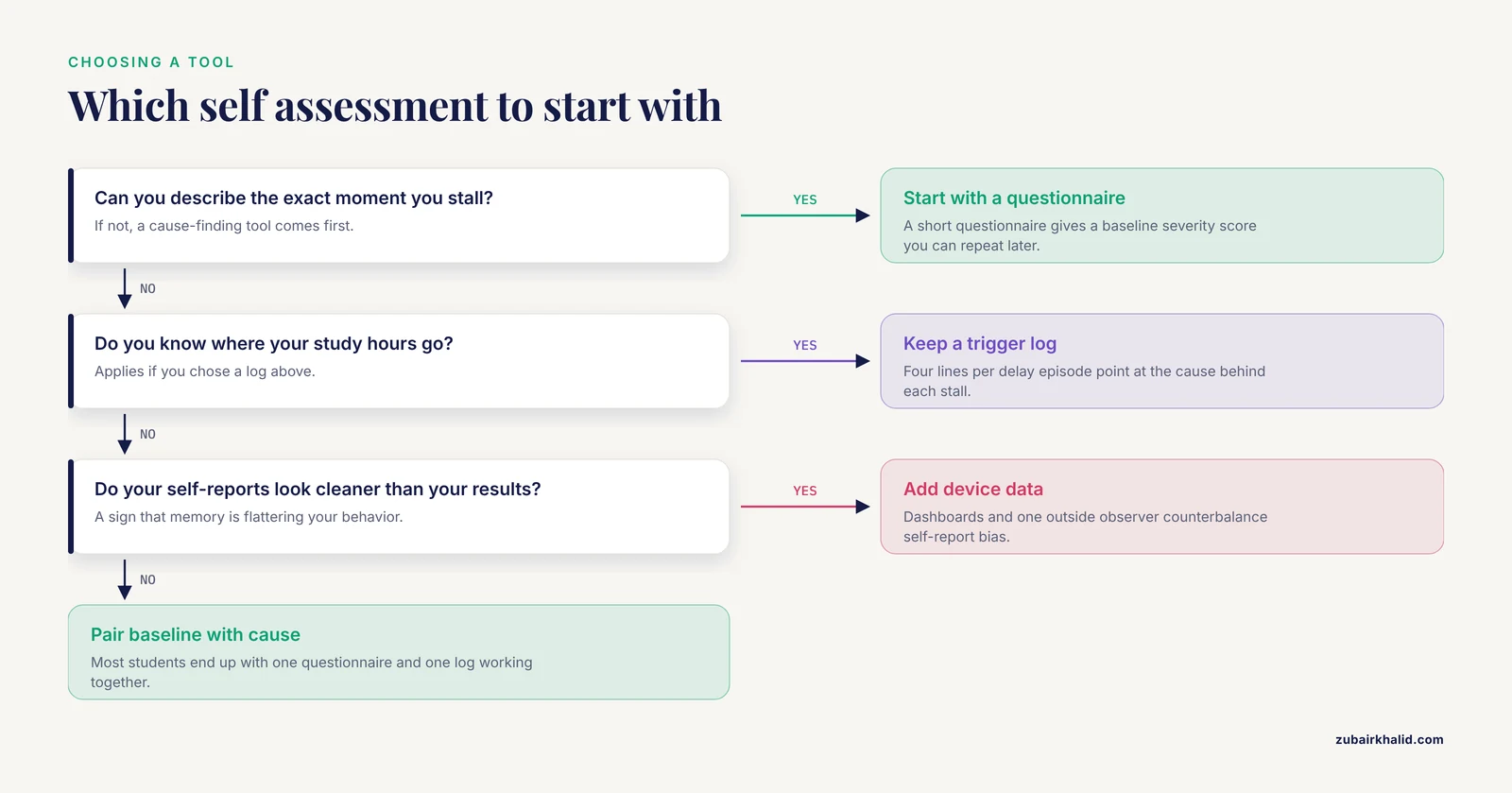
Marketing and habit gurus offer dozens of tools, but six criteria separate the options that actually help biology students from the ones that just feel productive.
Severity Versus Cause
Questionnaires answer how much. Logs answer why. If your main goal is a baseline and progress checks, weight the questionnaire. If your main goal is a change you can make this week, weight the log. Most students eventually want one of each, because severity without cause gives you no lever to pull, and cause without severity gives you no way to tell whether the lever worked.
Effort You Can Sustain
A two-week audit you actually finish beats an elaborate tracking system you abandon in four days. Match the tool to your worst week, not your best one. If logging every 30 minutes feels heavy, use hourly blocks. If four lines per episode feels heavy, write two.
Repeatability
The value of a self-assessment comes from re-running it, not from the first result. Pick tools with a built-in recheck: a questionnaire at the start of a term and after each exam block, a time audit roughly once per term, a trigger log during any course that worries you.
Fit With Biology Coursework
Biology schedules have a rhythm, weekly lab reports, problem sets that arrive in bursts, heavy reading loads, and long projects. A useful assessment separates task types so that lab-report delay and exam-cram delay do not blur into one number. If a tool cannot tell a lab report from a textbook chapter, its output will be too coarse to act on.
Resistance to Self-Deception
Memory smooths details and flatters intentions. Device data and one outside observer counterbalance self-report. When two sources disagree, trust the more objective one and treat the disagreement as the finding worth investigating.
Actionability
Every output should map to a next step. A score with no recheck date is trivia. A log entry with no matching fix is trivia. Before choosing, ask what you will do differently based on each possible result, and drop any tool whose answer is nothing.
From Results to Better Biology Study Methods
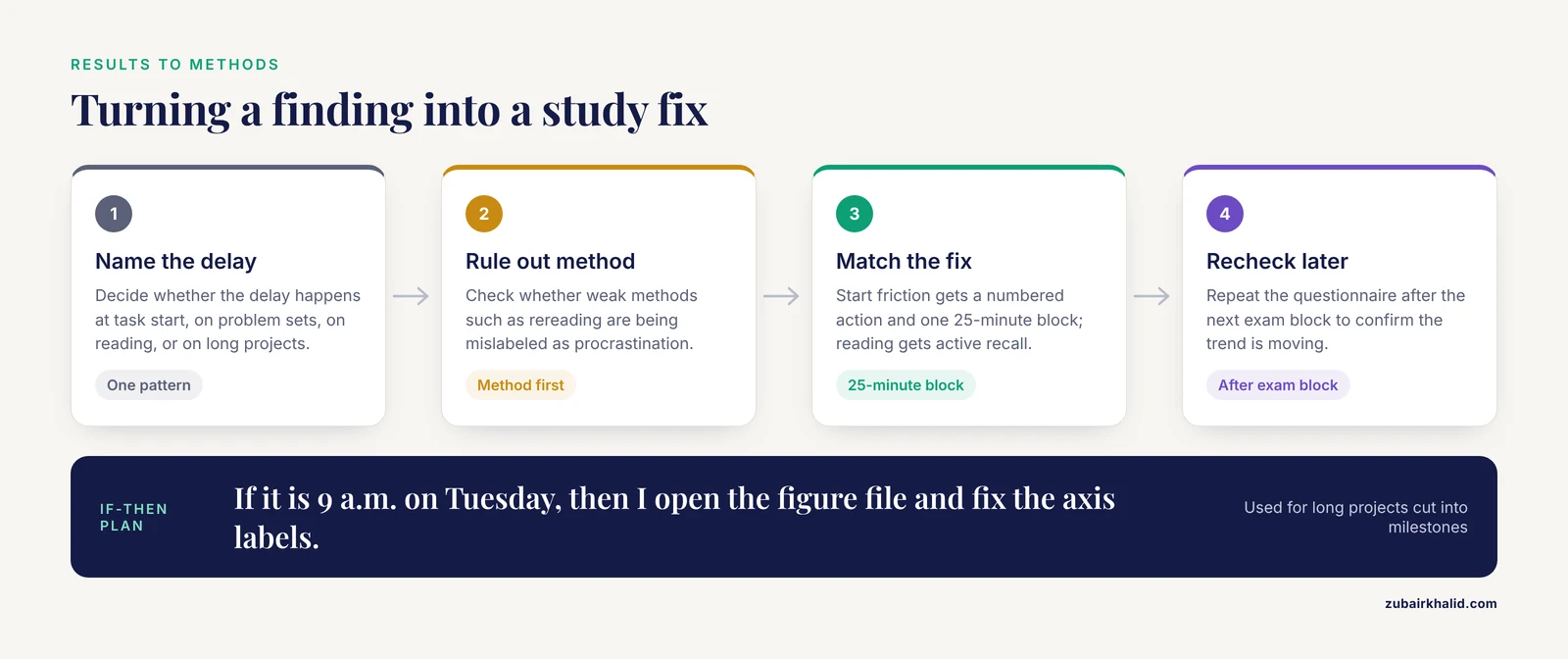
An assessment earns its keep only if it changes how you study biology. These are the most common conversions between a finding and a fix:
- Delays at task start. Rewrite tasks as concrete actions. "Answer chapter 12 questions 1 to 8" starts, "study physiology" does not. Then begin with one timed 25-minute block. That structure comes from the Pomodoro Technique, which uses 25 minutes of focused work followed by a 5-minute break, with a longer break after four blocks.
- Delays on problem sets. Attempt problems before reviewing notes, check answers, then redo the missed ones two days later. Review spaced across days with growing gaps is called spaced practice, and it suits problem-based courses especially well.
- Delays on reading. Preview the headings, turn each heading into a question, read to answer it, then close the book and write a short summary from memory. Pulling information out of memory rather than putting it in again is called active recall, and it is the single biggest methods upgrade for dense biology texts.
- Delays on long projects. Cut the project into milestones and attach an if-then plan to each one. An if-then plan, sometimes called an implementation intention, has the form "if it is 9 a.m. on Tuesday, then I open the figure file and fix the axis labels."
- Delays tied to place or people. Change the context instead of relying on willpower. Move problem sets to a quiet room, put the phone in a bag during timed blocks, and keep the library seat where you actually work.
Worked Scenarios
Scenario 1: The Night-Before Problem Set
An undergraduate in introductory biology and physiology finishes every problem set the night before it is due, at real cost to accuracy. She runs a two-week time audit alongside a trigger log. The audit shows study blocks repeatedly dissolving into short video sessions, and the log shows every episode begins at the same moment, when she reads a vague entry like "study physio" in her planner. The cause is start friction, not laziness. She rewrites each task as a numbered action, starts with one 25-minute block at a fixed morning time, and adds a study-group checkpoint the day before each deadline. After the next exam block she repeats a short questionnaire to confirm the trend is moving in the right direction.
Scenario 2: The Stalled Thesis Figure
A graduate student has delayed making figures for a manuscript for weeks. He completes a short questionnaire, scores high, and keeps a trigger log for three weeks. The log shows delays cluster on figure aesthetics, with thoughts like "the panel layout is not good enough yet." Perfectionism, not disorganization, is the engine. He adopts a rough-draft rule, attaches an if-then plan to a fixed daily time, and sets a standing weekly check-in with his advisor. A month later he repeats the questionnaire to confirm the direction of change, not to chase a perfect score.
Scenario 3: Passive Studying Disguised as Diligence
A pre-med student logs long hours rereading and highlighting a dense textbook, sees weak results on practice questions, and concludes she procrastinates because studying feels slow. A trigger log with a simple study-behavior column tells a different story. Almost all her logged time is rereading, and almost none is retrieval practice. Her problem is method, not delay, and no anti-procrastination technique would fix it. She switches to question-first study, spaced review of missed items, and weekly timed practice exams. The label "procrastination" stops describing her situation at all.
Common Mix-Ups When Reading Your Results
- Treating a score as a diagnosis. A questionnaire score describes a habit, it does not explain it.
- Reading one bad week as a pattern. Deadlines, illness, and lab chaos distort single weeks. Look for repetition across a full week of normal conditions before you conclude anything.
- Confusing overload with procrastination. If your calendar genuinely cannot hold the work, the fix is scheduling and triage, not a delay intervention.
- Confusing weak methods with procrastination. Rereading feels productive while building weak memory, and slow progress from weak methods gets mislabeled as a character problem.
- Confusing skill gaps with motivational failure. Avoiding genetics problems you never learned to solve is a tutoring problem, and timers will not solve it.
- Turning assessment into its own delay. A week spent comparing planners and questionnaires instead of starting the problem set is procrastination wearing a productive costume.
Common Mistakes and Limitations
- Logging during an abnormal week. Exam weeks inflate every measure. Run assessments during a normal week, and expect some distortion from memory and mood even then.
- Forgetting that logging changes behavior. The first audit week is part intervention. Plan a second week if you want a cleaner picture.
- Over-reading a small sample. Three delay episodes are an anecdote. Repeated episodes across a full week are a pattern.
- Assessing once and never again. Contexts drift between lab-report weeks and exam weeks. Re-run at checkpoints rather than treating the first result as permanent.
- Trusting device data alone. Dashboards cover screens only, and biology procrastination happens offline constantly.
- Using a self-assessment as a clinical evaluation. It is not one. If delay is chronic, distressing, or tangled with persistent low mood, anxiety, or attention difficulties, take your results to a campus counseling center or a licensed clinician, and if a documented condition affects your coursework, your campus accessibility office can discuss accommodations.
Frequently Asked Questions
What is a biology procrastination self assessment?
A structured way of measuring your own study delays, usually with a short questionnaire, a time audit, a trigger log, device data, or feedback from other people, so you can choose a fix based on evidence instead of guessing.
Which is the best biology procrastination self assessment if you have never used one?
A one- to two-week time audit paired with a trigger log, because together they show where your hours go and what happens in the moment you stall. Add a short questionnaire if you also want a baseline score to compare later.
How much time does a self-assessment take?
A questionnaire takes minutes, a time audit takes a few minutes a day for one to two weeks, and a trigger log takes a few lines per delay episode. None of them should cost more time than they return.
Can a self-assessment tell you why you procrastinate?
Partly. Logs and audits surface triggers such as vague tasks, fear of hard problems, or digital leakage, while questionnaires mainly measure how strong the habit is overall.
How often should you repeat a self-assessment?
Re-run a questionnaire at the start of a term and after each exam block, run a time audit about once per term, and keep a trigger log during any course that gives you trouble.
When should you get help instead of self-assessing?
When delay is persistent, distressing, or tangled with low mood, anxiety, or attention difficulties, bring your results to a campus counseling center or a licensed clinician rather than treating a score as the whole answer.