Unconscious Bias in Peer Review: How to Recognize and Mitigate It
By Dr. Zubair Khalid, DVM, MS, PhD ·

Peer review decides which findings enter the scientific record, and unconscious bias shapes how reviewers judge them. By the end of this guide you will be able to name the main forms of bias in peer review, run a six-step structured workflow that limits their influence, score a manuscript against fixed criteria with a worked calculation, draft comments that critique the science rather than the scientist, and audit your own review for bias before you submit it.
You need almost nothing to follow along: the manuscript in front of you, the journal's reviewer guidelines, and a text editor or spreadsheet. One optional step uses a short Python 3 script for the scoring calculation. The expected output is printed alongside so you can verify the arithmetic even without running the code.
Why Bias in Peer Review Matters
Peer review is the evaluation of a manuscript by qualified researchers before it is accepted for publication. Unconscious bias, also called implicit bias, is the automatic influence of associations, preferences, and expectations on judgment, operating without deliberate awareness. A reviewer who trusts a famous lab by default, or who reads an awkward English sentence as a sign of careless science, did not choose those reactions. They fire in seconds, feel like expertise, and leave no internal warning.
The stakes are concrete because peer review demonstrably reshapes published science. One published study on adolescent self-injury states in its own methods section that the analytical model was re-specified during peer review [1]. A reviewer pushed the analysis toward a more defensible form, which is the system working as designed. The same lever, tilted by bias, pushes work in the wrong direction, and authors may never learn why their paper was rejected.
Failures also compound. A narrative ethics review of forensic pathology examined publicly documented regulatory, judicial, and human-rights cases and found inadequate peer review among the recurrent vulnerabilities behind public failures, alongside loss of independence, over-certainty, and deficient documentation. The same review listed mandatory peer review, independent governance, transparent documentation, and workload limits among the preventive safeguards [2]. Forensic pathology is an extreme case, but the logic generalizes. Peer review is a quality and safety system, and quality systems fail in predictable ways when judgment is left unstructured.
Bias control therefore belongs to research ethics and to the responsible conduct of research. A reviewer holds confidential material, real power over careers, and almost no oversight. Reviewer conduct is treated as part of research integrity for the same reason data fabrication is: the reliability of the scientific record depends on it.
The Main Types of Unconscious Bias in Peer Review
Cognitive shortcuts
Confirmation bias is the pull toward evidence that supports what you already believe. In review it sounds like "this contradicts established findings" without naming which findings, or demanding impossible proof for a result the reviewer doubts. A Bayesian specialist who rejects a paper for using frequentist statistics, rather than for using them badly, is showing confirmation bias, not rigor.
Anchoring is over-weighting the first information received. The title and abstract set an expectation, and everything afterward is read through it. A paper whose abstract makes a strong causal claim gets reviewed as overclaiming even when the discussion is careful.
The halo effect lets one impressive feature inflate judgment of everything else. A large dataset, a famous co-author, or a polished figure can make weak methods look strong. Its mirror image, the horns effect, lets one typo or unconventional choice poison the whole assessment.
Identity and prestige biases
Affiliation bias favors or disfavors work based on the institution, country, or laboratory of origin. Name-based gender and ethnicity bias operates in the seconds it takes to read an author list. Career-stage bias penalizes first-time authors who have not yet absorbed the conventions their reviewers grew up with. These biases are the reason journals adopted masked review, and they are also why masking is imperfect, because self-citation patterns, preprints, and well-known datasets can reveal identities anyway.
Structural biases
Novelty and positivity bias favors exciting positive results over careful null or replication results, feeding the broader publication bias problem in which positive findings are more likely to reach print. Methodological dogma holds that one design is always superior, for example demanding a randomized trial for a question that can only be studied observationally. Language bias conflates polished idiomatic English with scientific rigor, a real inequity when most journals publish in English only. Language inclusion is a decision someone makes, as one sport science review on talent identification showed when it accepted studies written in English, Portuguese, or Spanish [3]. Competing-interest bias covers cases where the reviewer's own grants, papers, or patents are advanced or threatened by the manuscript, including coercive citation, the practice of demanding citations to the reviewer's own work as an implicit price for acceptance.
The table below maps each bias to what it actually looks like in a review comment, and the first-line countermeasure.
| Bias | What it looks like in a review | First-line mitigation |
|---|---|---|
| Confirmation bias | "This contradicts established findings" with no citation | Name your prior in the review, ask for the data |
| Anchoring | The abstract's claim sets the tone of every later comment | Read methods and results before introduction and discussion |
| Halo effect | Statistical problems overlooked in a paper from a famous lab | Score each criterion before reading the author list |
| Affiliation bias | "Surprising quality for a group like this" | Masked review, judge methods against stated criteria |
| Novelty bias | "Not novel" without naming the specific gap | Require the reviewer to state the exact gap |
| Methodological dogma | "Should have been a randomized trial" for an observational question | Match the design to the question type |
| Language bias | Grammar comments mixed into scientific criticism | Separate presentation comments into their own section |
| Competing-interest bias | Requests to cite the reviewer's own papers | Disclose conflicts to the editor, decline if the stake is close |
How Journals Reduce Bias Before You Are Even Involved
Blinding models
Single-blind review means reviewers know the authors while authors do not know the reviewers. Double-blind review masks the authors from reviewers as well. Open or transparent review makes identities known to both sides, sometimes with the reports published. Controlled comparisons find that masking author identity changes review outcomes for a meaningful share of manuscripts, but it does not eliminate bias, because identities leak through self-citations, preprints, and recognizable datasets. Treat blinding as one layer, not the whole solution.
Structured forms and checklists
A checklist converts a vague impression into rated questions, which is precisely the mechanism that limits bias. Clinical AI shows the pattern. A documented barrier to adopting black-box machine learning in medicine is the lack of transparency, trust, and systematic evaluation of explainability, and one response was the Clinician-informed XAI evaluation checklist with metrics, known as CLIX-M, built to assess explainable AI decision support systems [4]. Journal review forms work the same way by forcing attention to criteria a reviewer might otherwise skip.
Protocolized evidence assessment
Systematic reviews fix their search, eligibility, and appraisal plans before results are known, following PRISMA, the Preferred Reporting Items for Systematic Reviews and Meta-Analyses. A workplace violence review followed PRISMA across four databases and assessed methodological quality and risk of bias, taking both into account during interpretation [5]. A palliative care review searched six databases under a PRISMA protocol [6]. Risk of bias has formal instruments: the Cochrane Risk of Bias 2 (RoB 2) tool for randomized trials and the GRADE approach for certainty of evidence, both applied in a prosthodontic meta-analysis of 14 randomized clinical trials [7].
Search breadth is part of bias control. A scoping review of adolescent sexual and reproductive health injustices searched seven databases, spanning sources such as HeinOnline and JSTOR alongside PubMed and Scopus [8]. Eligibility criteria do the heavy lifting: a review of snow and ice effects on walking and cycling screened 1,501 records and included 14 [9]. Transparent reporting lets readers audit the choices, as in a digital alcohol marketing review that enumerated its 18 included quantitative studies by design, 10 cross-sectional, 7 experimental, and 1 longitudinal [10]. The same logic applies to reviewers: when a field lacks accepted standards, discretion expands, and a global review of long-term forest research plots found no widely accepted standard for plot establishment and monitoring across 141 studies [11]. Explicit criteria are what shrink that discretion.
Institutional safeguards
Individual technique cannot repair a broken system. The forensic pathology ethics review concluded that safeguards must include independent governance, mandatory peer review, transparent documentation, disclosure duties, and workload limits [2]. Workload deserves emphasis, because tired reviewers default to shortcuts and anchoring no matter how good their intentions are.
Training and calibration
Structured capability frameworks define what a role requires, an approach used to build Australia's first vocational training program for peer health navigators, where a capability framework drove curriculum design [12]. Reviewer competence can be specified the same way: know the field, know the reporting standards, know your conflicts, and calibrate your severity against other reviewers on the same manuscript.
Bias in Peer Review Step by Step: A Workflow You Can Run Today
These six steps turn bias awareness into a procedure. Run them in order on your next review.
Step 1. Screen the invitation for fit and conflicts
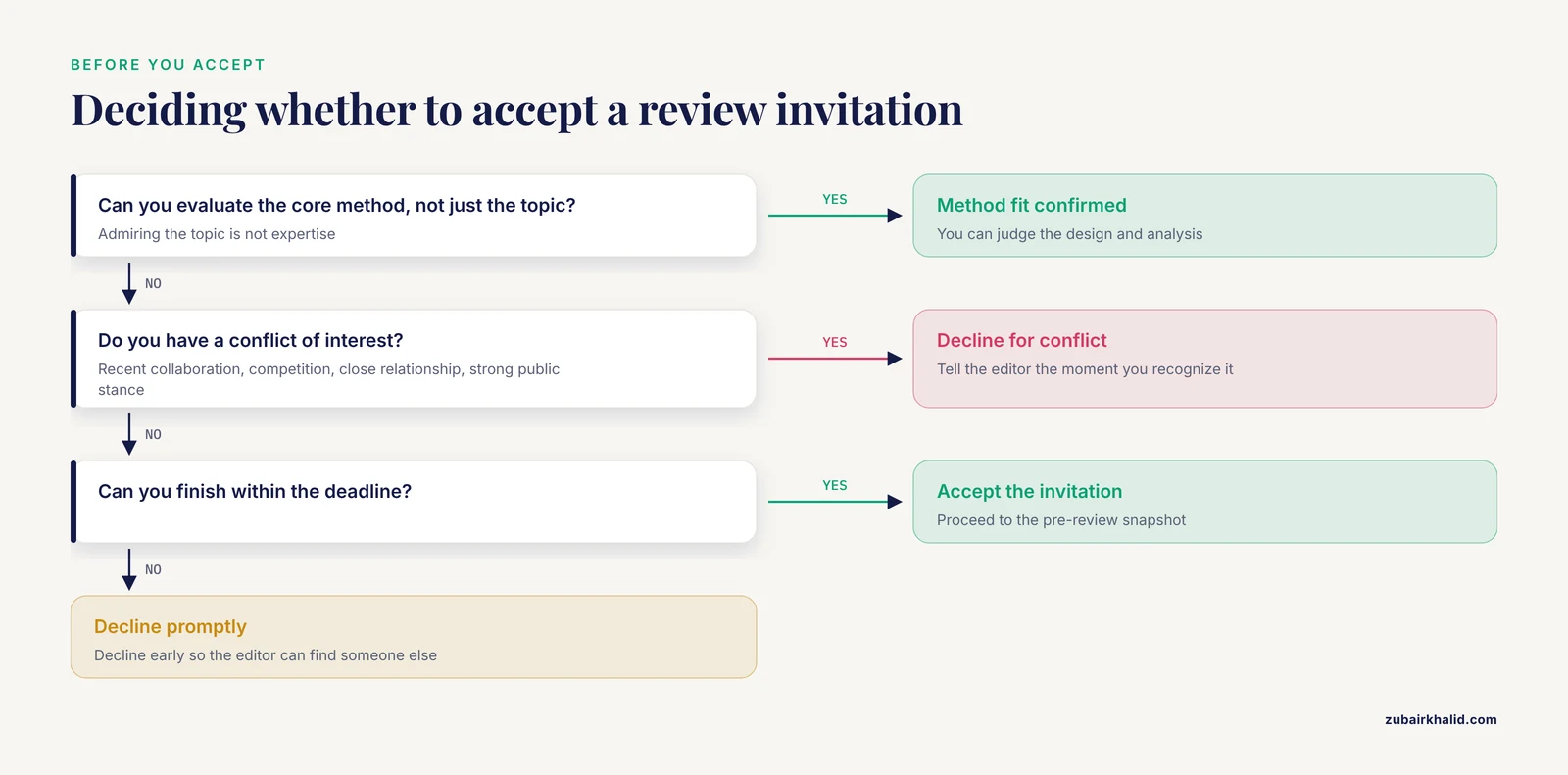
Before accepting, answer three questions. Can you evaluate the core method, not just the topic? Do you have a conflict of interest, meaning any financial, professional, or personal stake that could be advanced or harmed by the manuscript's fate? Examples include a recent collaboration with an author, direct competition for the same grant or question, a close personal relationship, or a strong public stance on the paper's conclusion. Many journals ask you to decline when you have co-published with an author recently, and their instructions specify the exact window. Can you finish within the deadline? If any answer is no, decline promptly so the editor can find someone else.
Step 2. Write a pre-review snapshot before deep reading
Read only the title, abstract, and figures, then close the file and write a snapshot. This captures your judgment before anchoring on the author list, the introduction's framing, or the discussion's rhetoric.
PRE-REVIEW SNAPSHOT (fill in before reading the full text)
Question the paper asks:
Main result claimed:
Could the evidence shown support that claim? yes / no / unsure
One result that would change my mind:
A filled example:
PRE-REVIEW SNAPSHOT (fill in before reading the full text)
Question the paper asks: Does a weekly feedback intervention reduce lab waste?
Main result claimed: 30 percent less waste at the intervention site
Could the evidence shown support that claim? unsure
One result that would change my mind: a matched control site over the same period
Keep the snapshot. Step 5 compares it with your final review to reveal how much the details moved you.
Step 3. Score the science against fixed criteria
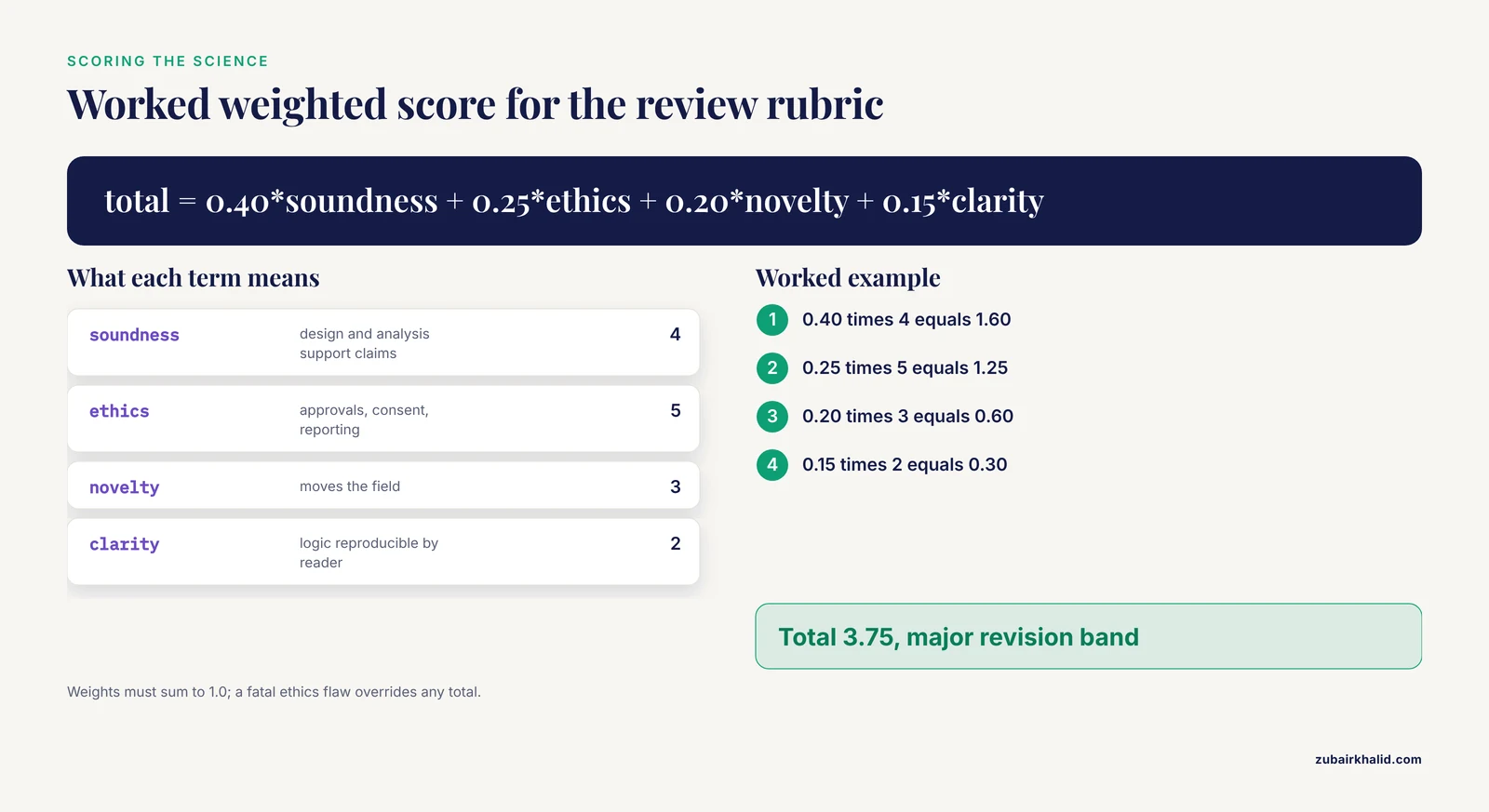
Define criteria and weights before reading, then score each criterion from 1 to 5 using written anchors. A defensible default set for empirical papers:
- Soundness, weight 0.40: do the design, analysis, and data support the claims?
- Ethics and reporting, weight 0.25: approvals, consent, data availability, and reporting standards.
- Novelty, weight 0.20: does the paper move its field relative to the literature it cites?
- Clarity, weight 0.15: could a trained reader in the field reproduce the logic?
Anchors are written definitions of what 1, 3, and 5 mean for each criterion. For soundness, a 5 means the design and analysis fully support the claims with no unaddressed threats, a 3 means the claims are mostly supported but at least one threat needs repair, and a 1 means the claims exceed the data. Writing anchors down is what stops drift between manuscripts.
Score each criterion, multiply by its weight, and sum. In Python 3:
criteria = {
    "soundness": 4,
    "novelty": 3,
    "clarity": 2,
    "ethics": 5,
}
weights = {
    "soundness": 0.40,
    "novelty": 0.20,
    "clarity": 0.15,
    "ethics": 0.25,
}
assert set(criteria) == set(weights), "criteria and weights keys must match"
assert abs(sum(weights.values()) - 1.0) < 1e-9, "weights must sum to 1.0"
total = sum(criteria[k] * weights[k] for k in criteria)
print(round(total, 2))
The expected output is:
3.75Hand check: 0.40 times 4 plus 0.20 times 3 plus 0.15 times 2 plus 0.25 times 5 equals 1.60 plus 0.60 plus 0.30 plus 1.25, which is 3.75.
Translate the total into a tentative recommendation with decision bands.
| Weighted total | Tentative recommendation | Condition |
|---|---|---|
| 4.0 to 5.0 | Accept or minor revision | Only if soundness and ethics both score 4 or higher |
| 3.0 to 3.9 | Major revision | Flaws fixable without new data collection |
| 1.0 to 2.9 | Reject | Fatal flaws in soundness or ethics |
The worked example lands at 3.75, in the major revision band. The score is a decision aid for your own consistency, not a verdict. Editors weigh your written reasoning, and a single fatal ethical flaw overrides any total.
Three common errors, with their exact messages and fixes. If you delete a criterion from criteria but keep its weight, the script runs and silently skips it, producing a wrong total. Fix: the first assert catches this with AssertionError: criteria and weights keys must match. If your weights do not sum to 1, the second assert stops the script with AssertionError: weights must sum to 1.0, and the fix is to divide each weight by the sum of all weights. If you score on a 0 to 5 scale instead of 1 to 5, nothing crashes but the range compresses, so write the anchors down and confirm both a 1 and a 5 are reachable.
Step 4. Draft comments tied to line numbers, not people
Structure every major concern the same way.
MAJOR CONCERN 1 (lines 214-231)
Issue: The comparison group is described as "matched" but no matching
variables are listed.
Why it matters: Without the matching variables the reader cannot judge
whether confounding was controlled.
Suggested fix: List the matching variables in a table, or restate the
design as unmatched and describe the statistical adjustment.
Three rules keep bias out of the prose. Comment on the text, never the author, so write "the methods section does not state" rather than "the authors failed to state". Tie every major concern to a line number or page so authors can respond precisely. Put presentation issues, grammar, formatting, phrasing, in a separate minor list so they cannot bleed into your judgment of the science.
Step 5. Run the bias self-audit
Before submitting, answer five questions in writing.
- Does my final review match my Step 2 snapshot in substance, and if not, what changed it?
- Did I demand anything I would not demand of a paper from my own lab or a famous group?
- Is every criticism about the manuscript text, or did any drift toward the authors?
- Did I request citations, and would I defend each one as scientifically necessary?
- If the author names and affiliations were swapped, would every sentence still stand?
A troubling answer looks like this: your snapshot said the evidence seemed adequate, and your final review demands a new multi-site study. That gap is where bias lives. Revise the review until the answers are clean. This audit is the highest-value five minutes in the process.
Step 6. Submit, then calibrate
Submit the report with your recommendation through the journal system. When the decision letter arrives, compare the editor's decision and, where journals share them, the other reviewers' reports with yours. Log where you were harsher or more lenient. Calibration across several reviews is what turns a rubric into skill. Sensible next steps: reread your own reports after every three or four reviews to check for severity drift, volunteer for lighter-weight conference abstract review to build volume, and keep a private file of rubric anchors as your field's standards evolve.
How to check your result
A review is ready when three checks pass. Every major concern maps to a specific manuscript location. The weighted total matches a hand calculation, for example 3.75 as shown above. And all five self-audit questions have clean answers.
Bias in Peer Review Tips for Your Next Review
Reviewer tips:
- Review the science, not the story. A compelling narrative is not evidence.
- Read methods and results before introduction and discussion to blunt anchoring.
- Time-box the first pass to one hour and take a break before writing the recommendation, because fatigue amplifies shortcuts.
- Ask for justification instead of declaring impossibility. "Please justify this choice" is fair. "This cannot work" usually is not.
- Separate "I would have done it differently" from "this is wrong". Only the second belongs in a major concern.
- Keep the manuscript confidential and never use its ideas or data before publication.
- Declare any conflict to the editor the moment you recognize it, even mid-review.
Author tips:
- Write the abstract last and make it match the results exactly, because the abstract is where reviewers anchor.
- State limitations plainly. Papers that acknowledge their limits, as one rare disease employment review did when it reported generally good methodological quality while noting small sample sizes and low response rates [13], give reviewers less room to invent worse ones.
- Include data and code availability statements up front.
- If you believe a decision was biased, use the journal's appeal process with a factual, point-by-point letter rather than an accusation.
Matching the Checklist to the Manuscript Type
Systematic reviews and meta-analyses
Check for a stated protocol, a PRISMA flow diagram, explicit eligibility criteria, and a formal risk-of-bias assessment such as RoB 2 with GRADE-rated certainty [7]. The PRISMA-guided workplace violence review that considered methodological quality during interpretation shows the pattern in practice [5]. One more marker of quality is refusing to over-pool. A narrative review of AI and robotics in knee replacement surgery declined quantitative pooling because the literature was too heterogeneous, interpreting evidence by clinical function and validation status instead [14]. Forcing a meta-analysis onto incompatible studies is an error you can catch at review stage.
Scoping reviews
Scoping reviews map a literature rather than pool it. The standard framework is PRISMA-ScR, an extension of PRISMA for scoping reviews, often run under the Arksey and O'Malley framework as developed in Joanna Briggs Institute guidance [15]. Check that the question, database list, and screening rules are stated, and that heterogeneity is handled by design, as in the snow and ice walkability review that synthesized its findings narratively because designs and measures varied [9]. Where automated tools appear, ask how they were verified: one scoping review of autoethnography used an AI-assisted workflow for data extraction, and a reviewer should expect a description of any human checks on such steps [15].
Qualitative studies and autoethnography
Reflexivity is the systematic examination of how a researcher's position, background, and relationships shape the findings. It is the qualitative counterpart of bias control, and you should expect a reflexivity statement rather than a claim of view-from-nowhere objectivity. Autoethnography, which integrates personal experience with cultural and professional analysis, is a legitimate approach with a growing literature, including a scoping review that mapped 53 studies in medical education and found collaborative autoethnography was the most common form (51 percent) [15]. Dismissing first-person data on sight is methodological dogma. Judging whether the method suits the question is rigor.
AI and machine learning papers
Ask three questions. Is the validation external or only internal? Can the model's reasoning be inspected, given that lack of transparency and systematic evaluation is a documented barrier to clinical adoption of black-box systems [4]? And are AI-based prediction and robotic execution kept distinct, a distinction one knee arthroplasty review found was often blurred under a single label [14]? A paper reporting only internal validation of an unexplainable model, then claiming clinical readiness, fails this checklist.
Common Mistakes and Limitations
These are the common mistakes reviewers make when trying to control bias in peer review, with fixes.
- Treating blinding as a complete fix. Masking reduces some biases and leaks in others, so treat it as one layer among several.
- Double-counting one flaw. If a small sample lowers your soundness score, it should not also lower novelty and clarity. One flaw, one location.
- Reviewing outside your core method. Admiring the topic is not expertise, so decline invitations you cannot judge.
- Demanding a new study. The standard is whether the claims are supported by the data in the paper, not whether you would have designed a better project.
- Coercive citation. Requesting citations to your own work is an ethical violation, not a gray area.
- Vague verdicts. "Not novel enough" without naming the specific gap is unusable for editors and authors alike.
- Confidentiality breaches, including discussing the manuscript with colleagues the editor did not approve.
- Conflating English polish with rigor, which penalizes researchers who write in a second language.
Limitations. No workflow removes bias, it reduces the share of judgment that bias controls, and the effect is probabilistic across many decisions rather than guaranteed in any single one. Structured tools help most when anchors are written down and calibrated across reviewers, and they decay when applied mechanically. Individual editorial decisions still require human judgment from the editor, who weighs conflicting reviews, watches for review-level bias, and holds information reviewers never see. Structural factors, including English-only publication and unequal access to well-resourced laboratories, sit above any individual reviewer and require action at the level of journals and scientific communities.
Frequently Asked Questions
What is unconscious bias in peer review?
It is the automatic influence of a reviewer's associations and preferences on their judgment of a manuscript, operating without their awareness. Common forms include prestige, confirmation, anchoring, and language bias, and each shifts evaluation away from scientific merit.
Does double-blind review actually reduce bias?
Yes, controlled comparisons find that masking author identity changes review outcomes for a meaningful share of manuscripts. It reduces rather than eliminates bias, because identities often leak through self-citations, preprints, and recognizable datasets.
Can I appeal a rejection I believe was biased?
Yes, most journals run a formal appeal process. Write a factual, point-by-point letter to the editor addressing specific claims in the reviews, and avoid accusations, because appeals succeed on documented evidence.
How do I report a reviewer's conflict of interest or misconduct?
Write to the journal's editorial office with specific evidence, such as a demand to cite the reviewer's own papers or a documented connection to a competing group. Editors can verify reviewer identities and act under publication ethics guidelines.
Should I use AI tools to help me review a manuscript?
Only if the journal permits it and never by uploading the confidential manuscript to an external tool, because that breaches confidentiality. AI can help with your own writing mechanics, but the scientific judgment must be yours, and you remain accountable for the report.
How long should a peer review take?
Most journals set deadlines measured in weeks, and a careful empirical review typically takes several hours across two or three sittings. If you cannot meet the deadline, decline early rather than submitting a rushed report.
What is the difference between single-blind, double-blind, and open peer review?
In single-blind review, reviewers know the authors while reviewers stay anonymous. In double-blind review, both sides are masked. In open review, identities are known to both sides, sometimes with the reports published alongside the paper.
How can authors reduce their exposure to reviewer bias?
Write precisely, state limitations plainly, separate claims from speculation, provide data availability, and choose journals whose review model fits the work. If bias is suspected, appeal with facts rather than resubmitting the same manuscript elsewhere unchanged.
Sources
- Peer victimization and family dynamics in the association between childhood abuse and adolescent non-suicidal self-injury: a cross-sectional moderated mediation study.
- When Forensic Pathology Fails: Ethical Lessons From International Regulatory, Judicial, and Historical Human-Rights Cases.
- A Multidimensional Perspective on Talent Identification and Development in Elite Athletes: A Scoping Review.
- Explainable AI-based techniques for disease classification: a systematic review and future work.
- Prevalence, determinants, and consequences of workplace violence in emergency departments - a systematic review.
- The palliative care needs of adolescents and young adults with a life limiting condition: a systematic review.
- Survival and biological and technical complications of veneered zirconia-ceramic versus metal-ceramic restorations: a systematic review and meta-analysis.
- Mapping drivers of sexual and reproductive health injustices among adolescent girls in Kenya, Ghana, and Zambia: a scoping review.
- Snow-sensitive built environment metrics and active behaviour: a systematic review.
- Associations Between Digital Alcohol Marketing and Alcohol-related Behaviours: A Systematic Review of Quantitative Studies.
- Long-term permanent plots in silviculture and forest ecology research: a global systematic review of progress, challenges, and prospects.
- Co-designed development of a vocational education and training program for peer health and social care navigators in Australia.
- Success factors enabling employment for adults with rare diseases: a systematic literature review and a qualitative study.
- Distinguishing artificial intelligence from robotic execution in total knee arthroplasty: a narrative review and evidence map.
- A scoping review of autoethnographic approaches in medical education research.