How to Automate Contribution Tracking in Research
By Dr. Zubair Khalid, DVM, MS, PhD ·

By the end of this article, you will be able to build an automated contribution tracking system for a research project. You will set up a version control repository, adopt a commit convention that labels work by contribution type, run a script that aggregates who did what, maintain a human-readable contribution ledger, and export a record you can use during authorship discussions, progress reports, and data management plans.
To follow the walkthrough, you need a computer with Git installed (version 2.20 or later), Python 3.8 or later, and a plain text editor. No paid software is required. Every command shown works on macOS, Linux, and Windows with Git Bash.
Why Automate Contribution Tracking in Research
Most research teams reconstruct contributions at the end of a project, usually the week before submission. That reconstruction depends on memory, and memory favors the people who talked the most in meetings. Recent work on academic authorship describes how "gift authorship" and authorship inflation arise when individuals with minimal input end up on the author list, often because of institutional norms rather than documented work, and the same literature argues that transparent authorship roles are part of the fix [1].
Automation changes the default. When every analysis script, figure, and paragraph lives in a repository with a timestamped record of who changed what, the evidence for contributions accumulates as a byproduct of doing the work. Nobody has to keep a diary, and nobody has to argue from recollection.
There is a second reason. Collaborative research often involves partners with less institutional power, including community organizations, junior staff, and students. Qualitative research on partnerships with shelters and young people shows that power imbalances shape who gets heard and who gets credit during a project [2]. An automated, timestamped record gives quieter collaborators a factual basis for describing what they did, which supports fairer scientific collaboration than a negotiation held in a hallway.
A third reason appears in evaluation itself. Frameworks for crediting algorithmic contributions to clinical decisions now emphasize auditable measurement, meaning the contribution claim must be linked to recorded evidence that someone can check later [3]. The same principle applies to human contributions. A claim backed by a repository history and a maintained ledger is auditable. A claim backed only by recollection is not.
What Counts as a Contribution
Before automating anything, decide what you are tracking. A useful scheme divides contributions into categories that map onto how authorship is actually assessed. The standard reference point is the CRediT taxonomy, an internationally recognized list of 14 contributor roles that includes Conceptualization, Methodology, Software, Validation, Formal analysis, Investigation, Data curation, Writing (original draft), Writing (review and editing), Visualization, Supervision, Project administration, Funding acquisition, and Resources. Most major publishers accept CRediT role statements at submission, which makes it the natural vocabulary for an automated tracking system.
Two categories deserve special attention because automation handles them differently:
- Artifacts. Code, manuscripts, analysis notebooks, figures, protocols, and data documentation. These live in files, so a version control system records them automatically.
- Activities. Mentoring, discussions, participant recruitment, pilot work, and administrative coordination. These rarely touch a file, so they need a lightweight manual log, which you will maintain in a structured file that the same scripts can aggregate.
Undergraduate and graduate researchers consistently report that visible skill development and mentorship shape their research experience, and that documentation of what they actually did matters for their growth [4]. A tracking system that records only paper drafts and ignores mentoring or data curation will undercount exactly the people who most need the record.
The Toolkit You Need
Your system has four layers, each doing one job.
| Layer | Tool | What it captures | Effort to maintain | Main limitation |
|---|---|---|---|---|
| Version control | Git | Every change to code, text, and figures, with author and timestamp | Nearly zero once adopted | Does not capture offline or non-file work |
| Commit convention | Plain text prefixes in commit messages | Which contribution category each change belongs to | One habit | Depends on people writing good messages |
| Provenance tooling | DataLad | Lineage of data files, metadata, and computational runs | Moderate | Requires some setup per project |
| Contribution ledger | A versioned YAML file | Mentoring, discussions, coordination, and other non-file work | A few minutes per week | Self-reported, so reconcile it against artifacts |
Later, after publication, bibliometric databases record a different, coarser layer of contribution: the published paper itself, its citations, and its collaboration network. Understanding how your internal records differ from those external records helps you keep both honest.
Automate Contribution Tracking Research Step by Step
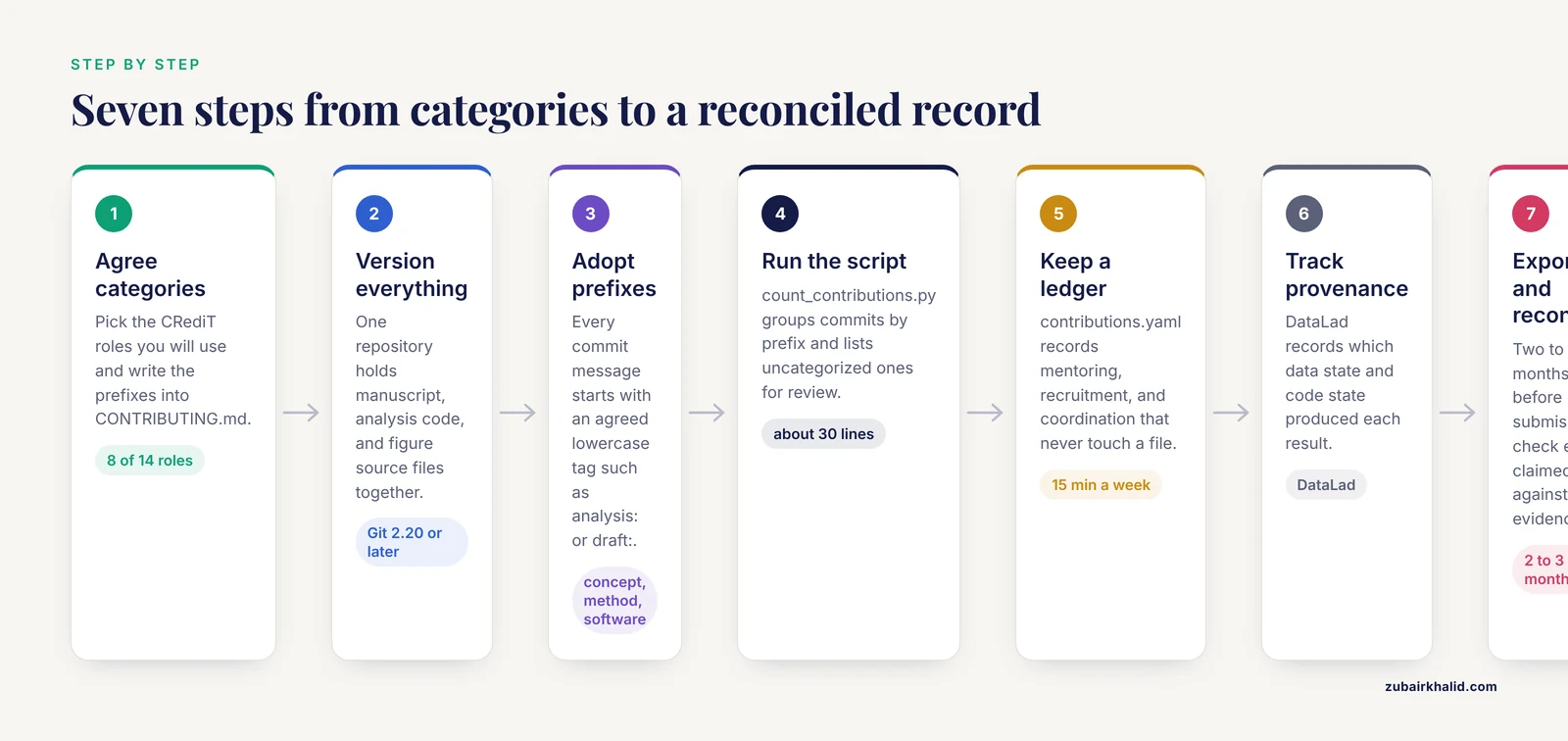
This is the core walkthrough. Each step builds on the previous one, and each ends with a check you can run to confirm the step worked.
Step 1: Agree on Contribution Categories
Meet with your team for thirty minutes and agree on two things. First, the list of CRediT roles you will actually use. A five-person lab project might use eight of the fourteen roles. Second, the commit prefixes that map work to those roles. A simple convention uses lowercase tags:
concept:for Conceptualizationmethod:for Methodologysoftware:for Softwareanalysis:for Formal analysisdata:for Data curationdraft:for Writing (original draft)revise:for Writing (review and editing)figure:for Visualization
Write the agreed list into a file named CONTRIBUTING.md at the repository root. This file is your convention document, and it doubles as the instructions you give to new collaborators.
Step 2: Put Every Artifact Under Version Control
Create one repository per project that holds the manuscript, the analysis code, and the figure source files together. From your project folder, run:
git init
git config user.name "Your Name"
git config user.email "[email protected]"
git add CONTRIBUTING.md
git commit -m "concept: adopt contribution convention and CRediT role list"
Expected output:
[main (root-commit) a1b2c3d] concept: adopt contribution convention and CRediT role list
 1 file changed, 12 insertions(+)
 create mode 100644 CONTRIBUTING.md
Use your institutional email address, not a personal one. The email address is how the aggregation script in Step 4 distinguishes collaborators, and institutional addresses keep the record unambiguous when people change roles. If a collaborator has committed with the wrong email before the repository is shared, fix it now rather than later, because rewriting history after others have pulled becomes painful.
Check the step worked with:
git log --onelineYou should see your first commit with the concept: prefix.
Step 3: Adopt a Commit Convention
Every commit message starts with one of the agreed prefixes followed by a short description:
git add analysis_growth_curves.py
git commit -m "analysis: fit exponential growth model to batch 3 data"
The prefix matters more than the wording that follows it. The aggregation script in Step 4 groups work by prefix, so a consistent prefix turns a pile of commits into a categorized contribution record without any manual tagging. If someone forgets the prefix, the commit still appears in the record, it simply falls into an "uncategorized" bucket that you clean up during the weekly review described in Step 5.
For larger teams using GitHub or a similar platform, pull request titles can carry the same prefixes. The script below works directly with commit data, which pull requests produce anyway when they merge.
Step 4: Build the Aggregation Script
Save the following as count_contributions.py in the repository root:
import subprocess
from collections import Counter

log = subprocess.run(
    ["git", "log", "--format=%aN\t%ae\t%ad\t%s", "--date=short"],
    capture_output=True, text=True, check=True
).stdout

counts = Counter()
uncategorized = []

for line in log.splitlines():
    fields = line.split("\t", 3)
    if len(fields) < 4:
        continue
    name, email, date, subject = fields
    prefix = subject.split(":").strip().lower()
    if prefix in {"concept", "method", "software", "analysis",
                  "data", "draft", "revise", "figure"}:
        counts[(name, email, prefix)] += 1
    else:
        uncategorized.append((name, email, subject))

print("Categorized contributions")
print(f"{'Name':<20} {'Role':<10} {'Commits':>8}")
for (name, email, prefix), n in sorted(counts.items()):
    print(f"{name:<20} {prefix:<10} {n:>8}")

print("\nUncategorized commits needing review:")
for name, email, subject in uncategorized:
    print(f"  {name}: {subject}")
Run it from the repository root:
python count_contributions.pyExpected output:
Categorized contributions
Name                 Role       Commits
Priya Raman          analysis         14
Priya Raman          figure            6
Marcus Webb          software         22
Marcus Webb          data              9
Dana Okafor          draft            11
Dana Okafor          revise            4

Uncategorized commits needing review:
  Dana Okafor: merged fix for figure sizing
  Marcus Webb: quick tweak
This table is your raw contribution record. It tells you, in one page, that Marcus Webb carried the software and data curation load, that Priya Raman owned the analysis and figures, and that two commits need prefixes added. To produce a per-author summary instead, change the final loop to aggregate over (name, email) and sum the counts across prefixes.
Step 5: Add a Human Contribution Ledger
Create a file named contributions.yaml in the repository. This ledger captures work that never touches a file:
people:
  - name: Priya Raman
    email: [email protected]
    orcid: 0000-0002-XXXX-XXXX
    log:
      - date: 2026-09-14
        role: Investigation
        hours: 3
        note: "Ran pilot assays for batch 3 protocol"
      - date: 2026-09-21
        role: Supervision
        hours: 1
        note: "Weekly check-in with undergraduate assistant"
  - name: Dana Okafor
    email: [email protected]
    orcid: 0000-0003-XXXX-XXXX
    log:
      - date: 2026-09-18
        role: Project administration
        hours: 2
        note: "Coordinated sample transfer with clinical partner"
Commit the ledger like any other file:
git add contributions.yaml
git commit -m "data: log September investigation and administration hours"
Because the ledger lives in the repository, editing it is itself a tracked event. A weekly five-minute review at the team meeting handles two jobs at once. Team members add missing ledger entries, and someone runs python count_contributions.py and prefixes any uncategorized commits. Fifteen minutes a week keeps the record complete. Rebuilding it after eight months takes far longer and produces far worse data.
Step 6: Track Data and Pipeline Provenance
If your project involves sensitive data or a computational pipeline, commit history alone does not tell the whole story. You need provenance, meaning a record of which data version and which code version produced which result. Work on reproducible medical research identifies traceability as a prerequisite of reproducibility and describes how platforms can extend distributed learning frameworks with privacy-preserving change tracing of data, metadata, and experiment execution using tools such as DataLad [5].
For a standard lab project, a practical entry point is to track data references rather than the data itself:
datalad create myproject
cd myproject
datalad save -m "data: register raw sequencing batch 3 checksums"
The goal at this stage is modest. Every figure in your manuscript should be traceable to a specific code state and a specific data state. When a reviewer asks how a result was produced, or when a collaborator joins mid-project, the provenance record answers the question in minutes. Teams building reproducible federated analysis platforms make exactly this trade: they track the state and lineage of data and computations rather than moving the data itself [5].
Step 7: Export and Reconcile Before Submission
Two to three months before you plan to submit, produce the final contribution record. Run the aggregation script, read the ledger, and generate a one-page summary per author that lists their CRediT roles, their counts by category, and their logged activities. Then hold the authorship meeting with that document on the table.
Reconciliation means checking three things:
- Every author's claimed roles are supported by repository evidence or ledger entries.
- Every person with substantial documented contributions is included in the author list or explicitly acknowledged.
- No role is claimed without evidence, which is the automated check against the gift authorship patterns described in the authorship literature [1].
The output of this meeting goes into the CRediT statement at submission. Because you reconciled against a record rather than memory, the statement survives scrutiny from co-authors, editors, and anyone who asks about it later.
Automate Contribution Tracking Research Tips
These tips address the details that separate a system people actually use from one that decays after a month.
Keep the commit convention shorter than seven tags. Every additional prefix adds a decision at commit time, and decision friction is why conventions get abandoned. Eight prefixes covers most lab projects.
Automate the reminder, not the entry. A recurring calendar event or a bot message in your team chat that says "run the contribution script before Friday meeting" outperforms any attempt to capture contributions in real time.
Record negative results and abandoned directions. A week of analysis that did not work is real contribution. A commit like analysis: test alternative normalization, rejected, see issue #14 documents effort that a final paper never mentions but a promotion committee or a supervisor may care about.
Give students ownership of their own ledger entries. Nursing students in graduation research projects report that mentorship, peer support, and faculty guidance shape what they get out of research, and that they value seeing their own skill development [4]. A ledger students maintain themselves turns contribution tracking from a surveillance chore into a professional record they can carry to job interviews and applications.
Link ledger entries to identifiers early. Collect ORCID identifiers during onboarding, not at submission time. Persistent identifiers let your internal record connect cleanly to external publication records later.
Document AI assistance the same way you document human work. Emerging evaluation frameworks for AI decision support argue that contribution claims need specified linkages and minimum telemetry for auditability rather than bare assertions [3]. The practical translation for a research team is simple. If an AI tool drafted text, generated code, or performed an analysis step, record that fact in the ledger and in the methods section, with the same specificity you would apply to a human contributor.
How Internal Records Connect to External Metrics
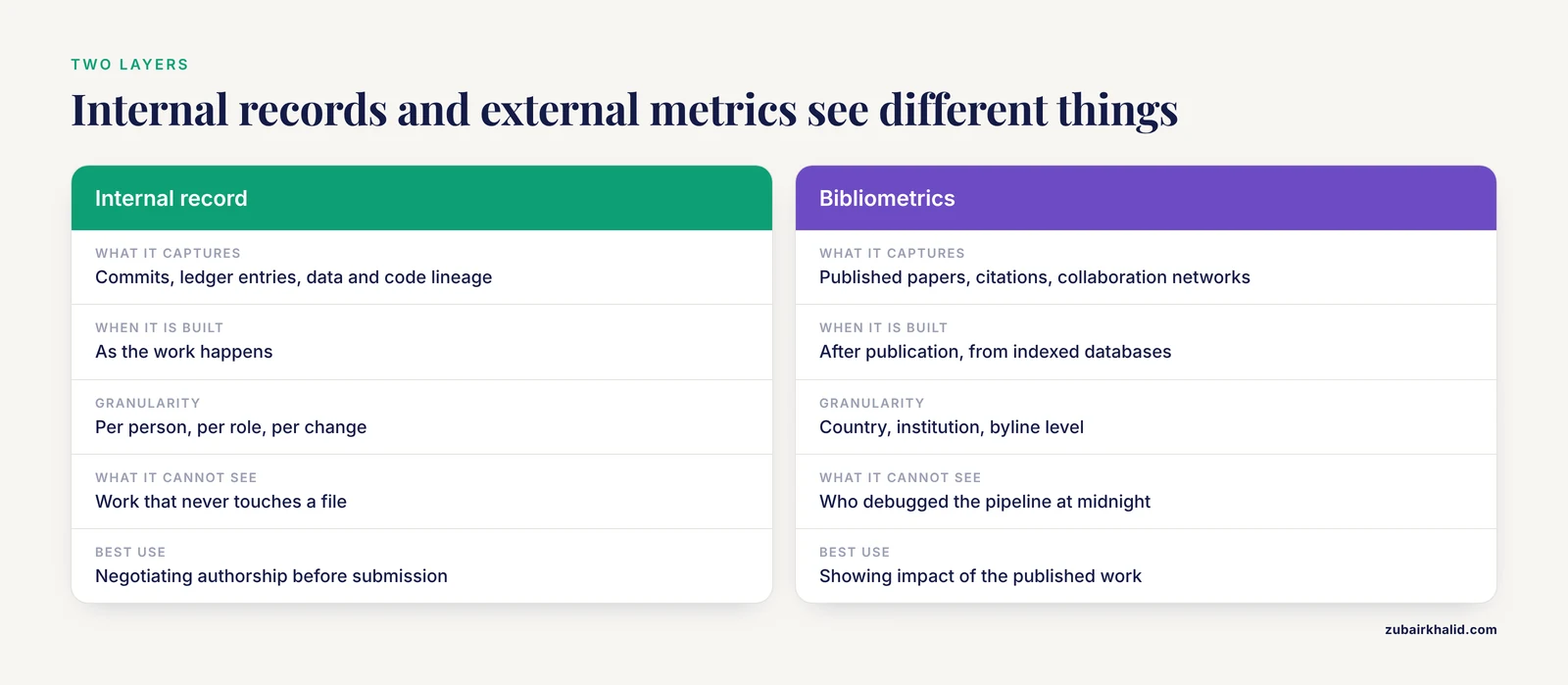
Once a paper is published, your carefully maintained internal record meets a much blunter instrument. Bibliometric analyses, which quantify research output and collaboration from large indexed databases, typically retrieve publications from sources such as the Web of Science Core Collection and then extract authorship, country, institution, and citation fields from each record [6]. A study of the 100 most-cited publications in robotic-assisted hip surgery extracted exactly those fields, including collaboration networks, to characterize who contributed what at the country and institution level [7]. A similar bibliometric mapping of intelligent assistance systems for knee surgery tracked authorship, institutional collaboration patterns, and citation trends across hundreds of articles [8].
Notice what those external records cannot see. They see names on a byline, not who debugged the pipeline at midnight. They see country affiliations, not which junior analyst on the paper did the modeling. This gap is precisely why the internal record matters. When hiring committees, reviewers, or promotion panels rely on external metrics alone, the literature documents systematic distortions including citation bias across disciplines, the Matthew effect in which highly cited researchers accumulate credit regardless of individual contribution, and geographic and institutional bias favoring high-income countries and prestigious institutions [1]. An accurate internal record is your evidence when external metrics tell the wrong story about your scientific collaboration.
The two layers work together. Use the repository record to negotiate authorship fairly before submission. Use published citation records, queried through the same databases the bibliometric studies use, to demonstrate the impact of the work afterward. Keep the two separate in your mind. A commit count is not a citation count, and neither substitutes for the other.
Common Mistakes and Limitations
Treating commit counts as effort measures. A two-line typo fix and a two-week modeling effort both appear as one commit. Use commit counts to corroborate role claims, never as the sole measure of anyone's input. The ledger exists to carry nuance that the script cannot see.
Letting identity drift accumulate. If Priya commits as [email protected] on her laptop and [email protected] on the cluster, the script reports two people. Standardize on one institutional email per person and fix drift during the weekly review with git log, format='%ae' | sort -u to list all addresses in use.
Tracking only code. Manuscript text, protocols, and figure sources belong in the same repository. Teams that version only code discover at submission time that the writing contribution record is empty.
Ignoring non-file labor. Participant recruitment, community partnership work, ethics paperwork, and mentoring generate no commits. Research on partnerships with vulnerable populations emphasizes that relational work, often carried by junior or less powerful team members, is easy to erase from the record unless someone deliberately logs it [2]. The ledger entries in Step 5 exist for this purpose. If the ledger shows nothing but computational work, your tracking system is failing the people it exists to protect.
Confusing automation with authorization. An automated record documents what happened, but it does not decide authorship. Authorship decisions still require human judgment about who meets the contribution thresholds of your target journal. Automation makes that judgment evidence-based, not automatic.
Assuming the tooling guarantees reproducibility. Provenance platforms and traceability frameworks improve the odds that a result can be re-examined, but the reproducible AI literature treats traceability as one prerequisite among several, not a guarantee [5]. Version your data references, pin your software environments, and still expect to spend effort on reproduction.
Letting the ledger rot after the project ends. Export a final snapshot of the repository history and ledger when the paper is accepted. Repositories get archived, accounts lapse, and a plain text export in the project's final folder survives all of it.
One limitation applies to every system described here. Individual projects differ in scale, sensitivity, and governance requirements, so adapt the steps to your institution's data policies and your collaborators' agreements rather than copying them wholesale.
Frequently Asked Questions
What does it mean to automate contribution tracking in research?
It means using version control, commit conventions, scripts, and structured logs to record who did what on a project as the work happens, instead of reconstructing contributions from memory at submission time.
What is the simplest system a small lab can start with?
A single Git repository holding code, manuscript, and figures, eight commit prefixes mapped to CRediT roles, and a one-page YAML ledger for non-file work. The aggregation script in Step 4 is roughly thirty lines of Python.
How do I handle collaborators who refuse to use Git?
Do not force them. Have them send plain text or tracked-changes documents, and commit their files yourself with the correct prefix and a note naming them in the message, then have them verify and sign off on the ledger entry during the weekly review.
Can contribution tracking help resolve authorship disputes?
Yes, in the sense that it replaces competing recollections with a timestamped record. It documents authorship inflation risks before they harden, because a role claimed without any supporting commits or ledger entries is immediately visible [1].
How is contribution tracking different from bibliometrics?
Contribution tracking records the internal work on a specific project, while bibliometrics analyze published outputs, citations, and collaboration networks from indexed databases after publication [6]. The first is granular and private, the second is coarse and public.
Should AI-assisted work be recorded as a contribution?
Record it as a documented assistance event, not as an authorship claim. Note the tool, the task, and the human who directed and verified the output, consistent with evaluation frameworks that require auditable linkage between a contribution and its measured outcome [3].
How often should we review the contribution record?
Weekly during active phases, in a five-minute block at an existing team meeting. Monthly reviews let uncategorized commits pile up, and end-of-project reviews are too late to recover context.
What tools handle data provenance alongside contribution tracking?
DataLad and similar distributed data management tools track the state and lineage of data, metadata, and computational runs, and have been integrated into federated research platforms specifically to support reproducibility and traceability [5].
Sources
- Challenges in Academic Authorship and Citation Metrics: Navigating Inflation, Biases, and the Rise of Evidence Synthesis.
- Navigating power imbalances in research with children and young people in shelters for domestic violence.
- A testable framework linking diagnostic AI contribution to outcome measurement in clinical decision support.
- Undergraduate Nursing Students' Experiences in Graduation Research Projects: A Descriptive Phenomenological Study.
- TrainTracks - federated learning for reproducible research on sensitive medical data.
- Global research trends and hotspots of urinary incontinence after robot-assisted radical prostatectomy: a bibliometric and visual analysis.
- Citation landscape and research themes of robotic-assisted total hip arthroplasty: a bibliometric analysis of the 100 most-cited English-language publications in the Web of Science Core Collection.
- Advances in intelligent assistance operative adjuncts for unicompartmental knee arthroplasty: A bibliometric analysis of research trends and developments.