How to Assign Writing Tasks in a Multi-Author Paper
By Dr. Zubair Khalid, DVM, MS, PhD ·

By the end of this guide, you will have a complete writing plan for your next multi-author paper: an inventory of every deliverable, a named owner and backup for each section, word budgets, a backward-planned timeline, a shared tracker, agreed rules for AI assistance, and a finished author contribution statement. The whole system runs on a plain spreadsheet and a ten-line script, so you need nothing more exotic than a shared folder.
Have four things on hand before you start: the target journal's author guidelines, your author list with a one-line note on what each person actually did for the project, the manuscript outline, and a shared folder or repository that every author can reach.
The steps below show how to assign writing tasks in a multi-author paper from kickoff to submission, and they treat writing as project management. Papers stall because sections have no owner, deadlines exist only in someone's head, and the author list gets settled after the fact instead of before the first draft. A written plan fixes all three problems at once.
Why Task Assignment Deserves an Hour of Your Time
Multi-author papers are the default in the life sciences. A bibliometric analysis, meaning a study that quantifies publication and collaboration patterns, of avoidable mortality research covering 3,031 documents found an average of 5.2 coauthors per article and only 244 single-authored papers in the entire set [1]. A bibliometric review of infrared thermography in dentistry identified 206 authors across 41 documents, with no single-authored papers at all [2]. If you are preparing your first submission, plan for a team.
Structured scientific collaboration pays. Researchers who joined an institute dedicated to team science produced more papers and built more diverse coauthor networks afterward, with no loss of individual productivity [3]. The same logic applies at the scale of one manuscript: a team with clear roles beats a team of talented people waiting for someone else to start.
There is also an integrity argument. Writing in the British Medical Journal as early as 1983, researchers highlighted honorary authorship and called for explicit disclosure of individual contributions in multi-author papers. Cosmetic authorship, meaning people listed as authors despite minimal or absent contributions, has persisted anyway, and commentators now treat undisclosed AI-assisted writing as the newest member of the same problem family [4]. A written task assignment agreed before drafting starts is the simplest defense, because every name on the byline maps to named deliverables.
The cost of skipping this hour is familiar to anyone who has sat on a stalled manuscript: a Methods section nobody remembers writing, three versions of the Discussion in three inboxes, and a submission date that quietly moves by a season.
Authors, Contributors, and Who Gets Which Job
Separate authors from contributors before you assign anything. Most biomedical journals apply the same core criteria: an author made a substantial contribution to the study design, data collection, analysis, or interpretation, drafted or critically revised the manuscript, approved the final version, and agrees to be accountable for the work. People who helped in narrower ways, for example by providing reagents, recruiting participants, or commenting on a single draft, belong in the acknowledgments rather than the byline.
Two boundary cases deserve attention. Honorary or gift authorship, where a department head or senior collaborator is added for status rather than work, remains the classic failure mode. And contribution does not track seniority: patient and public partners in health research can meet full authorship criteria, and published computational projects have included them as coauthors when they helped develop study materials and the manuscript itself [5].
A practical rule for assignment: every author owns at least one deliverable, whether a section, a figure set, the references, or a defined review round. If someone cannot be tied to a deliverable, move them to the acknowledgments. That single rule prevents most authorship disputes before they start.
Step-by-Step: Assign Writing Tasks Across Your Research Team
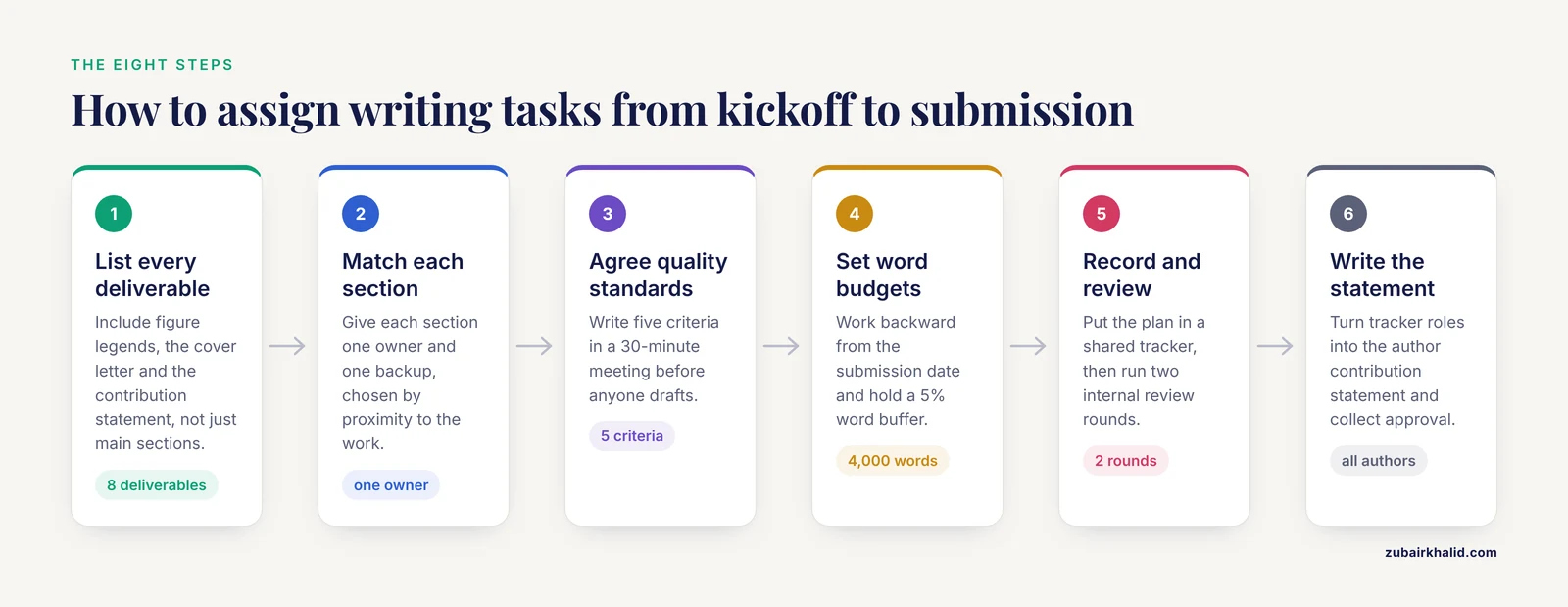
The eight steps assume a typical research article of 3,000 to 5,000 words with four to eight authors. Scale the numbers to your case.
Step 1. Inventory every deliverable
List everything the submission needs, not just the main sections. Missed items such as figure legends or the data availability statement are what delay submissions. Save the following as manuscript_inventory.yaml in your shared folder:
# manuscript_inventory.yaml
manuscript: "IL-6 signaling in a murine asthma model"
target_journal: "Journal of Immunology (example)"
main_text_limit: 4000
abstract_limit: 250
submission_date: 2027-02-15
deliverables:
  - id: D1
    item: "Structured abstract"
  - id: D2
    item: "Introduction with gap statement"
  - id: D3
    item: "Methods (animal protocol, flow panel, statistics)"
  - id: D4
    item: "Results with 4 figures and 2 tables"
  - id: D5
    item: "Discussion including limitations paragraph"
  - id: D6
    item: "References, formatted and verified"
  - id: D7
    item: "Supplementary methods and figure legends"
  - id: D8
    item: "Author contribution statement and cover letter"
Expected output: a file listing 8 deliverables. Run cat manuscript_inventory.yaml and confirm nothing is missing, especially the items teams forget, such as figure legends, the cover letter, and the contribution statement.
Step 2. Match each section to the person closest to the work
Assign owners by proximity to the work, not by rank or spare time.
- Methods goes to whoever ran the experiments, because only they know the exact parameters.
- Results goes to whoever produced the analysis, usually the person who made the figures.
- Introduction goes to a strong synthesizer, often a postdoc or senior graduate student who knows the literature.
- Discussion goes to the lead author with the principal investigator (PI), the supervising lab head, because it carries the interpretation and the claims.
- The abstract is written last, by the first and senior authors.
- References and submission formatting go to a detail-oriented team member.
Give every section one owner and one backup. If two people genuinely share a section, name one of them the owner who merges the final text. Joint ownership is how sections stall. If authorship order is contested, tie the first author position to the person who drafts the most sections and the core figures, and record the decision in the tracker.
Step 3. Agree on quality standards before anyone drafts
Expectations about scholarly writing differ, even within one team. In a pharmacology course exercise, students who co-created the rubric later used to grade their own writing assigned significantly higher weight to ideas and significantly lower weight to sentence fluency than a faculty rubric did, favoring content over mechanics [6]. A rubric is simply a scoring guide that lists quality criteria. The lesson for a research team: agree on what good looks like before drafts exist, or you will relitigate it in every review round.
Run a 30-minute meeting and write down five criteria. A workable starter set:
- The introduction states the knowledge gap in three sentences or fewer.
- Methods contain every parameter needed to repeat the experiment.
- Each figure is self-explanatory with its legend.
- Every claim in the Discussion is tied to a result in the paper.
- Sentences average under 25 words, and jargon is defined at first use.
Post the list where the drafts live. Reviewers comment against the criteria, and owners resolve comments against the same list.
Step 4. Set word budgets and a backward-planned timeline
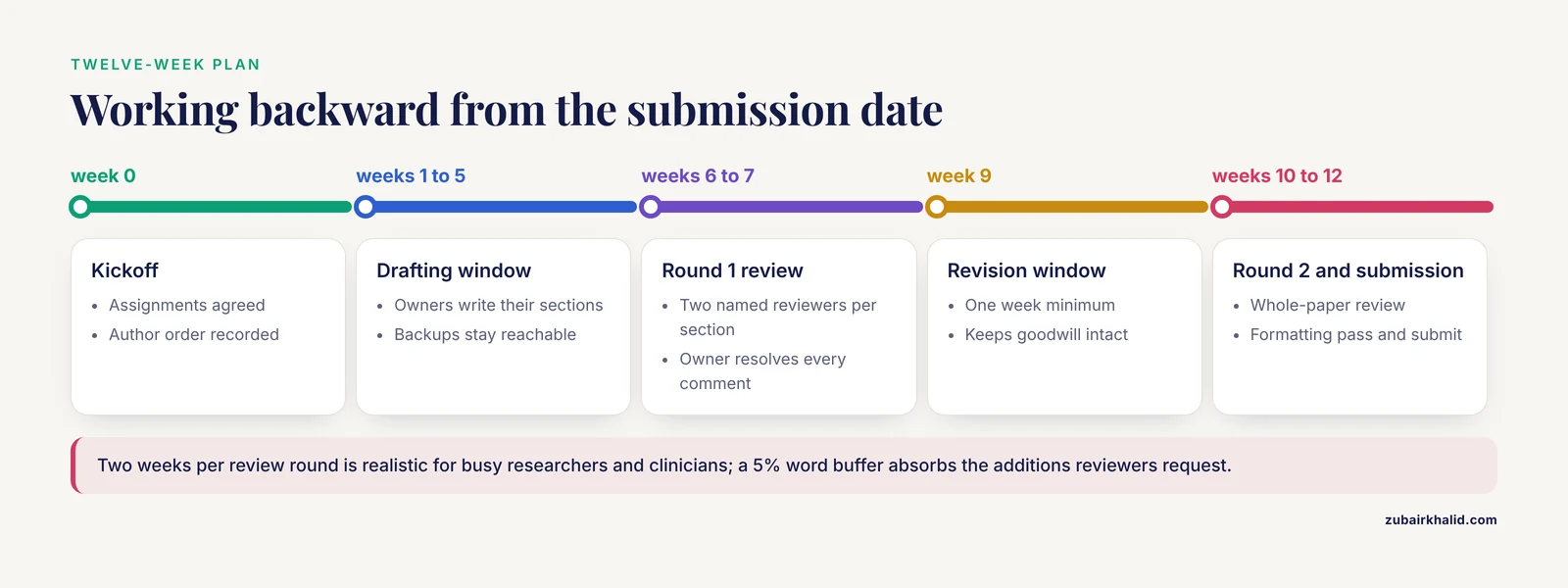
Two numbers drive the schedule: the journal's word limit and the submission date. Work backward from the date.
For a 4,000-word main text:
Main text target: 4,000 words (journal limit)
Introduction:  400 words (10%)
Methods:     1,200 words (30%)
Results:     1,000 words (25%)
Discussion:  1,200 words (30%)
Subtotal:    3,800 words
Buffer:        200 words (5%, held for text reviewers ask you to add)
Abstract:      250 words (separate journal limit)
For the calendar, budget two review rounds and hold a buffer:
Submission target:        week 12
Journal formatting pass:  week 12 (1 week)
Round 2 internal review:  weeks 10 to 11 (2 weeks)
Revision window:          week 9 (1 week)
Round 1 internal review:  weeks 6 to 7 (2 weeks)
Drafting window:          weeks 1 to 5 (5 weeks)
Kickoff and assignments:  week 0
The parameters that matter: two weeks per review round is realistic for busy researchers and clinicians, one week per revision window is the minimum that keeps goodwill intact, and a 5% word buffer absorbs the additions reviewers always request. If the journal limit is tighter, cut the Introduction and Discussion first, never the Methods.
Step 5. Record the plan in a shared tracker
Put the assignments in one file everyone can see. This CSV is a working template, and the same format scales from three authors to thirty:
section,owner,backup,reviewer_1,reviewer_2,draft_due,revision_due,word_budget,status
Abstract,Author A,Author B,PI,Author D,2026-12-18,2027-01-15,250,not started
Introduction,Author B,Author A,PI,Author D,2026-11-27,2027-01-15,400,not started
Methods,Author C,Author D,PI,Author B,2026-12-04,2027-01-15,1200,not started
Results,Author D,Author C,PI,Author E,2026-12-11,2027-01-15,1000,not started
Discussion,Author A,PI,Author E,Author C,2026-12-18,2027-01-15,1200,not started
References,Author E,Author B,Author C,Author A,2026-12-24,2027-01-15,0,not started
Supplementary,Author D,Author C,PI,Author A,2026-12-27,2027-01-15,0,not started
Validate the file with a short script so nobody discovers a gap in week 9:
import csv

TARGET = 4050  # 4,000 main-text limit plus 250-word abstract

with open("writing_plan.csv", newline="") as f:
    rows = list(csv.DictReader(f))

budget = sum(int(r["word_budget"]) for r in rows)
unowned = [r["section"] for r in rows if not r["owner"].strip()]
print(f"Sections planned: {len(rows)}")
print(f"Words budgeted:   {budget} of {TARGET} allowed words")
print(f"Sections missing an owner: {unowned or 'none'}")
Expected output:
Sections planned: 7
Words budgeted:   4050 of 4050 allowed words
Sections missing an owner: none
Common errors and fixes:
KeyError: 'word_budget'. Someone renamed or deleted a header cell. Restore the exact header row and rerun the script.ValueError: invalid literal for int() with base 10. A word budget contains text or is blank. Replace it with a number, using 0 for sections with no prose budget such as references.- "You need access. Request access, or switch to an account with permission." The file owner forgot to share the tracker. Open the Share settings and add every author with Editor permission.
Keep the tracker next to the drafts. A plan nobody can find is a plan nobody follows.
Step 6. Run a two-round internal review
Define the review order before the first draft lands.
- Round 1, section review. The two named reviewers for each section comment by the review deadline. The owner resolves every comment and marks the section revised in the tracker.
- Round 2, whole-paper review. Every author reads the full manuscript against the Step 3 criteria and flags cross-section problems, such as a Methods detail that never appears in Results.
- Approval. The senior author signs off on the final text, and every author approves the final version, which journals require for authorship anyway.
Set comment etiquette too: reviewers write suggestions rather than rewrites, owners respond to every comment with accept, change, or query, and nobody edits another person's section directly without a tracked suggestion.
If your team drafts in a version control system such as Git, which records every edit and lets collaborators merge changes, expect this message the first time two authors edit the same file:
CONFLICT (content): Merge conflict in discussion.md
Automatic merge failed, fix conflicts and then commit the result.
The fix is mechanical. Open discussion.md, find the block between the conflict markers, keep the intended text, delete the marker lines, save, and commit. The deeper fix is the one-owner rule from Step 2, which prevents most conflicts from existing at all.
Step 7. Set rules for AI assistance before the first draft
Decide as a team what AI tools may and may not do, and write it down. A defensible position treats chatbots as collaborators for routine sections and language polish, while humans keep direct control of the methodological and bibliographic content, which is the core of scientific validity [7]. Undisclosed or excessive AI use belongs to the same problem family as honorary authorship, because both obscure who genuinely contributed [4].
Practical rules that work:
- Every section keeps a human owner, even when a tool helped with the first pass.
- Every citation introduced with AI assistance is verified against the actual paper by the section owner.
- Methods and Results text is written, or at minimum fully rewritten and verified, by the people who did the work.
- Disclosure follows the target journal's policy, and the contribution statement notes any AI tool use.
AI tools can also help with the coordination side of research, for example organizing literature and citations and supporting communication across multiple research centers, though content entering the manuscript still needs expert supervision for accuracy and credibility [8].
Step 8. Convert the plan into the author contribution statement
Most journals now require a role-based contribution statement, with roles such as conceptualization, methodology, investigation, formal analysis, data curation, writing (original draft), writing (review and editing), supervision, and funding acquisition. Your tracker already contains everything the statement needs:
Author contributions
A. Reyes: Conceptualization, funding acquisition, supervision,
  writing (original draft: Discussion, Abstract), writing (review and editing).
B. Okafor: Investigation (literature synthesis), writing (original draft: Introduction),
  writing (review and editing).
C. Nwosu: Investigation, methodology, writing (original draft: Methods).
S. Patel: Formal analysis, visualization, writing (original draft: Results).
T. Dubois: Data curation, references and submission formatting,
  writing (review and editing).
M. Chen: Conceptualization, supervision, writing (review and editing).
Every author approves this statement in writing, by email or in the shared document, before submission. If a name on the byline cannot be matched to a role, revisit the author list now rather than at revision stage.
Checking that the plan is complete
Run through this list before the kickoff meeting:
- The validation script reports no missing owners and a budget that matches your target.
- Every author appears at least once as an owner, backup, or reviewer.
- Every draft due date precedes its revision date, and all dates precede the submission date.
- The contribution statement matches the tracker line for line.
- The journal's guidelines match your format for contributions, abstract structure, and reference style.
If all five pass, distribute the plan and schedule the kickoff call.
A Worked Example: Assigning Tasks for a Six-Author Paper
Here is the format in action for the inventory from Step 1, with a February submission target.
The team: A. Reyes, research lead. B. Okafor, postdoc who knows the literature. C. Nwosu, graduate student who ran the animal work. S. Patel, analyst who built the figures. T. Dubois, research assistant who manages references. M. Chen, PI.
The reasoning: Nwosu owns Methods because she set the dosing and tissue-collection parameters. Patel owns Results because she generated the flow cytometry figures, the fluorescence-based cell analysis at the center of the paper. Okafor owns the Introduction as the strongest synthesizer. Reyes owns the Discussion with Chen as backup, and the two of them write the Abstract last. Dubois owns references and submission logistics, with a word budget of zero because the section carries no prose. Chen reviews everything and approves the final version.
| Section | Owner (drafts) | Backup | Reviewers | Word budget | Draft due |
|---|---|---|---|---|---|
| Abstract | A. Reyes | B. Okafor | M. Chen, T. Dubois | 250 | Dec 18 |
| Introduction | B. Okafor | A. Reyes | M. Chen, T. Dubois | 400 | Nov 27 |
| Methods | C. Nwosu | S. Patel | M. Chen, B. Okafor | 1,200 | Dec 4 |
| Results | S. Patel | C. Nwosu | M. Chen, T. Dubois | 1,000 | Dec 11 |
| Discussion | A. Reyes | M. Chen | T. Dubois, C. Nwosu | 1,200 | Dec 18 |
| References | T. Dubois | B. Okafor | C. Nwosu, A. Reyes | 0 | Dec 24 |
| Supplementary | S. Patel | C. Nwosu | M. Chen, A. Reyes | 0 | Dec 27 |
The backups matter more than they look. Patel covers Methods while Nwosu is at a conference in early December, and Okafor covers the Abstract if Reyes is teaching. Nobody waits on a single calendar.
Tools That Keep the Team on Schedule
You need five categories of research collaboration tools, and none of them need to be expensive.
- A shared document or repository for drafts, with suggestion mode or version control so reviewer comments never overwrite the owner's text.
- A reference manager with a shared library, so every author inserts citations from the same verified pool.
- The task tracker from Step 5, whether a spreadsheet or a board tool.
- A searchable channel for decisions, so the agreement about section scope lives somewhere findable.
- Protected writing time on every author's calendar.
That last item deserves real commitment when the project matters. A hospital medicine department ran 3-day, 2-night writing retreats within a 2-hour radius of the hospital, with writing blocks of 45 to 90 minutes interspersed with breaks, feedback, and shared meals, at a cost of $296 per attendee per retreat. Nearly 80% of the 18 faculty and fellows who attended rated the retreats extremely helpful, and of the 24 papers worked on there, 12 were accepted and 6 more were under review within about a year [9]. You do not need a retreat budget to copy the mechanism. Protect 90-minute blocks, remove clinical and email obligations, and write alongside colleagues.
For distributed and inclusive teams, flexibility is the tool that matters most. Projects that included patient partners as coauthors scheduled around partner availability, offered online and in-person participation, used explanatory videos, and held one-to-one catch-up sessions for new members [5]. The same tactics keep an international team of graduate students and PIs moving across time zones.
Next steps: hold the kickoff call, put the first checkpoint on the calendar two weeks out, and review the tracker at every lab meeting until submission.
Common Mistakes and Limitations
- Assigning by availability instead of expertise. The person with free afternoons is rarely the person who knows the flow cytometry panel. Proximity to the work beats spare time.
- Giving one section two owners. Shared ownership means neither person feels responsible. Name one owner and one backup, and the backup acts only when the owner is unreachable.
- Skipping the quality criteria. Without agreed standards, review rounds become taste arguments that the loudest voice wins.
- Letting the Discussion drift. The Discussion is the hardest section and the easiest to postpone. Assign it in week 1 with a draft due date like any other section.
- Adding byline names without deliverables. Cosmetic authorship persists wherever the author list stays vague [4]. Tie every name to a deliverable in the tracker.
- Treating AI drafting as invisible labor. Undisclosed AI use blurs genuine contribution in the same way cosmetic authorship does [4]. Set the rules from Step 7 before drafting starts, not at revision stage.
- Assuming many authors guarantee quality control. In a series of 22 retracted biomedical publications, plagiarism accounted for 45.5% of retractions, and none of the retracted articles had a single author [10]. Shared authorship diffuses responsibility unless the plan assigns it explicitly.
- Ignoring the journal's specific rules. Journals differ on authorship criteria, contribution statement formats, AI disclosure, and word limits. Treat the plan above as a template, and let the target journal's author guidelines override it wherever they conflict.
The main limitation of any plan is that teams change. People leave, experiments fail, and priorities shift. Revisit the tracker at each checkpoint and reassign openly rather than letting gaps grow silently.
Frequently Asked Questions
How do we decide the order of authors?
Decide order at the kickoff, not at submission. The convention in the life sciences places the largest contributor first, coauthors in descending order of contribution, and the supervising author last. Write the agreed order into the tracker so it is settled before the first draft exists.
What is the difference between an author and an acknowledged contributor?
Authors meet all core criteria, including drafting or critical revision, final approval, and accountability for the work. People who provided materials, technical help, or a single round of comments belong in the acknowledgments. If someone cannot be tied to a deliverable in your tracker, they are an acknowledgment.
Can two people write the same section?
Yes, but never give a section two owners. Name one owner who merges the final text, and treat the second person as a co-drafter or backup. For large sections, split by subsection, for example one person writes the animal protocol and another writes the statistical methods.
What should I do when a coauthor misses a deadline?
Send one reminder with a new firm date, then activate the backup. If the delay repeats, escalate to the PI and reassign the section openly in the tracker. The backup column exists for exactly this moment, so use it without guilt.
Should students and junior researchers draft sections?
Yes. Drafting a Methods or Results section is one of the best forms of writing training in research, and it builds earned authorship. Pair the junior drafter with an experienced reviewer, and judge the section against the agreed criteria rather than the mentor's personal style.
Can we use AI tools to draft parts of the manuscript?
Only within rules your team sets in advance and your journal allows. Keep a human owner for every section, keep methods and references under direct human control, verify every citation against the real paper, and disclose use according to journal policy.
When should we start assigning writing tasks?
Start before the last experiment finishes, ideally once results are firm enough to know the paper's main claim. Eight to twelve weeks before a target submission date is comfortable for a standard research article, and starting early costs almost nothing because the plan is one meeting and one spreadsheet.
What if the journal requires a specific contribution format?
Read the author guidelines before the kickoff and map your tracker roles to the journal's required taxonomy, which many publishers base on a standard set of contribution roles. Adjust the statement to the journal's exact wording, then collect written approval from every author before submission.
Sources
- Collaboration Networks, Trends, and Scientific Impact in Avoidable Mortality Research (2000-2024): A Bibliometric Study.
- Trends, Collaborative Networks, and Impact of Infrared Thermography and Thermal Therapies in Dentistry: A Bibliometric Study.
- Membership in team science institute enhances diversity of researchers' collaboration networks.
- From honorary authorship to AI-assisted writing: two challenges to genuine scientific contribution.
- From input to impact: embedding PPI in computational ovarian cancer research.
- Student perceptions of scientific writing in pharmacology: Student generation of collaborative rubrics to score a social pharmacology writing project.
- [[On the shoulders of Chatbots: academic writing and artificial intelligence].](https://pubmed.ncbi.nlm.nih.gov/41716093/)
- Use of Artificial Intelligence Tools for Research by Medical Students: A Narrative Review.
- Development and evaluation of a writing retreat program to build community and promote productivity in academic hospital medicine.
- Retraction of biomedical publications with Tunisian affiliation: causes, characteristics, and legislation regarding breaches of scientific integrity.