How to Align Research Methodologies Across Disciplines
By Dr. Zubair Khalid, DVM, MS, PhD ·

Aligning research methodologies across disciplines means making separate fields' questions, terms, measures, and procedures comparable, not making them identical. The rule of thumb is simple: agree on the research question and the constructs first, harmonize the measurements second, and standardize the protocol only where the comparison you plan to make actually demands it. Teams that reverse this order, standardizing pipetting steps or software settings before agreeing on what they are measuring, usually discover too late that their data cannot be combined.
This guide walks through the main alignment options, their pros and cons, the criteria that decide which option fits a given project, and worked scenarios drawn from published cross-disciplinary studies.
Why Cross-Disciplinary Alignment Fails Without Structure
Mixed teams produce mixed data unless someone engineers comparability on purpose. A review of hackathon-based cross-disciplinary coding in soft matter research found that inconsistencies in metrics, definitions, and analysis algorithms across research groups, combined with high-dimensional experimental data streams, hindered the identification of performance intersections among related material systems [1]. The same problem appears in implementation science, where quantitative data remain highly heterogeneous because of non-standardized instruments, variable operationalizations, and context-specific adaptations that challenge comparison, replication, and cumulative knowledge building [2].
The failure modes are predictable. Two disciplines use the same word for different constructs. Two labs measure the same quantity with different protocols and report numbers that look comparable but are not. Two teams analyze shared data with different algorithms and reach different conclusions from the same files. None of these are talent problems. They are alignment problems, and each has a documented solution.
How to Align Research Methodologies Across Disciplines: The Main Options
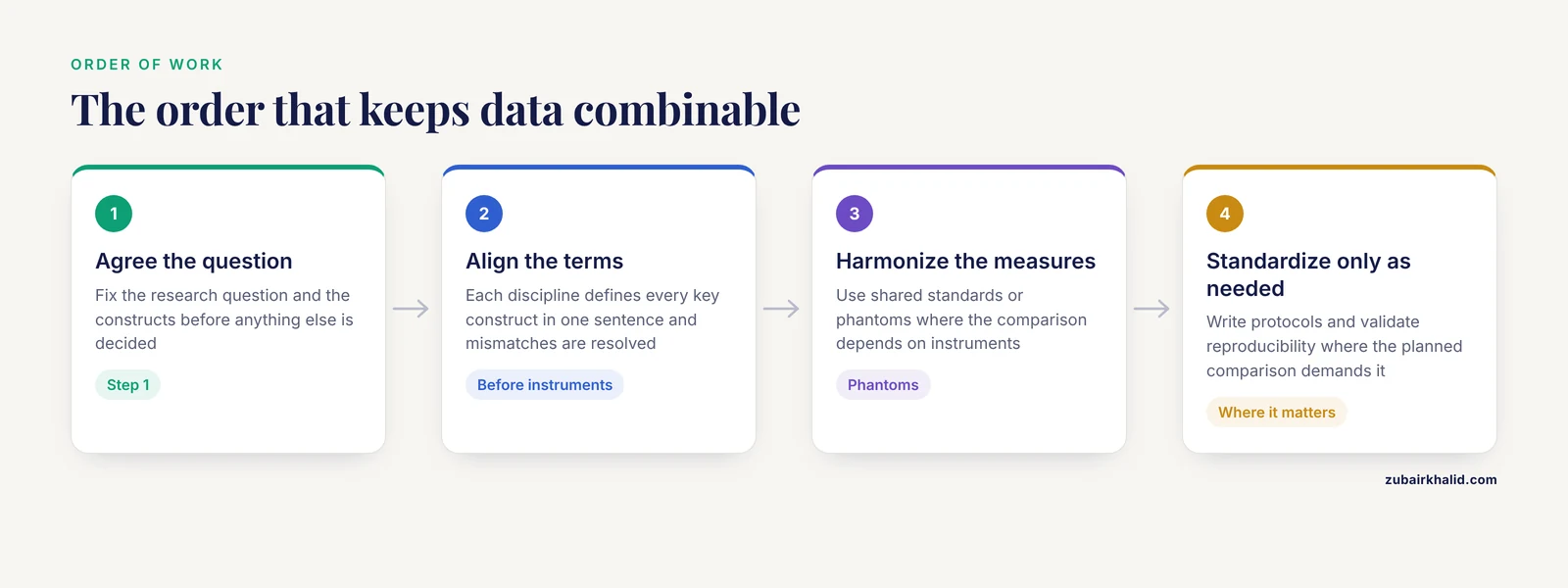
There is no single best method for aligning research methodologies across disciplines. The best option depends on where the incomparability sits: in the concepts, the instruments, the protocols, the data, or the team itself. The table below summarizes the six main options, and each is explained in its own section.
| Option | What it aligns | Best suited for | Main trade-off |
|---|---|---|---|
| Shared conceptual framework | Research question, study phases, logic of inquiry | Teams mixing qualitative and quantitative methods, or clinicians with engineers | Frameworks guide structure but do not by themselves make data comparable |
| Construct and nomenclature alignment | Definitions and terminology | Fields with overlapping vocabulary but different meanings | Requires sustained negotiation between discipline representatives |
| Measurement harmonization with shared standards | Instrument calibration and quantitative outputs | Multi-site studies using physical instruments or imaging platforms | Requires manufacturing or distributing reference standards |
| Protocol standardization with validation | Step-by-step procedures and analysis pipelines | Technique-heavy methods where operator choices affect results | High upfront cost, and over-standardization can waste effort where variability does not matter |
| Statistical data harmonization | Already-collected datasets | Retrospective synthesis across studies that cannot be re-run | Constrained by construct validity and psychometric gaps in the original data |
| Structured collaboration and governance | People, roles, workflows, and shared tools | Large multidisciplinary teams and long-running programs | Governance overhead, and it fails if deliverables are vague |
Option 1: Adopt a Shared Conceptual Framework
A shared framework gives every discipline a common map of the project, even when the methods each group contributes differ. In a patient safety research program spanning obstetrics and neonatology, investigators organized their work around a five-step systems engineering approach: problem analysis, design, development, implementation, and evaluation. Within those five steps they deployed methods from very different traditions, including interviews, focus groups, direct observation, teamwork scales, flow disruption analysis, the Systems Engineering Initiative for Patient Safety model, design thinking, and simulation-based testing of processes and prototypes [3]. The framework did not flatten these methods into one. It placed them in sequence so that each discipline knew when its method was load-bearing.
This is the cheapest form of alignment and often the first one worth attempting. If team members cannot agree on the stages of the project, no amount of statistical harmonization will rescue the work.
Option 2: Align Constructs and Nomenclature Before Instruments
Construct validity, meaning the question of whether an instrument measures what a team claims it measures, sits at the top of the challenge list for cross-study data harmonization [2]. The practical response is to fix terminology before anyone touches a data collection instrument.
A clinical practice guideline for peripheral nervous system manifestations in Sjögren's disease shows what this looks like when done formally. A topic review group spanning rheumatology, neurology, and guideline methodology developed an aligned nomenclature of peripheral nervous system terms that can be used across disciplines, alongside structured good-practice statements and evidence-graded recommendations [4]. The nomenclature came first because rheumatologists and neurologists use overlapping but non-identical vocabularies for neuropathies, and any pooled evidence would be uninterpretable without agreed terms.
A usable exercise for any team: write down every key construct, have each discipline define it in one sentence, and resolve every mismatch before the first data collection session.
Option 3: Harmonize Measurements With Shared Standards or Phantoms
When the comparison depends on instruments, physical reference standards do work that documentation cannot. In a national network of preclinical PET imaging facilities, investigators manufactured six identical image quality phantoms to a standard specification and distributed them to six sites, where they were imaged using local acquisition and reconstruction protocols across multiple scanner platforms. Substantial variability appeared in contrast recovery, uniformity, and spill-over ratios under site-specific conditions. Two findings carry the lesson. First, centralized automated re-analysis produced only minor reductions in variability, meaning inter-user effects were small compared with site-specific protocol variations. Second, optimizing reconstruction parameters reduced inter-scanner variability by an average of 60 percent across larger rods, particularly for voxel-wise maximum contrast recovery coefficients, which are more sensitive to noise and reconstruction settings than the standard averaged metric [5].
The generalizable point: locate the dominant source of variability before choosing a harmonization tool. Centralized analysis was the intuitive fix and the wrong one. Shared physical standards plus targeted parameter optimization was the effective combination.
Measurement robustness also has a procedural dimension. In a prospective study of multiparametric quantitative ultrasound for hepatic steatosis, researchers examined whether measurements held across breathing states. Fat fraction, backscatter coefficient, and signal-to-noise ratio stayed consistent between breath-hold and normal breathing, while the attenuation coefficient rose slightly during normal breathing [6]. Specifying acquisition conditions that must be held constant is part of measurement alignment, and it only becomes visible when someone tests for it.
Option 4: Standardize Protocols and Validate Reproducibility
Technique-heavy methods need written protocols and demonstrated reproducibility, especially when collaborators come from different expertises. A review of atomic force microscopy (AFM) for cross-disciplinary materials research describes the problem directly. AFM maps surface mechanical, electrical, chemical, and magnetic properties at the nanoscale through controlled probe-sample interactions, capabilities that go well beyond the visualization offered by scanning electron microscopy or transmission electron microscopy, and this makes it valuable across domains from electronic materials to energy storage. But effective implementation is often challenged by the technical complexity and the varied domain expertise among collaborators. The review responds with validated approaches for measurement optimization, covering experimental protocols through quantitative data analysis, to ensure reproducibility and support successful cross-disciplinary implementation [7].
The pattern to copy: for any shared core method, publish or circulate a protocol that specifies acquisition parameters, defines the analysis pipeline, and reports validation results that a newcomer discipline can reproduce. Reproducibility documentation is the handoff artifact between disciplines.
Option 5: Harmonize Existing Data Statistically
When the data already exist and the studies cannot be re-run, statistical harmonization is the remaining option, and it comes with named obstacles. A methodology paper on harmonizing quantitative implementation data identifies five core challenges: construct validity, measurement alignment, psychometric gaps, contextual heterogeneity, and temporal differences in data collection. Against these costs, harmonization offers substantial gains, including increased statistical power and the ability to test mediators and moderators across studies [2].
The honest framing is that statistical harmonization cannot repair constructs that were never measured comparably. It works best when the underlying constructs match and only the operationalizations differ, and it should be paired with sensitivity analyses that show how conclusions change under alternative harmonization assumptions.
Option 6: Build Alignment Through Structured Collaboration and Governance
Some misalignment lives in the team rather than the methods, and the fix is structural. One response is the hackathon model developed for active matter and biomaterials research. The organizers enforce a flat hierarchy, pairing participants from high school students to faculty with varied skills to collectively contribute to data acquisition and processing, ideation, coding, testing, and dissemination, all with clearly defined goals and deliverables, while beta-testing high-throughput analysis software and workflows [1]. Defined deliverables are the alignment mechanism. Ambiguity about who produces what, by when, is what allows metric definitions to drift.
Process governance can carry alignment into routine operations. In a tertiary cancer hospital, a multidisciplinary team applied Lean Management to surgical instruments, introducing standardized categorized management, optimized instrument sets, shared instrument pools, and IT-enabled traceability. The intervention streamlined instrument set variety by 32.7 percent, reduced average instruments per set by 21.3 percent, saved 4.9682 million CNY in configuration costs, and cut labor time across roles, including a 27.2 percent reduction in scrub nurse counting time [8]. The relevance to methodology alignment is the design pattern: standardize categories, pool shared resources, and make every item traceable. Version-controlled protocol repositories and shared code bases are the research analogs of the shared instrument pool.
Aligning Research Methodologies Across Disciplines: Pros and Cons
Each option trades something. Weighing these pros and cons explicitly, in a team meeting rather than in one person's head, prevents silent mismatches.
Shared conceptual framework. Pros: cheap, fast, works with any mix of methods, and clarifies sequencing. Cons: does not by itself make numbers comparable, and frameworks can become ceremony if nobody maps specific methods to specific stages.
Construct and nomenclature alignment. Pros: prevents the most expensive errors, since misaligned constructs invalidate every downstream analysis, and it scales to guidelines and multi-stakeholder fields [4]. Cons: slow, requires negotiation, and feels abstract to teams eager to start collecting data.
Measurement harmonization with shared standards. Pros: produces demonstrably comparable quantitative outputs, and empirical evidence shows large variability reductions when the right lever is pulled, such as the roughly 60 percent inter-scanner variability reduction achieved through reconstruction optimization [5]. Cons: reference standards cost money and time to manufacture and distribute, and they only exist for some measurement types.
Protocol standardization with validation. Pros: the strongest protection for technique-dependent methods, and validated protocols let new disciplines adopt a method without years of apprenticeship [7]. Cons: high upfront effort, and over-standardization wastes resources where residual variability does not affect the comparison.
Statistical data harmonization. Pros: unlocks existing data, increases statistical power, and enables tests of mediators and moderators that single studies cannot support [2]. Cons: bounded by the quality of the original constructs and instruments, sensitive to contextual and temporal differences, and easy to overstate.
Structured collaboration and governance. Pros: builds alignment capacity into the team itself, trains new collaborators, and produces shared tools as byproducts [1]. Cons: requires sustained facilitation, and flat hierarchies need deliberate moderation to avoid reverting to seniority-driven decisions.
The Criteria That Decide Real Choices
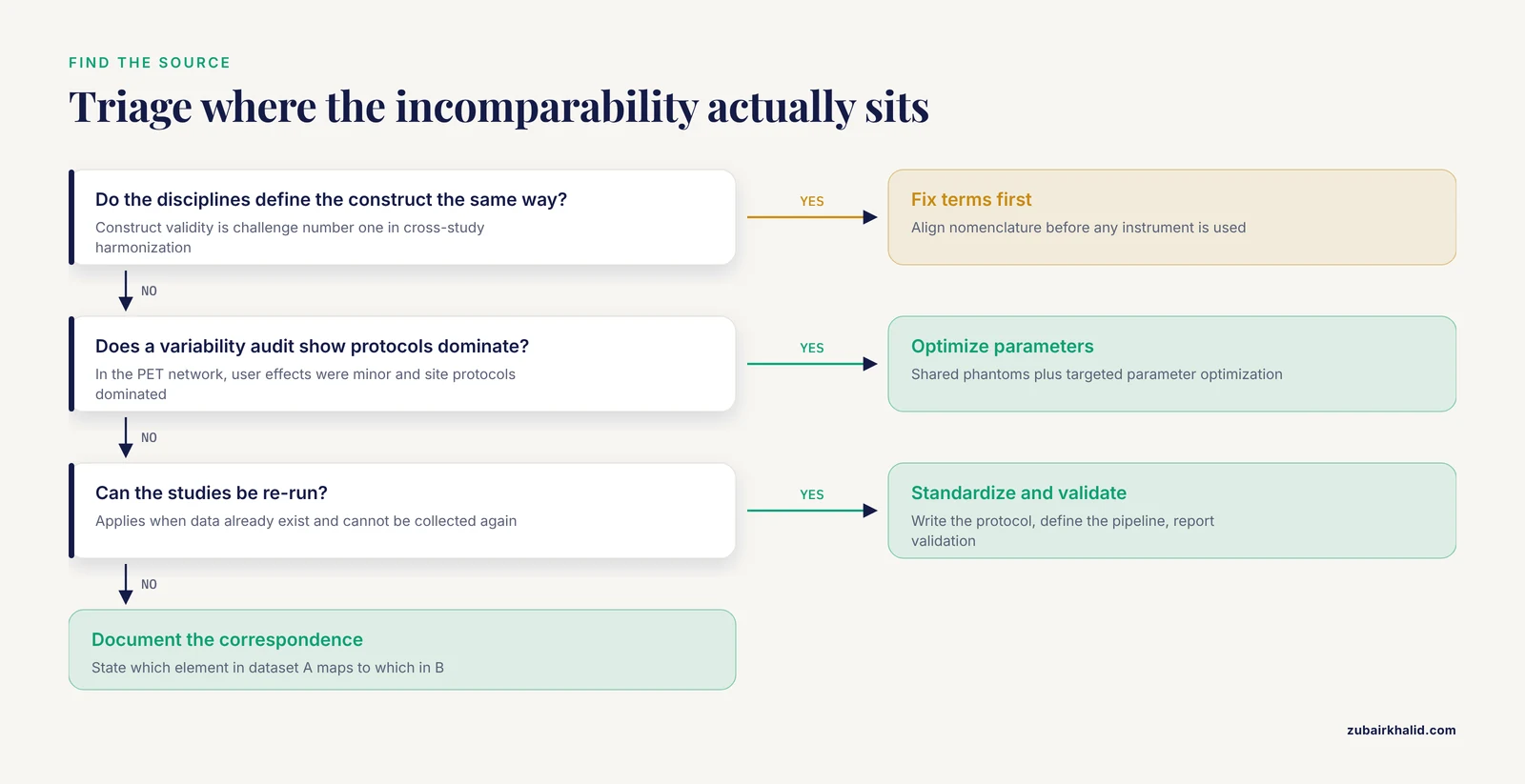
Five questions sort the options quickly.
Where does the variability come from? The PET harmonization study is the cleanest demonstration that this question must be answered empirically. Centralized re-analysis, the intuitive remedy for messy multi-site data, barely moved the needle because users were not the problem. Site-specific protocols were, so parameter optimization was the intervention that worked [5]. Run a small variability audit before committing to any harmonization strategy.
Can the constructs be measured comparably at all? If two disciplines operationalize a construct in incompatible ways, no statistical procedure fixes it. Construct validity is challenge number one in cross-study harmonization for a reason [2]. When constructs are sound but instruments differ, measurement alignment techniques apply. When psychometric properties are missing altogether, harmonization claims must stay modest.
How technique-dependent is the core method? Methods whose outputs depend on operator choices and instrument settings, such as nanoscale property mapping by AFM, need protocol standardization and documented reproducibility as a condition of cross-disciplinary use [7]. Methods with mature standardized outputs need less of this.
Do the disciplines share evaluation metrics? Machine learning research in nursing illustrates a field that has largely converged on metrics: accuracy, area under the receiver operating characteristic curve, precision-recall, and F1-score for classification, and mean absolute or squared error for regression, with supervised approaches predominating [9]. Teams entering such a field should adopt its metrics rather than inventing parallel ones. Fields without converged metrics, by contrast, need the nomenclature and definition work described in Option 2 [1].
Is the team itself aligned? Cross-disciplinary medical education research applies constructive alignment, the principle that objectives, teaching activities, and assessments must point at the same outcomes, through a five-dimensional analytical framework covering driving forces, curriculum restructuring, pedagogical innovation, practical translation, and outcome evaluation [10]. The same logic applies to research teams. If deliverables, timelines, and evaluation criteria are not aligned across disciplines, methodological alignment documents will sit unread.
One more practical note applies when artificial intelligence enters the workflow. Reviews of AI integration in polysaccharide research report that prediction accuracy can exceed 0.95 for tasks such as extraction optimization, well above the 0.7 to 0.8 range of traditional response surface methodology models, while flagging inconsistent data quality across the field as an unresolved challenge [11]. AI amplifies whatever alignment state the underlying data are in, so alignment work becomes more valuable, not less, as teams adopt machine learning components.
Worked Scenarios
Scenario 1: A Multi-Site Imaging Study
Six sites, several scanner platforms, and a plan to pool quantitative results. The wrong sequence is to pool data first and re-analyze centrally when the numbers look scattered. The demonstrated sequence is to distribute identical phantoms, image them under local protocols, measure where the variability actually lives, and then optimize the parameters that drive it. That sequence revealed that user effects were minor, protocol variation dominated, and reconstruction optimization delivered an average 60 percent reduction in inter-scanner variability for the most sensitive metrics [5].
Scenario 2: Clinicians and Engineers Studying Team Performance
A patient safety team combines ethnographic methods with engineering design. The five-step systems engineering framework assigns each method to a stage. Problem analysis uses interviews, focus groups, direct observation, and flow disruption analysis. Design applies design thinking and task analysis, which in the obstetric arm examined the physical characteristics of ten labor and delivery units and found significant heterogeneity in size, design, and organization. Development and testing use simulation, as with the delayed cord clamping cart built to address ergonomic challenges. Evaluation closes the loop. Each discipline sees exactly where its method leads the project.
Scenario 3: A Community With Drifting Definitions
A research community studying related dynamic material systems finds that metrics, definitions, and analysis algorithms differ group to group, blocking cross-study comparison [1]. The community response is a recurring hackathon with flat hierarchy, defined deliverables, and shared code development, which simultaneously trains participants in interdisciplinary collaboration and produces shared analysis software. This is alignment as an ongoing community practice rather than a one-time project step.
Make Correspondence Explicit Before You Compare
A useful principle from computational chemistry generalizes to all methodological alignment. Root-mean-square deviation, a standard structural similarity measure, becomes unreliable when atom-to-atom correspondence between two molecules is ambiguous, when atom ordering is inconsistent, or when alignment introduces chirality inversion. One recent solution, OTMol, formulates molecular alignment as a fused supervised Gromov-Wasserstein optimal transport problem, using the intrinsic geometric and topological relationships within each molecule to establish correspondence in a principled, data-driven way while preserving chirality and bond connectivity [12].
The transferable lesson: before comparing two things across disciplines, establish the correspondence between them explicitly. Which element in dataset A corresponds to which element in dataset B? Which survey item maps to which construct? Comparison without stated correspondence produces numbers that look rigorous and mean nothing.
This principle also governs synthesis. A living systematic review of problems with systematic reviews, updated through May 2025 with 209 additional articles, found that critically low methodological quality and absence of protocols remained among the most frequently reported issues, alongside spin in abstracts and conflicts of interest, notably in evidence underpinning clinical practice guidelines [13]. Registered protocols and transparent correspondence rules are what make cross-disciplinary synthesis trustworthy rather than merely assembled.
Training, Tools, and the Skills of Scientific Collaboration
Alignment is a skill that can be taught, and teams that invest in it move faster. Undergraduate neuroscience curricula that embed short-term research projects in cognitive-behavioral studies, neuroimaging, and neuroanatomy, aligned with theoretical course components across a 12-week semester, give students the practical and analytical perspective needed to generate and interpret new knowledge [14]. In healthcare, a cross-disciplinary review of machine learning in nursing found that limited formal education leaves many nurses hesitant to integrate such tools into everyday care, and it responds by introducing fundamental concepts, evaluation metrics, and applications with nursing-specific examples [9]. Team members do not need to become experts in each other's fields, but they do need structured exposure to the methods their collaborators rely on.
Research collaboration tools support alignment at every stage. Version-controlled protocol repositories serve the role that validated AFM protocols serve within that field [7]. Shared traceability systems, adapted from Lean practice in clinical settings, keep shared resources accountable [8]. Community coding platforms and hackathon infrastructure let distributed groups test shared workflows against common deliverables [1]. Bibliometric and visualization tools, such as co-occurrence network analyses of authors, institutions, and keywords used to map the ciliopathies research landscape, help teams identify which groups and themes are already connected and where new scientific collaboration would fill a gap [15]. Choose tools that encode the agreements you have made, because a tool that enforces a shared data schema prevents more drift than any meeting can.
Common Mistakes and Limitations
Assuming centralized analysis fixes protocol variability. The multi-site PET study showed that centralized automated re-analysis produced only minor reductions in variability while protocol optimization reduced inter-scanner variability substantially [5]. Diagnose the source of variability before selecting the remedy.
Harmonizing data without checking construct validity. Statistical harmonization of instruments that measure different constructs produces precise-looking nonsense. Construct validity heads the challenge list in cross-study harmonization for a reason [2].
Adopting a metric without asking what it captures. Standard metrics can hide meaningful differences. Even voxel-wise versus averaged versions of the same imaging metric respond differently to noise and reconstruction settings [5]. Communities that have not converged on definitions should treat metric selection as a substantive decision, not a formality [1].
Ignoring when data were collected. Temporal differences in data collection are a named harmonization challenge, since context and practice change over the span of a multi-study synthesis [2].
Treating documentation as optional. Absence of protocols is among the most common defects found in published systematic reviews across disciplines and journals [13]. Write the protocol, register it, and version it.
Over-standardizing. Standardization costs effort at every step it touches. Spend it where the planned comparison demands it, guided by a variability audit, rather than everywhere by default.
Expecting shared tools to substitute for shared understanding. Traceability systems and shared pools improved measurable outcomes in the surgical instrument program, but only after a multidisciplinary team agreed on categories and standards [8]. Tools enforce agreements. They do not create them.
A final limitation applies to any guidance of this kind. Every cross-disciplinary team faces a distinct combination of constructs, instruments, contexts, and constraints, so treat the options here as a decision framework to adapt, and validate alignment choices empirically within your own project before committing to them.
Frequently Asked Questions
What does aligning research methodologies across disciplines actually mean?
It means making the questions, terms, measures, and procedures of different fields comparable so their results can be combined and interpreted together. It does not mean forcing every discipline to use identical methods. The goal is comparability where comparison matters, with each discipline's methods retained where they add unique value.
What are the main options for aligning methods across disciplines?
The six main options are a shared conceptual framework, construct and nomenclature alignment, measurement harmonization with shared standards, protocol standardization with validation, statistical harmonization of existing data, and structured collaboration with governance. Most real projects combine two or three, chosen by where the incomparability actually sits.
What are the pros and cons of full standardization versus looser harmonization?
Full standardization gives the strongest comparability for technique-dependent methods but costs the most upfront effort and can waste resources where variability does not affect the comparison. Looser harmonization, such as aligning constructs and nomenclature while leaving protocols flexible, is cheaper and preserves disciplinary strengths but leaves residual variability that must be measured and reported honestly.
Which research collaboration tools support cross-disciplinary work?
The tools that matter most encode your agreements: version-controlled protocol repositories, shared data schemas, traceability systems for shared resources, community coding platforms for joint analysis workflows, and bibliometric mapping tools for identifying collaborators and research gaps. Pick tools that enforce the constructs, metrics, and protocols the team has already agreed on.
How do you handle measures that cannot be standardized across sites?
First find out where the variability actually comes from, since the dominant source may be protocols rather than users or instruments. Where physical reference standards exist, distribute them and optimize parameters against them. Where they do not, document acquisition conditions, test robustness explicitly, and report residual variability rather than claiming equivalence the data cannot support.
Do all team members need training in each other's methods?
No, but every member needs structured exposure to the methods their collaborators rely on, including what the core techniques measure, how outputs are validated, and which evaluation metrics apply. Targeted training, whether through embedded research projects, cross-disciplinary reviews, or collaborative events with defined deliverables, consistently reduces the hesitancy and miscommunication that derail mixed teams.
Sources
- Hacktive matter: data-driven discovery through hackathon-based cross-disciplinary coding.
- Harmonizing quantitative implementation data across studies: challenges and proposed strategies.
- The Value of a Cross-Disciplinary Approach to Human and System Performance Research in Obstetrics and Neonatology: AHRQ's Patient Safety Learning Laboratory.
- Clinical Practice Guideline for Evaluation and Management of Peripheral Nervous System Manifestations in Sjögren's Disease.
- A harmonisation framework for multi-centre preclinical PET imaging across a national research infrastructure.
- Multiparametric Quantitative Ultrasound for Hepatic Steatosis: Comparison with CAP and Robustness Across Breathing States.
- Atomic Force Microscopy for Cross-Disciplinary Materials Research.
- Lean Management of Surgical Instruments in Multidisciplinary Collaboration: Practice Research With Multidimensional Evaluation of Cost and Quality.
- Machine Learning in Nursing: A Cross-Disciplinary Review.
- Chemistry-medicine interdisciplinary integration in medical education: a narrative review of teaching reform, evidence synthesis, and international perspectives.
- Artificial Intelligence Reshaping Non-Starch Polysaccharides Research: A Comprehensive Review of Intelligent Integration From Extraction Optimization to Functional Design.
- OTMol: Robust Molecular Structure Comparison via Optimal Transport.
- What's the meta now? More updates on the problems with systematic reviews.
- Incorporating advanced neuroscience research in undergraduate neuroscience education.
- Research Hotspots and Trends in Ciliopathies: A Bibliometric and Visualization Analysis.