Aligning Your Timeline with Your Specific Aims: A Decision Guide
By Dr. Zubair Khalid, DVM, MS, PhD ·

Your Specific Aims page describes what you will do and why it matters, while your timeline describes when and in what order you will do it, and the single biggest difference between them is that aims argue for significance while the timeline argues for feasibility. The rule of thumb for choosing between timeline structures is simple: if your aims depend on each other, use a sequential timeline, if your aims are independent, use a parallel timeline, and if your project carries real scientific risk, use a milestone-gated hybrid. This guide walks through each option on its own terms, compares them side by side, works through realistic scenarios, and lists the mix-ups that reviewers see most often.
Why the Timeline and the Specific Aims Page Must Match
A grant proposal is read as one document, not as separate sections. A reviewer reads the Specific Aims page first, forms a mental model of the project, and then checks the research strategy and timeline against that model. When the timeline mirrors the aims, the reviewer can trace every aim to a block of time, a set of personnel, and a set of expected products. When the timeline drifts away from the aims, the reviewer starts asking questions the proposal cannot answer: Can this team really do three animal studies in one year? Why does the timeline show a sequencing phase the aims never mention? Is Aim 3 possible if Aim 1 produces a negative result?
This is why aligning your timeline with your specific aims is one of the highest-leverage moves in grant proposal planning. The aims page carries the conceptual load. The timeline carries the credibility load. A brilliant set of aims paired with an impossible timeline reads as a proposal written by someone who has never run the experiments. A modest set of aims paired with a clean, honest timeline reads as a proposal from someone who will actually deliver.
The alignment works in both directions. You start from the aims to build the timeline, but building the timeline often forces you to revise the aims. If you cannot fit Aim 3 into the project period without heroic assumptions, the fix is usually to shrink, merge, or cut Aim 3 rather than to compress the schedule. Many experienced investigators draft the aims page and the timeline together, revising each against the other until they lock.
The Three Main Ways to Align Timeline with Specific Aims
Most funded proposals use one of three timeline architectures. Each one answers a different question about how your aims relate to each other. Understanding the options is the first step in choosing the best way to align timeline with specific aims for your particular project.
Option 1: The Sequential Timeline
In a sequential timeline, your aims run one after another. Aim 1 occupies roughly the first third of the project period, Aim 2 the second third, and Aim 3 the final third. Each aim starts only after the previous one delivers its key output. The timeline reads like a staircase, and the reader can tell at a glance what the lab will be doing in year two.
A sequential timeline fits projects where the aims form a chain of dependency. If Aim 1 generates the reagents, models, or datasets that Aim 2 needs, and Aim 2 produces the results that Aim 3 needs, the sequence is not a stylistic choice. It is the actual logic of the work. Many mechanistic biology projects follow this pattern: build the tool, apply the tool, interpret the results.
Pros of the sequential timeline:
- The proposal reads clearly. A reviewer can follow the logic of the project from the aims page straight through the timeline without effort.
- Budget justification becomes easy. Each project year supports one aim, so personnel effort, animal numbers, and supplies map cleanly onto budget periods.
- Risk concentrates at the front. If Aim 1 fails, you learn early and can redirect before spending the bulk of the award.
- The narrative arc of the research strategy matches the chronology of the work, which makes the whole proposal feel coherent.
Cons of the sequential timeline:
- There is little slack. A six-month delay in Aim 1 pushes everything downstream and can leave Aim 3 starved for time.
- Personnel with skills tied to a later aim sit idle early on, or you must justify their effort in ways that strain credibility.
- Reviewers of fast-moving fields may worry that a rigid sequence ignores the reality that some experiments finish early and some run long.
- The final aim gets the least calendar time, even though it often carries the interpretive weight of the whole project.
Option 2: The Parallel Timeline
In a parallel timeline, all aims start near the beginning and run concurrently through the project period. Each aim appears as its own work stream, with its own personnel and its own milestones, moving forward at the same time as the others. The timeline reads like a set of parallel bars rather than a staircase.
A parallel timeline fits projects where the aims are genuinely independent. Suppose Aim 1 tests a hypothesis in a cell culture system, Aim 2 tests the same hypothesis in an animal model, and Aim 3 analyzes existing human cohort data. None of these aims needs output from another. Running them in parallel uses the full project period for every aim and lets specialized personnel work steadily in their own areas.
Pros of the parallel timeline:
- Every aim gets the full project period, which supports the most ambitious version of each aim.
- Specialized personnel (a bioinformatician, an animal technician, a biostatistician) have continuous, credible effort across all years.
- A setback in one aim does not automatically delay the others, which strengthens the feasibility argument.
- Productivity looks steady. Publications and datasets emerge throughout the project rather than piling up at the end.
Cons of the parallel timeline:
- The proposal can look scattered if the aims lack a unifying intellectual thread. Parallel work streams need a strong integrating hypothesis or the reviewer wonders why the project is one grant rather than three.
- Management burden is high. The principal investigator must juggle several concurrent work streams, and the timeline must show that the team has the bandwidth to do so.
- Budget periods support partial work on several aims at once, which makes itemized justifications longer and more complex.
- If the aims quietly depend on each other after all, the parallel structure hides that dependency and sets up exactly the feasibility criticism the timeline was supposed to prevent.
Option 3: The Milestone-Gated Hybrid
In a milestone-gated hybrid, the aims are grouped into phases, and each phase ends at a decision point defined by explicit milestones. The timeline shows the phases and the gates. A milestone is a concrete, checkable result, such as a validated assay, an enrolled cohort reaching a target size, or a model producing a defined phenotype. At each gate, the project either advances to the next phase or redirects based on what the milestone data showed.
A milestone-gated hybrid fits projects with real scientific uncertainty, where the path from Aim 1 to Aim 2 depends on what Aim 1 finds. It is the structure reviewers often ask for when a project is ambitious. The hybrid tells the reviewer that you have thought about failure modes and planned around them, which is one of the strongest feasibility signals a proposal can send.
Pros of the milestone-gated hybrid:
- It directly addresses risk. Gates show the reviewer where the project could branch and what evidence would trigger each branch.
- It preserves the clarity of a sequential structure while allowing some aims to run concurrently within a phase.
- It protects the budget. Work on an expensive later phase does not begin until cheaper earlier work has cleared its gate.
- Milestones give the project natural checkpoints for reporting, no-cost extensions, and renewal planning.
Cons of the milestone-gated hybrid:
- Milestones must be genuinely checkable. Vague gates such as "optimize the method" weaken the proposal rather than strengthening it.
- The timeline is harder to draw and harder to read, and a confusing hybrid can look like hedging.
- Too many gates make the project look fragile. Too few make it look rigid. Calibrating the number takes judgment.
- Contingency plans attached to gates add length to the research strategy, and length is always under pressure.
Side-by-Side Comparison
The table below is the core of this decision guide. It compares the three options across the criteria that actually decide real choices in grant proposal planning.
| Criterion | Sequential Timeline | Parallel Timeline | Milestone-Gated Hybrid |
|---|---|---|---|
| Core assumption | Aims depend on each other in order | Aims are independent | Key aims carry uncertainty that resolves over time |
| Best-fit project | Mechanistic chain: build, apply, interpret | Multi-model or multi-approach programs | Ambitious projects with genuine branching points |
| Readability for reviewers | Very high | Moderate to high | High if drawn well, low if cluttered |
| Feasibility signal | Strong if dependencies are obvious | Strong if independence is obvious | Strongest, because it shows planned risk management |
| Slack for delays | Low | Moderate | Moderate, with gates absorbing some delay |
| Budget justification | Simple, aim-by-aim per year | Complex, multiple aims per year | Moderate, phase-based |
| Personnel planning | Uneven effort across years | Steady effort across years | Steady within phases |
| Publication rhythm | Back-loaded | Evenly distributed | Phase-linked |
| Main failure mode | One delay cascades through everything | Aims look disconnected | Vague or decorative milestones |
| Worst-fit case | Aims that are actually independent | Aims with hidden dependencies | Simple, low-risk, tightly scripted projects |
How to Choose: The Criteria That Decide Real Choices
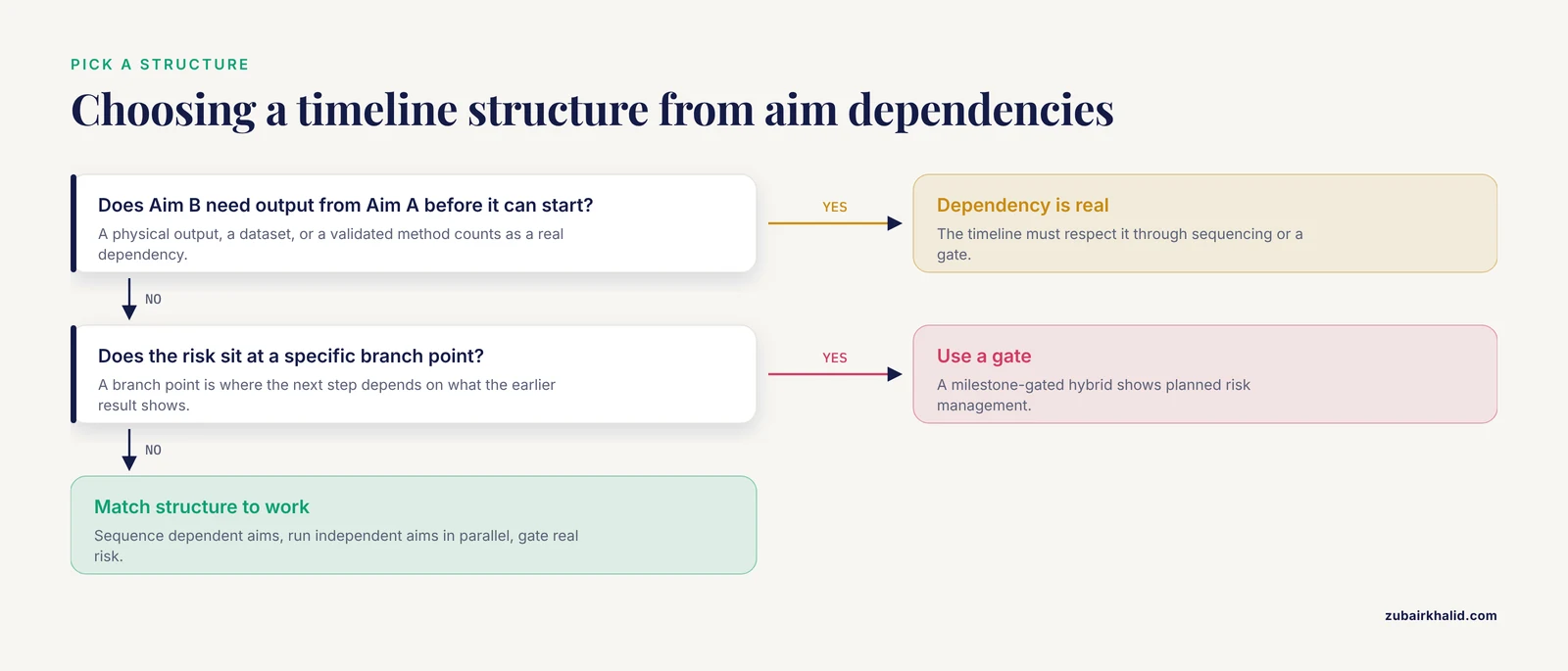
Knowing the align timeline with specific aims grant options is only half the job. The other half is applying the decision criteria honestly to your own project.
Dependency. Ask a direct question about each pair of aims: does Aim B need a physical output, a dataset, or a validated method from Aim A before it can start? If yes, the dependency is real and the timeline must respect it, either through sequencing or through a gate. Dependencies that appear in the research strategy but not in the timeline are a classic red flag. Dependencies that appear in the timeline but not in the aims are a second one. The two sections must tell the same story.
Risk. Ask where the project could fail scientifically. If the riskiest step is also the earliest, a sequential structure surfaces that risk where the reviewer can see it and where you can respond to it. If risk is distributed across aims, parallel work streams with independent fallbacks are more defensible. If the risk sits at a specific branch point, that branch point is your gate, and the hybrid is probably the best align timeline with specific aims grant structure for you.
Resources and personnel. Look at your actual team. A parallel structure presumes enough hands to run several work streams at once. If your team is two people plus students, a parallel timeline with three concurrent aims will not survive a careful read. Similarly, a sequential timeline that leaves your bioinformatician with zero effort for two years invites the question of why that person is on the grant at all. Personnel effort listed in the budget must match the timeline, aim by aim and year by year.
Project duration. Short awards compress everything. A two-year pilot rarely has room for a three-phase gated structure, because phases eat calendar time. Long project periods have the opposite problem, in that a strictly sequential plan can leave the final years looking thin. Duration pushes short projects toward parallel structures and long projects toward hybrids with meaningful later phases.
Reviewer expectations in your study section. Different panels weight feasibility differently. A panel full of trialists will look hard at enrollment milestones. A panel of molecular biologists will look hard at reagent validation. When you know your study section, you know which criterion the timeline must emphasize. Colleagues who have served on the relevant panel, or mentors who have reviewed for it, are the fastest source of that information.
Worked Scenarios
Abstract criteria become concrete in scenarios. These three cover the situations most trainees and early-career investigators face when aligning timeline with specific aims.
Scenario 1: A Five-Year Project with Dependent Aims
Consider a project with three aims. Aim 1 generates and validates a new mouse model. Aim 2 uses the model to test a mechanistic hypothesis in vivo. Aim 3 tests whether a candidate intervention modifies the phenotype identified in Aim 2.
Here the dependencies are physical and unavoidable. Aim 2 cannot start until a validated model exists, and Aim 3 needs the phenotype from Aim 2. A sequential timeline is the honest structure. Year one supports model generation and validation, with validation defined as a checkable milestone, such as confirming the expected molecular change in the target tissue. Years two and three support the mechanistic studies. Years four and five support the intervention studies and the interpretive work.
The weak point of this structure is the end of year one, where a validation failure would cascade. The fix is not to abandon the sequence but to add one element of the hybrid: a small contingency stream, described in one paragraph, covering the alternative model that would be used if the primary one fails. That paragraph costs little space and converts the proposal's biggest weakness into evidence of planning.
Scenario 2: A Two-Year Pilot with Independent Aims
Consider a pilot project with two aims. Aim 1 measures a biomarker in archived patient samples. Aim 2 tests the same biomarker's predictive value in a prospective patient series collected during the award.
The aims share a question but not a workflow. Neither needs output from the other. The best fit is a parallel timeline. Both work streams start in month one. The retrospective arm reports early, which produces a manuscript within the first year and demonstrates productivity at any interim review. The prospective arm runs for the full two years, since recruitment is usually the rate-limiting step.
The main risk here is recruitment falling short. The timeline should show recruitment as an explicit monthly or quarterly target tied to a milestone, and the research strategy should state what the investigators will do if accrual lags, such as widening eligibility criteria or extending follow-up within the project period. This is a lightweight version of a gate, and it is enough for a short award.
Scenario 3: A Career Development Award
Consider a mentored career development award spanning several years, where the aims must build a discrete research program while the candidate also completes training activities. The aims here often have a training logic as well as a scientific one: an early aim uses techniques the candidate already commands, a middle aim builds a new skill under mentorship, and a late aim integrates both into an independent direction.
A milestone-gated hybrid usually fits best. The early aim runs immediately and doubles as a proof of feasibility. The middle aim starts once the candidate has completed the relevant training module, which itself becomes an early milestone. The late aim launches at a gate defined by results from the first two. The timeline shows research blocks and training blocks side by side, so the reviewer can see that the candidate's development and the research plan reinforce each other rather than compete for the same hours. This dual display is what separates a credible career development timeline from a research timeline with training pasted on top.
Common Mix-Ups When Aligning Your Timeline with Your Specific Aims
Certain mix-ups appear again and again in proposals, in the classroom, and in review feedback. Each one is avoidable, and each one is the kind of thing a good research grant writing course drills deliberately.
- The Gantt chart that ignores the aims page. The timeline lists activities (sample collection, data analysis, manuscript preparation) but never names the aims. The reviewer cannot map one onto the other. Label every timeline row with the aim it serves.
- Dependencies stated in prose but invisible in the chart. The research strategy says Aim 2 requires the validated reagents from Aim 1, but the chart shows both aims starting in month one. Whichever section the reviewer checks first, the other contradicts it.
- Personnel effort that contradicts the schedule. The budget charges a co-investigator at a steady effort across all years, but the timeline shows that investigator's aim confined to one year. Either the timeline or the budget is wrong, and the reviewer will assume the worse.
- Milestones that are not checkable. A milestone like "characterize the mechanism" cannot be verified as done or not done. A milestone like "confirm by western blot that protein X is absent in knockout tissue" can be. Reviewers notice the difference, and so will you at your own progress reviews.
- The heroic final year. The timeline compresses the most difficult work, often the human subjects work, into the last year of the project. This is the single most common feasibility criticism in review. Front-load the slowest, riskiest elements, especially anything requiring recruitment, regulatory approval, or long observation periods.
- No mention of what happens if things go wrong. A timeline with no contingency language reads as either naive or dishonest. One or two sentences per gate, or one short contingency paragraph overall, is enough.
- Timeline drift after revision. The investigator revises the aims in response to pre-review feedback but forgets to update the timeline and budget. The resubmission then contains an internal contradiction that was not there before.
Common Mistakes and Limitations
The mix-ups above are craft errors. This section covers deeper mistakes in how people think about timelines, along with the honest limits of any planning method.
Treating the timeline as a formatting chore. The timeline is not the last figure you make before submission. It is a feasibility argument, and it deserves the same drafting and revision cycles as the aims page. Building it early, during grant proposal planning rather than the final week, will change your aims for the better, usually by exposing an aim that cannot be done in the time available.
Confusing calendar time with effort. A year of calendar time is not a year of full-time effort on one aim. Trainees, shared equipment, animal facility scheduling, and regulatory review all consume calendar time without appearing in effort charts. Experienced investigators build invisible overhead into the visible schedule. A useful discipline is to assume that each major experimental phase needs more calendar time than your first estimate, and to check whether the total still fits the project period.
Planning to the best case. A timeline built on the assumption that every experiment works the first time signals inexperience, because every scientist knows that experiments rarely work the first time. The question a reviewer is really asking is not "will everything go right" but "does this investigator know what to do when something goes wrong." Contingency language answers that question.
Over-gating a simple project. The hybrid structure is powerful, and like any powerful tool it gets overused. A project with low scientific risk and a tight script does not need gates, and adding them makes the proposal look unsure of itself. Match the structure to the actual uncertainty in the work.
The limits of any timeline. Even a well-built timeline is a plan for a future you cannot fully observe. Reagents change, key personnel move, equipment queues lengthen, and results point in unexpected directions. The purpose of aligning your timeline with your specific aims is not to predict the future. It is to demonstrate at review time that the project is achievable, and to give yourself a structure you can actually manage against once the award starts. When real events diverge from the plan, the timeline gives you a baseline for reporting, rebudgeting, and requesting extensions.
Individual judgment still applies. Every project, team, and funding mechanism is different, and the decision criteria here interact in project-specific ways. Mentors, program officers, and colleagues who have served on review panels can pressure-test your particular timeline in ways no general guide can. Share the aims page and the timeline together, and ask specifically whether the reader can map one onto the other without effort.
Frequently Asked Questions
How do I align a timeline with specific aims in a grant proposal?
Name each aim explicitly in the timeline, order the work to respect the dependencies between aims, and make sure personnel effort and budget years match the schedule shown for each aim. The timeline should let a reviewer point to any project year and see which aim is active, who is doing the work, and what output is expected.
What is the best timeline structure for a grant with dependent aims?
A sequential timeline is usually the best fit for dependent aims, because it makes the chain of logic visible and concentrates risk where the reviewer can see it. If the first dependent step carries substantial scientific risk, add a single contingency plan or gate rather than restructuring the whole project.
Should grant aims run in sequence or in parallel?
Run aims in sequence when each one needs output from the previous one, and run them in parallel when they are genuinely independent. The test is physical, not rhetorical: ask whether Aim B could begin tomorrow without any deliverable from Aim A. If the answer is yes for every pair of aims, a parallel structure is defensible.
What are the pros and cons of a milestone-gated grant timeline?
The pros are that gates show planned risk management, protect the budget by delaying expensive phases until cheaper ones succeed, and create natural reporting checkpoints. The cons are that milestones must be genuinely checkable, the timeline is harder to draw clearly, and too many gates can make a sound project look fragile.
How detailed should milestones be in a research grant?
Detailed enough that a colleague could verify completion without ambiguity. Each milestone should name the measurable result, the method used to assess it, and the time point by which it is expected. Avoid process milestones such as "optimize" or "characterize" in favor of result milestones such as a validated assay, an enrollment target, or a confirmed phenotype.
Can I change my timeline after the grant is funded?
Yes, within the rules of your funding mechanism, and funders expect timelines to evolve as results accumulate. Most agencies allow rebudgeting, aim adjustments, and no-cost extensions through defined administrative processes, with your program officer as the first contact. A well-documented original timeline makes these conversations easier, because deviations are measured against a baseline you and the reviewer both understood.