How to Use Funding Announcements to Shape Your Research Proposal
By Dr. Zubair Khalid, DVM, MS, PhD ·

By the end of this article you will be able to read a funding announcement the way a reviewer reads it, extract every requirement into a working checklist, map each requirement to a specific section of your proposal, and score a draft for coverage before you submit. You will also know the mistakes that sink otherwise strong applications.
Have these on hand before you start:
- The full call document, including the announcement text, evaluation criteria, budget rules, and eligibility terms
- A spreadsheet program such as Excel, Google Sheets, or LibreOffice Calc
- Python 3 installed if you want to run the scoring script in the walkthrough
- Your draft specific aims or research plan, even if rough
- The funder's strategic plan or published research priorities, if available
Why the Funding Announcement Is a Design Document, Not an Ad
Most early-career researchers treat a funding announcement as a bulletin board notice. They read it once, decide they fit, and write the proposal they were already planning. This habit wastes enormous effort.
A published case analysis of Norway's national AI Center call shows why. The call was written broadly and explicitly included artificial intelligence in education. It drew 50 applications from large consortia spanning multiple disciplines and sectors, and 88 percent were rejected [1]. The authors argue that the breadth of the call, combined with the scale of investment, demanded evaluation processes with deep disciplinary expertise and procedural transparency. For an applicant, the lesson is blunt. A broad call attracts many applicants who each assume they fit, and most of them are wrong in some specific, checkable way that a careful reading of the announcement would have caught.
A funding announcement is a design specification. It tells you what problem the funder believes exists, what evidence the funder will accept, and what a winning application looks like. Treat it like a protocol. You would not run an experiment without reading the method section first. Do not write a proposal without dissecting the call.
This is the core discipline behind the phrase "align research proposal with funding call." Alignment means every major element of your proposal traces back to something the call explicitly asks for, and every explicit ask in the call traces to somewhere in your proposal.
The Anatomy of a Funding Announcement
Before the walkthrough, learn the parts. Nearly every announcement from government agencies, foundations, and internal university programs contains these components.
Call topic and scope. A short statement of the problem area. Read the scope sentence for boundary words such as "including," "such as," and "priority will be given to." These words define the center and edges of the call.
Funder priorities. Many funders publish the strategic thinking behind a call separately. Priority-setting exercises are one source. The James Lind Alliance palliative and end-of-life care Priority Setting Partnership, refreshed between May 2023 and February 2025, collected 1,032 responses to its first survey and 626 to its second, and produced an updated list of 24 research priorities shaped by patients, carers, and professionals [2]. When a funder points to a document like that, the priorities in it are effectively the grading rubric behind the call.
Evaluation criteria and weighting. The explicit list of what reviewers score, sometimes with percentage weights. This is the single most underused section of any call.
Eligibility and formatting rules. Degree requirements, institutional eligibility, page limits, font rules, reference styles, and attachment lists. These are pass or fail gates, not scored content.
Budget rules. Total ceiling, allowable costs, cost-sharing requirements, and project duration limits.
Engagement and translation requirements. Many health and social care funders now require explicit evidence of public or stakeholder involvement in project design. UK and international funders of health and social care research have adopted policies requiring the public voice in project design, and meeting that requirement demands skilled, prepared lay partners rather than last-minute names on a form [3].
Submission logistics. Portal, deadline, letter-of-intent requirements, and review timeline.
Build a separate row in your planning spreadsheet for each of these seven components. The walkthrough below shows exactly how.
Align Your Research Proposal With a Funding Call, Step by Step
This is the working core of grant proposal planning. Each step produces an artifact you can show a mentor or internal reviewer.
Step 1. Read the Call Three Times With Three Different Goals
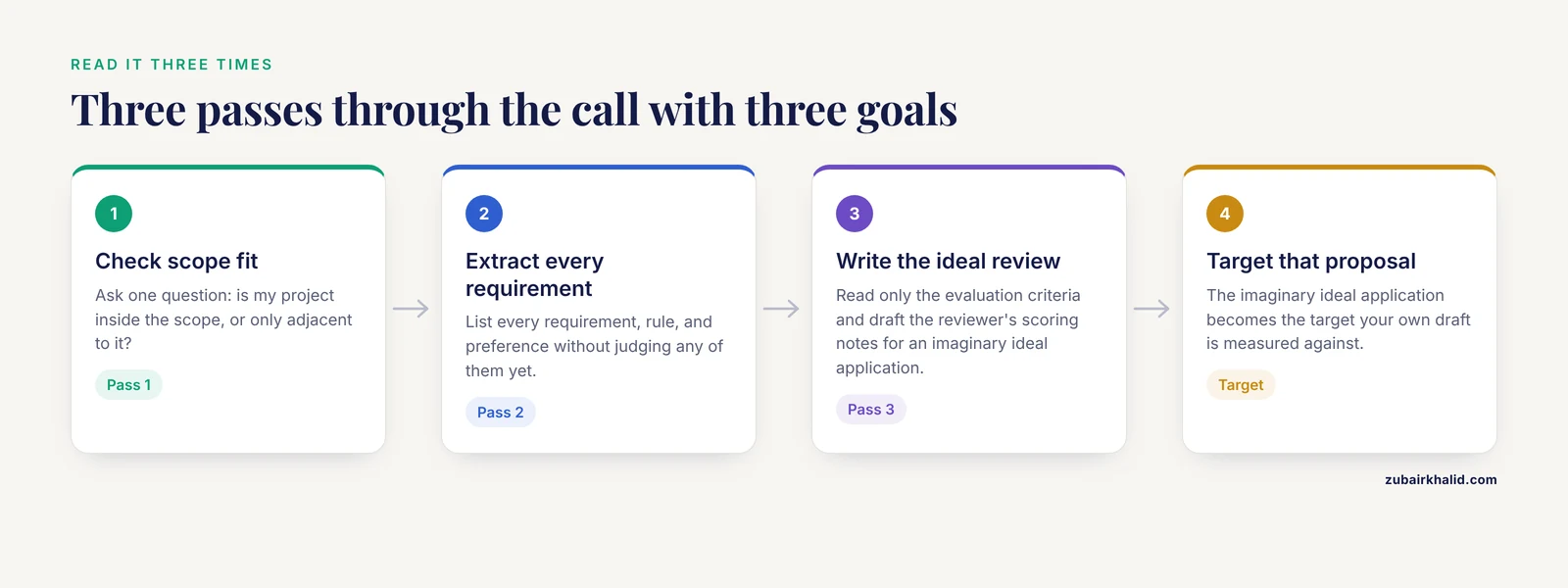
First pass, ask one question: is my project inside the scope, or adjacent to it? Adjacent projects fail at higher rates than clearly in-scope ones. Second pass, extract every requirement, rule, and preference into a list without judging them. Third pass, read only the evaluation criteria and try to write the reviewer's scoring notes for an imaginary ideal application. That imaginary proposal becomes your target.
Step 2. Build a Compliance Matrix
Create a spreadsheet where each row is one requirement from the call and each column tracks where you address it. Save this as a CSV file named call_matrix.csv with this structure:
requirement,call_section,proposal_section,coverage,notes
Proposal addresses at least one stated priority,Scope,Specific Aim 1,full,"Aim 1 quotes priority language verbatim"
Interdisciplinary consortium required,Eligibility,Team and Environment,partial,"Need one partner from a second discipline"
Public involvement evidence,Engagement,Approach - Patient Partners,none,"Contact caregiver organization this week"
Budget within ceiling,Budget,Budget Justification,full,"Currently 92 percent of ceiling"
Data sharing plan required,Rigor,[Data Management](/blog/guides/data-management-basics-principles-processes-and-best-practices),none,"Draft after consulting repository"
The coverage column takes three values: full, partial, or none. The notes column holds your next action for that row.
Step 3. Score Your Draft Against the Evaluation Criteria
Once your matrix has real content, automate the gap check. This short script reads the CSV and reports every requirement you have not fully covered:
import csv

with open("call_matrix.csv", newline="") as f:
    rows = list(csv.DictReader(f))

total = len(rows)
gaps = [r for r in rows if r["coverage"].strip().lower() != "full"]

print(f"Requirements tracked: {total}")
print(f"Fully covered: {total - len(gaps)}")
print(f"Gaps remaining: {len(gaps)}")
for r in gaps:
    target = r["proposal_section"] or "NO SECTION ASSIGNED"
    print(f'- [{r["coverage"].upper()}] {r["requirement"]} -> {target}')
Run it from the folder that contains your CSV:
$ python check_alignment.py
Requirements tracked: 5
Fully covered: 2
Gaps remaining: 3
- [PARTIAL] Interdisciplinary consortium required -> Team and Environment
- [NONE] Public involvement evidence -> Approach - Patient Partners
- [NONE] Data sharing plan required -> Data Management
That output is your writing to-do list. Re-run the script after every revision session. When gaps reach zero and every notes cell contains a completed action, your proposal is structurally aligned with the call. The script does not judge quality. It only guarantees that nothing the call asked for went unaddressed, which is the failure mode you can fully control.
Step 4. Rewrite Your Aims in the Language of the Call
Reviewers scan quickly. If your specific aims use your lab's vocabulary while the call uses the funder's vocabulary, the reviewer must do the translation work, and many will not.
Take the call phrase and mirror its structure. Suppose a call says it seeks work that "demonstrates the economic and societal value of the proposed model of care." A generic aim might read: "Aim 1: Evaluate the intervention's effect on patient outcomes." An aligned aim reads: "Aim 1: Quantify the economic and societal value of the virtual care model, including cost per patient and effects on equity of access." The science is the same. The second version lets the reviewer tick the box without effort.
This principle applies across fields. In mHealth research for cancer in low and middle income countries, an analysis of research and development priorities argued that researchers should leverage technologies proven for other conditions and align delivery with local context through human centered design, rather than reinvent tools [4]. A proposal that echoed that alignment language, naming the existing technologies it would adapt and the local context it would serve, would map directly onto those published priorities. A proposal that described a novel app from scratch would not.
Step 5. Budget for What the Call Values, Not Just What the Lab Needs
Funders signal what they will pay for, and a budget that ignores those signals reads as naive. Two patterns appear repeatedly in modern calls.
First, engagement costs real money and real time. A user-centered design study that recruited 25 family caregivers as equal partners in co-design research found that recruitment through caregiver agencies was the most efficient and effective mechanism, but the work of building relationships, aligning values, and establishing trust with those agencies required considerable time [5]. The authors drew explicit implications for funding agencies on this point. For you, the implication runs the other way: if your call values co-design, your budget must show line items and hours for that relationship work, not a vague "community engagement" total.
Second, measurement burden is a budgetable problem. In oncology value-based payment programs, stakeholders identified patient burden, survey fatigue, and provider resource constraints as implementation barriers to patient-reported measures, and recommended designing programs with scientifically sound measures standardized to reduce burden [6]. If your call involves collecting patient-reported outcomes, budget for survey administration time and for minimizing respondent load. Show the reviewer you anticipated the barrier they know exists.
Step 6. Plan for Open Science and Rigor Requirements
Many funders now expect preregistration, open materials, open data, and adequately powered designs. These expectations have an evidence base. A rejoinder to critics of open science practices argued that preregistration, high statistical power, and independent direct replications are exactly what raise the rate of true discoveries, and that pragmatic concerns about these practices have available solutions and are overstated [7]. When a call asks for a data sharing plan or a power analysis, treat the ask as a scored element. State your sample size rationale, name your repository, and specify what you will preregister. Vague sentences such as "data will be made available upon reasonable request" score poorly against a call that asked for a concrete plan.
Step 7. Ground the Project in Demonstrated Demand
Reviewers favor proposals that show the target population actually wants the solution. Mixed-methods demand analysis is one template. A study of transitional care after minimally invasive cardiac intervention surveyed 137 patients across four hospitals and used the Kano model to classify demands, finding no "must-be" demands, which indicated patients had grown accustomed to a lack of post-discharge guidance, while health monitoring, medication guidance, symptom management, and personalized exercise plans emerged as "one-dimensional" demands that strongly affect satisfaction [8]. A proposal built on that finding could justify each intervention feature by pointing to a measured demand category. That is what demand grounding looks like: the call's scope statement, plus evidence the need is real and characterized, plus features matched to that evidence.
Step 8. Show the Partnership Architecture the Call Implies
Some calls implicitly, or explicitly, favor consortia and networks over single-lab projects. Practice-based research networks illustrate why. A network for community-based clinical research in otology and neurotology, called the CHEER Network, was built on the premise that strategic alignment between a research network and an established research infrastructure creates a framework for successful competition for research funding in hearing and balance disorders [9]. If your call mentions consortia, networks, or multi-site delivery, name your partner sites, describe the infrastructure each contributes, and explain how the pieces connect. A consortium listed without an operating structure is a red flag to experienced reviewers.
Large initiatives follow the same logic. A proposed interoperability moonshot, developed from an expert roundtable and structured appraisal of standards and policy, identified five barrier domains including fragmented terminology standards, overlapping exchange standards, and insufficient funding, then organized recommendations around them [10]. Notice the architecture: barriers first, then recommendations mapped one to one. That structure, barriers mapped to solutions, is exactly what reviewers want to see in a proposal responding to a strategic call.
Practical Tips for Aligning a Research Proposal With a Funding Call
These tips separate proposals that merely comply from proposals that win.
Quote the call sparingly and precisely. One or two verbatim phrases from the call, placed where you address them, outperform scattered keyword stuffing. Reviewers notice genuine alignment and notice performative alignment faster.
Mirror the evaluation criteria as section headers. If the call weights "scientific quality" at 40 percent and "impact" at 30 percent, make sure a reviewer can find those two things in under thirty seconds. Headings do that work.
Use published priority lists as a pre-writing source. Priority-setting partnerships publish their outputs precisely so researchers and funders can act on them. The palliative care refresh described above explicitly framed its 24 priorities as a call to action for researchers and funders [2]. Similarly, stakeholder workshops on virtual care identified sustaining and scaling priorities, including a common framework for evaluating and comparing virtual care services and integration between acute and primary care [11]. Building your aims from published priorities puts your proposal on the funder's own map.
Engage stakeholders as design partners, not subjects. Research priority-setting work and co-design literature converge on this point. In oncology measurement programs, a key recommendation was to engage patients throughout measure and program development and evaluation [6]. In virtual care, the stakeholder group included innovation deliverers, innovation recipients, and implementation facilitators, and the priorities that emerged reflected all three perspectives [11]. Your proposal should describe who shaped the design, not just who will be enrolled.
Assign one person to own compliance. Formatting errors, missing attachments, and eligibility misses are the cheapest failures to prevent. Give a co-investigator or research administrator the compliance matrix and the authority to block submission until gaps close.
Write the reviewer's summary sentence yourself. After drafting, write one sentence a reviewer could copy into their notes: "This application responds to priority X of call Y using method Z with partners A and B." If you cannot write that sentence, the reviewer cannot either.
Common Mistakes and Limitations
Assuming fit because the topic overlaps. The Norwegian AI Center case is the cautionary example. A broad call that explicitly named artificial intelligence in education still produced an 88 percent rejection rate across 50 applications from large consortia [1]. Overlap with the topic is not fit with the call. Fit means matching the scope sentence, the evaluation criteria, and the intended deliverables simultaneously.
Recycling a proposal from a different funder. Reviewers can identify a repackaged application within the first page. The aims stay identical, only the framing sentence changes. Restructure the aims around the call's own logic instead.
Ignoring weighting in the evaluation criteria. If impact carries more weight than track record, an early-career applicant should spend more words on impact. Applicants often allocate words by habit rather than by weight.
Treating engagement as decoration. A paragraph naming patient partners, with no budget lines, no recruitment method, and no decision-making role, fails the requirement it was written to satisfy. The recruitment study cited above showed that working through established agencies demands time for building relationships and trust before the research starts [5]. Describe that work concretely, including when it happens in the project timeline.
Writing aims no stakeholder asked for. Priority-setting exercises exist because funders want research anchored in stated needs. Proposals disconnected from documented priorities compete against proposals that quote them.
Underestimating the consortium overhead. Multi-partner applications carry coordination costs that single-site budgets hide. Budget for meetings, data transfer agreements, and partner compensation.
Discarding the feedback after rejection. The Norwegian case analysis argued that even unsuccessful applicants can gain meaningful reflection, learning, and improved proposal competence when evaluation feedback is thorough and well-substantiated, and noted that the substantial aggregate investment in proposal development, equivalent in one case to roughly half a full-time work year, should generate learning [1]. When you receive reviewer comments, put them into the same compliance matrix. They are requirements from the most informed reader your proposal will ever get.
One limitation to hold in view. Calls differ widely in format, criteria, and review culture, and no single alignment procedure guarantees funding. Reviews also depend on reviewer expertise and panel composition, which applicants cannot control [1]. Alignment raises your probability of success. It does not make outcomes predictable.
Building the Skill Over Time
Alignment is a learnable craft, and structured training accelerates it. A formal research grant writing course typically teaches call analysis, aim construction, budget justification, and reviewer psychology in one curriculum, which is faster than learning each through failed submissions. Pair any course with practice: take one live call, complete the full walkthrough above, and have a senior colleague read your compliance matrix before you write a word of prose. Most universities also run internal mock review panels. Volunteering to review colleagues' drafts teaches you the reviewer's side of the transaction, and that perspective is the fastest route to writing proposals that score well.
Frequently Asked Questions
How far before the deadline should I start grant proposal planning?
Start at least three to six months before the deadline for a standard investigator-initiated proposal. The compliance matrix, partnership building, and budget work all take longer than the writing itself, and engagement partners need lead time to commit.
What does "align research proposal with funding call" mean in concrete terms?
It means every requirement and preference in the call maps to a specific, locatable part of your proposal, and every major proposal element traces back to an explicit ask in the call. The compliance matrix in this article is the working tool for checking both directions of that mapping.
Should I change my research question to fit a funding call?
Change the framing, deliverables, and design, not the core question. If your question genuinely sits outside the scope, submit it to a better-matched call rather than bending the science to fit, because mismatched projects score poorly even when the science is sound.
How do I find funding announcements worth reading?
Monitor funder websites, your institution's research office digest, and colleagues in your subfield. Read calls even in months you do not plan to apply, because priority language repeats across cycles and early reading improves later proposals.
What should I do when a call is broad and my project fits only partly?
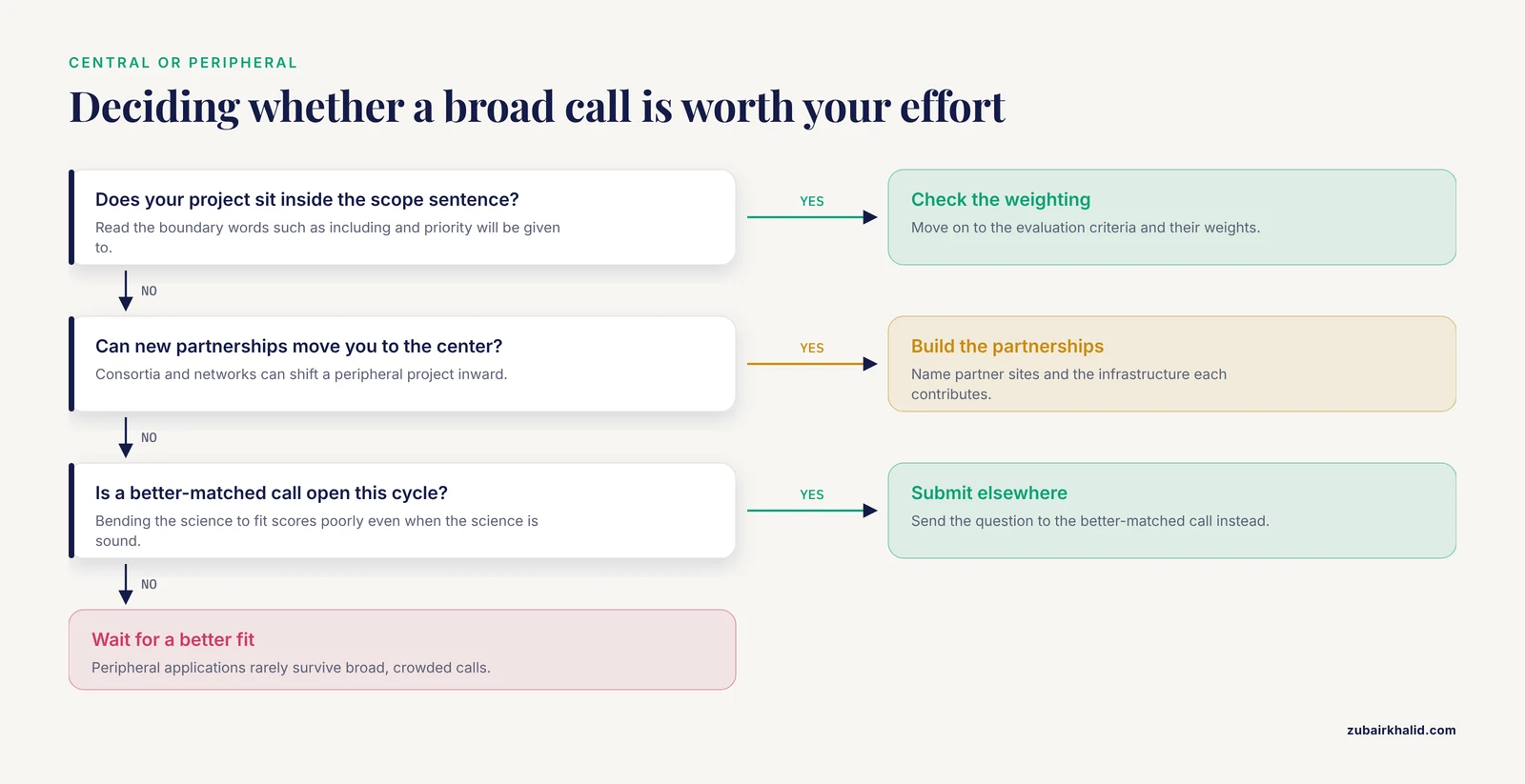
Read the scope sentence and the "priority will be given to" language closely, and decide honestly whether you are central or peripheral. In broad calls with high rejection rates, peripheral applications almost never survive review, so either build the partnerships that move you to the center or wait for a better-matched call.
How much detail should the budget justification contain?
Enough that a reviewer can verify every major line item against a stated activity in the research plan, including personnel effort, engagement costs, and data or dissemination expenses. A justification that merely lists costs without tying them to aims signals weak planning.
Do rejected applications have any value?
Yes. Thorough, well-substantiated reviewer feedback can generate real reflection, learning, and improved proposal competence for unsuccessful applicants, so mine the comments and reuse them to revise the compliance matrix for the next submission.
Can a research grant writing course help, or is practice enough?
A structured course compresses years of trial and error into taught principles on call analysis, aim writing, and budget justification. Combine it with live practice on a real call and feedback from experienced reviewers, because the skill is ultimately built through reviewed drafts.
Sources
- Trust, transparency, and disciplinary alignment in research funding evaluations: an illustrative case from the Norwegian AI Center call (2024-2025).
- Setting research priorities for palliative and end-of-life care: a James Lind Alliance Priority Setting Partnership Refresh.
- Partners in projects: preparing for public involvement in health and social care research.
- Mobile health for cancer in low to middle income countries: priorities for research and development.
- Recruitment of caregivers into health services research: lessons from a user-centred design study.
- Improving patient-reported measures in oncology: a payer call to action.
- Benefits of open and high-powered research outweigh costs.
- Demand analysis of transitional care for patients undergoing minimally invasive cardiac interventions with AI-driven solutions: a mixed-methods approach.
- Building a national research network for clinical investigations in otology and neurotology.
- An Interoperability Moonshot Proposal.
- Defining a core set of research and development priorities for virtual care in the post-pandemic environment: a call to action.