Authorship Ethics in the Age of AI
By Dr. Zubair Khalid, DVM, MS, PhD ·

AI authorship ethics is the branch of research ethics that decides who earns credit for scholarly work, and who answers for its accuracy, when artificial intelligence tools help produce it. The rule that major editorial bodies have converged on is direct: AI cannot be an author, because authorship requires accountability for the finished work, and only a human can accept that responsibility.
Generative tools now draft manuscripts, clean datasets, write analysis code, and summarize literature in seconds. That capability has collided with authorship traditions built over decades, and publishers, editors, and institutions have responded with new rules. This guide explains what AI authorship ethics means, where the rules come from, how to comply with them, and where genuine uncertainty remains.
What Does AI Authorship Ethics Mean?
Research ethics is a code of what is morally and legally right or wrong in the conduct of research, a moral code for the responsible conduct of research [1]. Authorship ethics is one of its core components, concerned with granting credit to the people who make intellectual contributions to a project and withholding it from those who do not [2].
AI authorship ethics extends those principles to machine tools. It asks three questions that older guidelines never had to answer:
- Contribution. Does output from a model count as an intellectual contribution, the kind that traditionally earns a place on the byline?
- Accountability. Who is responsible when AI-generated text contains an error, a fabricated citation, or a copied passage?
- Transparency. What must authors tell editors and readers about how the work was produced?
AI authorship ethics, explained in one sentence, comes down to this: machines can help with the work, but humans take the credit and humans carry the blame. Current policy treats an AI tool as an instrument, closer to a statistical software package than to a collaborator.
The topic sits apart from adjacent debates about AI in peer review or AI in data analysis. Those raise their own questions, but AI authorship ethics is specifically about the published record: who is named, who is responsible, and what readers are told. Authorship ethics in the age of AI therefore has two jobs, protecting honest contributors from losing credit and protecting readers from unverified machine output.
Why Authorship Rules Exist
Authorship is both a reward and a burden. It signals who did the work, and it binds those people to the paper's claims. Scholars of publication ethics describe authorship and contributorship as among the most important, sensitive, and complex areas of academia, demanding critical awareness from authors, editors, and readers alike [3].
The International Committee of Medical Journal Editors (ICMJE) sets the criteria most biomedical journals use. All four must be met:
- Substantial contributions to the conception or design of the work, or to the acquisition, analysis, or interpretation of data.
- Drafting the work or revising it critically for important intellectual content.
- Final approval of the version to be published.
- Accountability for all aspects of the work, including ensuring that questions about the accuracy or integrity of any part are properly investigated and resolved.
The fourth criterion is the one that excludes machines. A language model cannot investigate concerns about its own output, answer for errors, or approve a manuscript. Recent updates to the ICMJE recommendations explicitly address artificial intelligence alongside authorship, conflict of interest disclosure, data sharing, and predatory journals, and they reinforce that accountability rests with humans [4].
When these rules break down, the violations have names:
- Ghost authorship. A person who contributed substantially, often a professional writer or an early-career researcher, is left off the byline [2].
- Gift or guest authorship. Someone who did not meaningfully contribute is listed anyway, sometimes a senior colleague or a favor for a friend [2].
- Plagiarism, fabrication, and falsification. Using others' words or ideas without credit, inventing data, or manipulating results, the violations most consistently identified as threats to publication integrity [5], [6].
These are not victimless shortcuts. Editorial guidance on research integrity warns that unethical authorship and related misconduct are serious mistakes that can damage an author's reputation and career [7].
What Generative AI Changed
Large language models (LLMs) differ from every previous writing technology. Word processors, citation managers, and grammar checkers assisted the writer, but no earlier tool composed and shaped the message itself the way LLM-based AI does [8]. An LLM generates text by predicting, token by token, what plausibly comes next given its training data and the user's prompt. It keeps no faithful record of its sources, has no stake in the paper's claims, and cannot verify anything it writes. Fluent, confident prose can contain invented facts and fabricated references, which is why every sentence of AI output needs human verification.
The scale of the shift is visible in a 2023 experiment by McGuire, who published a position paper generated by ChatGPT 3.5 arguing for redefinitions of plagiarism and co-authorship in higher education, then added her own human reflection comparing the composing processes behind each version [8]. The exercise captures the core tension. AI can now produce publishable-looking argument, so the line between assistance and authorship must be drawn by policy and honesty rather than by technical limits.
AI also introduces subtler forms of copying. Researchers in Kenya describe "algorithmic plagiarism", where AI tools recombine or generate text without clear provenance, alongside concerns about data sovereignty, meaning the extraction of local and indigenous knowledge by globally trained models [9]. Their analysis of the Kenya National AI Strategy 2025-2030 argues that ethics must be treated as a prerequisite rather than an afterthought in AI-assisted research.
The Official Positions on AI and Authorship
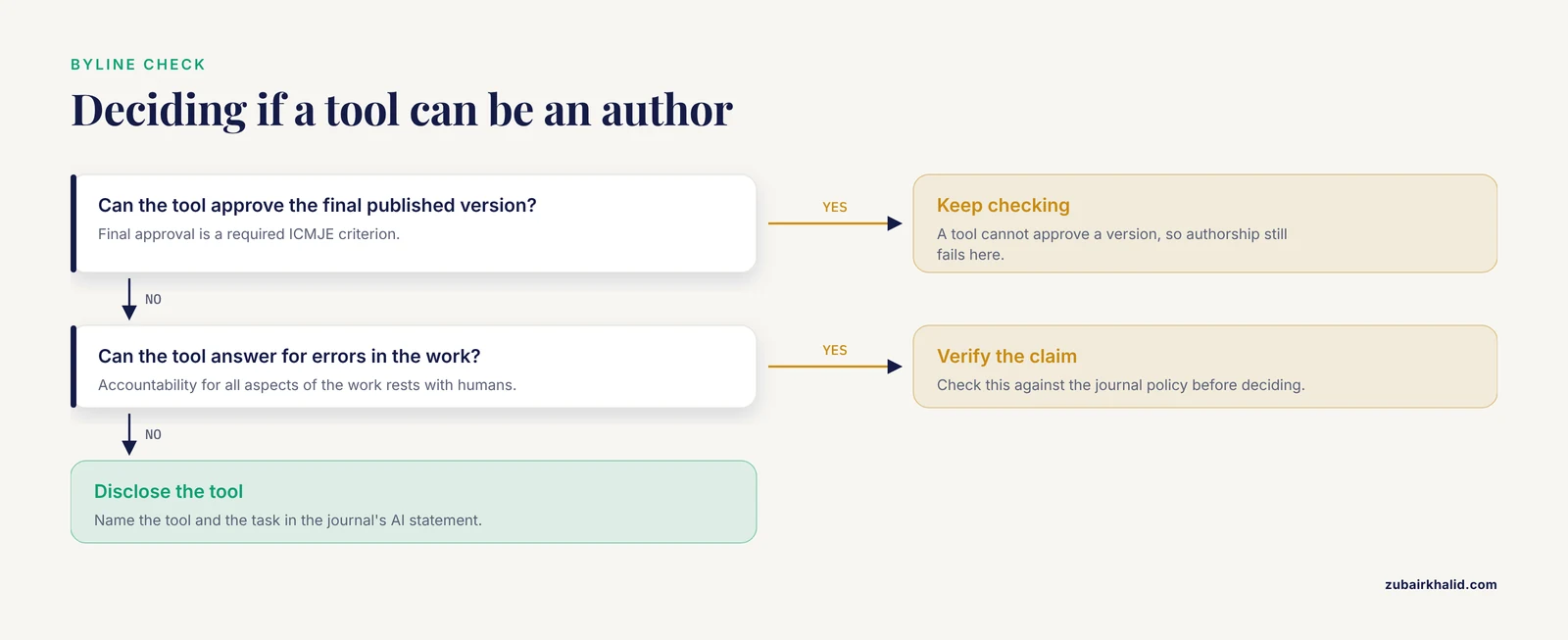
The ICMJE recommendations, the framework many medical journals adopt, now cover the use of artificial intelligence as part of a broader update addressing authorship, disclosure, data sharing, and open access risks [4]. At the journal level, recommended AI governance has three parts: mandatory disclosure of AI use, prohibition of AI authorship, and documented human verification of AI-assisted content [10]. From the publishers' side, authorship and contributorship remain a priority area where authors, editors, and readers all need critical awareness [3].
The practical upshot fits into a short table:
| Question | Human author | AI tool |
|---|---|---|
| Listed in the byline? | Yes, when all four ICMJE criteria are met [4] | No, journal governance prohibits AI authorship [10] |
| Approves the final version? | Yes, this is a required criterion [4] | No, it cannot approve or verify anything |
| Responsible for errors? | Yes, for all aspects of the work [4] | No, accountability stays with the human authors [10] |
| How is the contribution recorded? | Byline and contributorship statements [3] | Separate AI use disclosure [10] |
| Can hold copyright? | Yes | No |
Where AI Use Fits: Assistance Versus Contribution
Not every use of AI raises the same concerns. An analysis of AI in biological publishing argues that using AI to assist with drafting, linguistic editing, and organizing text, tables, and figures is ethically comparable to established editorial support services, provided its use is transparently disclosed and full accountability remains with the human authors [10]. The same analysis notes that academic dishonesty predates AI, since fabrication, plagiarism, and ghost authorship largely reflect distorted "publish or perish" incentives rather than technological novelty.
A practical dividing line looks like this:
Disclosed assistance, generally acceptable. Grammar and style editing, reformatting tables, tightening prose you wrote, generating code comments, or summarizing your own draft for an abstract.
Human work, never delegable. Forming hypotheses, designing experiments, interpreting results, deciding what the paper claims, responding to reviewers, and approving the final version. These are the intellectual contributions that authorship exists to credit [11], [2].
The distinction matters because disclosure alone does not transfer responsibility. A disclosed AI error is still the authors' error [10].
Can AI Help Resolve Authorship Disputes?
A cross-sectional study compared two LLMs, Google Gemini 2.5 Flash and DeepSeek-V3.2, against expert Committee on Publication Ethics (COPE) forum responses across 12 authorship and contributorship cases, using three prompting strategies (minimal, deterministic, and stochastic) and scoring responses in seven domains on a 5-point scale [12]. Both models earned perfect scores (5 ± 0) for actionability of recommendations and high marks for safety and avoidance of hallucination (4.88 ± 0.33). They were weakest at identifying the ethical issue in the first place (Gemini 3.91 ± 1.33, DeepSeek 3.82 ± 1.29). Prompt quality mattered: under minimal prompts, Gemini's ethical identification dropped to 3.55 ± 1.44, compared with 4.09 ± 1.3 under deterministic or stochastic prompts. Gemini showed an 8% major disagreement rate with COPE, DeepSeek a 16% combined rate of minor and major disagreements, and the differences between the models were not statistically significant.
The lesson for authors and editors is to treat AI as a first-pass adviser, not an arbiter. It can suggest concrete next steps, but it often misses the actual ethical problem, so confirm its advice against COPE resources or your institution's research integrity office.
The Systemic Pressures Behind Authorship Problems
Authorship violations rarely come from confusion alone. They grow out of incentives. Graduate students illustrate the pattern. A content analysis of 10 refereed communication and media journals from 2007 to 2016 found graduate students in approximately 23% of sampled articles, most often as lead authors on multiauthored papers, and the study's authors note that if expectations to secure lead authorship keep rising, students need to assess and negotiate authorship based on intellectual contributions, tasks, and sustained commitment [11].
The AI sector adds its own pressures. The research landscape is shaped by the immense capital required for large-scale model development, a funding-driven paradigm that prioritizes capability over questions of societal cost. Roughly 70% of AI PhDs enter industry while about 20% enter academia, according to the AI Index Report (2023) cited in that analysis, and critical research such as bias audits or environmental impact studies presents legal and reputational risks to funders, creating an incentive gap [13]. For authorship ethics, the consequence is that the people best positioned to scrutinize how these tools work are structurally outnumbered, so authors cannot outsource their judgment to the tools' developers.
Even the rules themselves are hard to find. An analysis of the author guidelines of 163 journals where academics at a research-intensive university published in 2022 found that guidelines are not consistently clear and the information is not easily accessible [14]. Guidance on publication ethics keeps shifting as journals respond to new questionable practices, which leaves authors to check policies journal by journal [15], [16].
A Practical Workflow for AI-Assisted Manuscripts
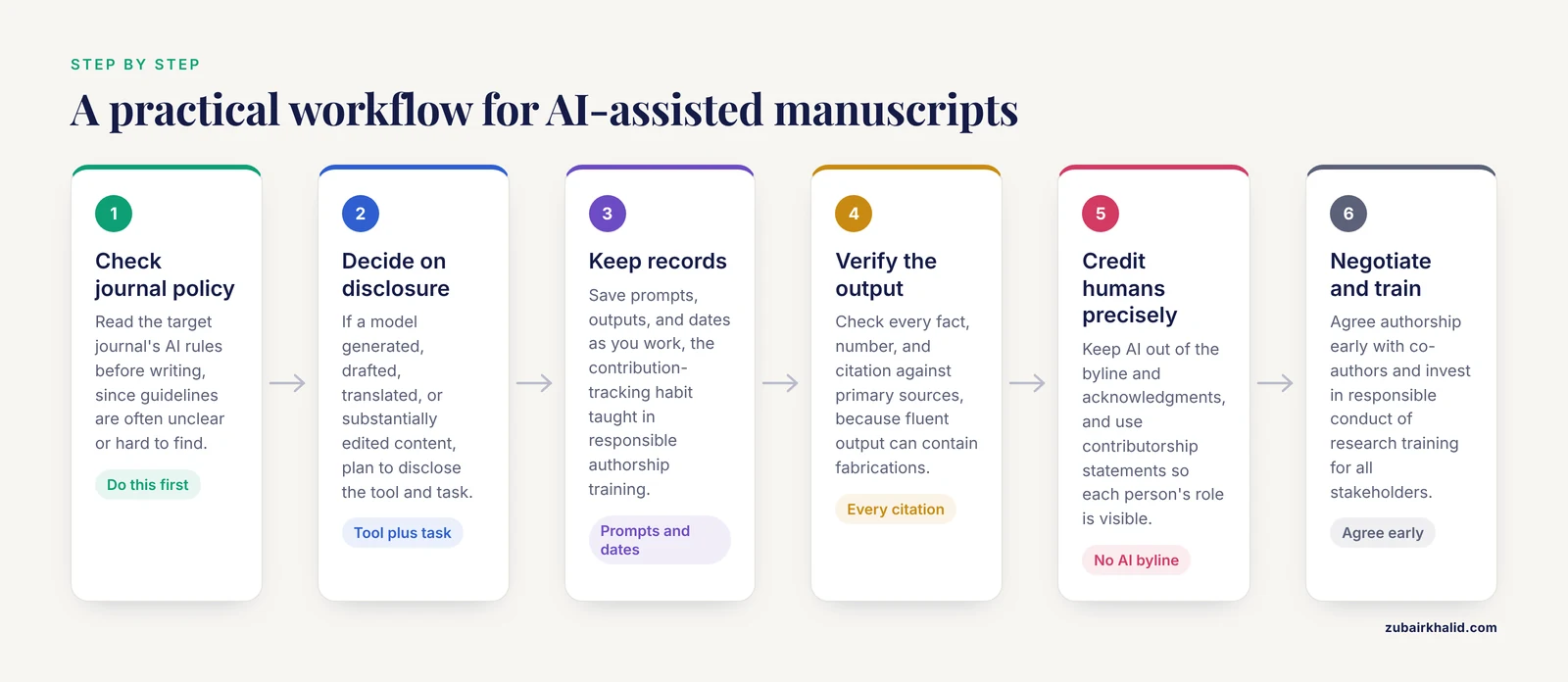
- Check the target journal's AI policy before you write. Policies are not uniform, and journal guidelines are often unclear or hard to locate, so look early rather than at submission time [14].
- Decide which tasks need disclosure. If a model generated, drafted, translated, or substantially edited any content, plan to disclose the tool and the task in the section the journal specifies [10], [4].
- Keep records as you work. Save prompts, outputs, and dates, the same contribution-tracking habit taught in responsible authorship training [2].
- Verify everything the model produced. Check every fact, number, and citation against primary sources, because fluent output can contain fabrications.
- Keep AI out of the byline and the acknowledgments. Journal governance prohibits AI authorship, and crediting a tool as a contributor misstates who is accountable [10].
- Credit humans precisely. Use contributorship statements so each person's role is visible, which addresses ghost and gift authorship directly [3], [2].
- Negotiate authorship early. Agree with co-authors on contributions, order, and AI use at the start of the project, not after the draft exists [11].
- Invest in training. Instruction in responsible conduct of research, including authorship ethics, is recommended for every stakeholder in the research community, from students to supervisors [1], and structured teaching activities have improved student understanding of authorship criteria and contribution tracking [2].
Common Mistakes and Limitations
- Assuming one universal policy exists. Journals differ, and their guidelines are frequently unclear or hard to find, so the only safe assumption is that each venue must be checked individually [14].
- Treating disclosure as a license. Disclosing AI use satisfies transparency, but accountability for accuracy and integrity remains with the human authors [10].
- Pasting unpublished data into public chatbots. AI-assisted research raises data sovereignty concerns, including the extraction of local knowledge by globally trained models, so sensitive or community-held data deserves the same caution as any other disclosure risk [9].
- Believing AI output is plagiarism-free by default. Generated text can reproduce training material or recombine sources without attribution, the pattern described as algorithmic plagiarism [9].
- Asking AI for ethics advice with vague prompts and trusting the answer. Prompt quality changed ethical identification scores in the COPE comparison, and both models were weakest at spotting the ethical issue itself [12].
- Leaving authorship decisions until the manuscript is done. Late negotiations breed disputes, and early agreements based on intellectual contributions prevent them [11].
- Confusing writing help with intellectual contribution. Language editing earns acknowledgment or disclosure, not authorship, which is reserved for those meeting the contribution criteria [4], [2].
One limitation deserves a plain statement. This article explains the rules and the evidence behind them, but individual authorship disputes and suspected misconduct are resolved through institutional processes and journal editorial procedures, not through general guidance.
What Is Still Uncertain
Several questions remain open. Disclosure norms have not settled, because journals are still deciding where AI declarations belong and what wording they require. Definitions may move, since proposals to redefine plagiarism and co-authorship for the LLM era are actively debated rather than adopted [8]. The peer review system faces its own strain, with rapid growth in publication output intensifying the reviewer bottleneck, and proposals such as machine-readable extensions to the IMRAD format and better reviewer incentives are still experimental [10]. How national data sovereignty rules will interact with globally trained models is also unresolved, a question now being framed in national strategies such as Kenya's [9].
Frequently Asked Questions
What does AI authorship ethics mean?
It is the part of research ethics that governs credit, accountability, and disclosure when artificial intelligence tools help produce scholarly work. The core rule is that AI cannot be an author, and humans remain fully responsible for the published work.
Can ChatGPT or another AI tool be listed as an author?
No. Journal governance prohibits AI authorship, and a tool cannot meet the accountability requirement in the ICMJE criteria. Disclose the tool's role in a designated statement instead.
Do I have to disclose AI use for grammar and editing?
Yes, whenever the journal's policy covers language editing, and many now do. Name the tool and the task, then verify every sentence yourself before submission.
Is AI-assisted writing plagiarism?
It can be. Presenting AI-generated text as your own original writing, or using AI to recombine other people's ideas without attribution, fits the pattern of algorithmic plagiarism. Disclosed assistance with your own content is a different, generally acceptable use.
Who is accountable when AI introduces an error or a fake citation?
The human authors. Disclosure does not transfer responsibility, and documented human verification of AI-assisted content is now part of expected journal governance.
What are the ICMJE authorship criteria?
Four requirements that all must be met: substantial contribution to the conception, design, data, or interpretation of the work, drafting or critical revision, final approval of the published version, and accountability for all aspects of the work.
What are ghost, gift, and guest authorship?
Ghost authorship leaves a real contributor off the byline. Gift or guest authorship adds someone who did not meaningfully contribute. All three patterns violate authorship ethics.
Can AI tools help resolve an authorship dispute?
They can offer a useful first pass. In a comparison against COPE forum responses, two LLMs gave highly actionable recommendations but were weakest at identifying the ethical issue itself, so confirm their advice with human experts.
Sources
- Legal Research Methodology: Research Ethics and Unethical Practices in Authorship and Publication
- Activity for CUREs to increase student understanding and application of responsible authorship and publication practices
- Authorship and Contributorship in Publication Ethics and Guidelines: The Publishers’ Perspective
- Enhancing Research Integrity and Publication Ethics: An Analysis of the Latest International Committee of Medical Journal Editors Recommendations
- VIOLATION OF PUBLICATION ETHICS, AUTHORSHIP AND CONTRIBUTORSHIP: RULES
- How Can Occupational Medicine Research Ensure it Adheres to Research and Publication Ethics?
- Potentially Dangerous Mistakes in Publication Ethics: Unethical Authorship
- Leveraging ChatGPT for Rethinking Plagiarism, Digital Literacy, and the Ethics of Co-Authorship in Higher Education
- Ethics as a Prerequisite: Navigating Plagiarism and Data Sovereignty in AI-Assisted Research in Kenya
- When Form Intersects with Automation: Ethics, Authorship, and the Future of IMRAD.
- Navigating the Decisions and Ethics of Authorship: An Examination of Graduate Student Journal Article Authorship
- Navigating the ethical landscape of scholarly publishing: a comparative evaluation of Gemini and DeepSeek LLMs in addressing authorship and contributorship disputes
- Navigating Authorship and Ethics: A Framework for Evaluating Human-AI Collaborative Outputs in Art Education
- Issues of authorship threatening research integrity: Pointers for ethical publication practices
- Update on Scholarly Publication Ethics: Navigating the Confusing Landscape.
- Publication Ethics, Today’s Challenges: Navigating and Combating Questionable Practices