How to Run an Agile Retrospective for Your Research Team
By Dr. Zubair Khalid, DVM, MS, PhD ·

By the end of this guide you will be able to plan, run, and follow up on an agile retrospective for your research team. You will have a ready-to-copy meeting agenda, a small script that turns sticky-note votes into a ranked priority list, a worked capacity calculation for turning complaints into scheduled work, and a research project plan template that keeps every retrospective connected to the next one.
You need very little to get started: a 60 to 90 minute calendar slot, a shared document or whiteboard, sticky notes (physical or digital), a timer, and one person willing to facilitate. Everything else is technique, and this article walks through that technique step by step.
What an Agile Retrospective Actually Is
A retrospective is a structured meeting in which a team examines how it worked during a recent period and agrees on concrete changes for the next one. In agile software development, teams work in short cycles called sprints, and the retrospective is the meeting held at the end of each sprint. Regular reflection on how to become more effective is one of the most important principles of Agile Software Development, and the Sprint Retrospective is the practice built around it [1].
The word "agile" matters less than the loop it describes: work for a fixed interval, reflect on the interval, change one or two things, repeat. Research teams already live inside loops, in the form of experiments, grant cycles, semesters, and submission deadlines. The retrospective gives those loops a deliberate learning step instead of letting lessons dissolve into hallway conversation.
A retrospective is not a lab meeting. A lab meeting reviews the science, meaning data, results, and next experiments. A retrospective reviews the work itself, meaning process, communication, tools, workload, and decisions. You review the pipeline, not the pipetting results.
Why Research Teams Should Bother
Research project management fails for predictable reasons. A process mapping study of a collaborative quality improvement study on antibiotic stewardship in Argentine intensive care units documented eleven stages of the research process, from question formulation to dissemination, with an estimated total effort of roughly 1,020 person-hours. The stages rated most difficult, at 4 out of 5, were ethical and institutional approvals, data collection, analysis, and dissemination, which together consumed about half of that total effort. Barriers clustered in institutional and regulatory domains [2].
That pattern will feel familiar to anyone who has managed a study. The friction is rarely in the hypothesis. It is in approvals that stall, data collection that slips, and handoffs between people that nobody owns. A retrospective is the cheapest instrument available for surfacing that friction while it is still small. It converts private frustration into a ranked, owned list of fixes.
There is also precedent for agile thinking inside research programs. The developers of the tricot approach, a decentralized on-farm testing framework supported by crowdsourced citizen science, published a retrospective of how that method was developed, validated, and evolved across successive applications and studies [3]. Their paper is a large-scale example of the same habit this article asks your team to build: look back at what you actually did, compare it with what you intended, and let the comparison change the next iteration.
Before the Meeting: Preparation
Assign three roles. They can rotate each cycle, which keeps the workload fair and builds facilitation skill across the team.
- Facilitator. Runs the agenda, enforces timeboxes, and stays neutral. The facilitator participates in discussion but does not dominate it.
- Scribe. Captures every proposed item and every action in the shared document in real time.
- Timekeeper. Calls out transitions between agenda steps. In a six-person team, the facilitator can double as timekeeper.
Gather your materials at least a day ahead. You need a board divided into columns (a whiteboard with sticky notes, or a digital board such as any shared document with columns), a timer, and the log from your previous retrospective. That last item matters more than anything else. The first agenda item of every retrospective is checking what happened to the actions from the last one.
Send a short pre-read 24 hours before the meeting. Ask each person to arrive with two or three observations from the past cycle. This single habit cuts meeting time substantially, because people stop spending the first twenty minutes remembering what annoyed them.
Agile Retrospective for Research Teams Step by Step
The walkthrough below assumes a team of five to eight people, a two-week work cycle, and a 75-minute meeting. Adjust the times proportionally.
Step 1. Set the Frame (5 minutes)
Open with two statements. First, the classic prime directive of retrospectives, in your own words: everyone did the best they could with the information, tools, and time they had at the moment. The meeting examines the system, not the people. Second, the timebox: "We end at 3:30, and we leave with at most three actions."
Write the frame on the board and leave it visible. When discussion turns personal, point at it.
Step 2. Check Actions From Last Time (10 minutes)
Read each action from the previous retrospective out loud. For each one, ask a single question: done, in progress, or dropped? If it was dropped, ask why in one sentence. Dropped actions are data. They usually mean the action was too large, had no owner, or solved a problem nobody actually had.
Step 3. Gather Data Silently (10 minutes)
Give everyone a timer-protected window to write observations alone, before anyone speaks. Use the 4Ls format for a first retrospective:
- Liked: what worked well this cycle
- Learned: what the team figured out
- Lacked: what was missing, in tools, information, or people
- Longed for: what people wished had happened
Silence the room. Phones down, no talking. A silent writing phase prevents the loudest voice from setting the agenda before quieter people have formed their thoughts, which addresses the unequal participation problem that plagues many retrospective meetings [1].
Each person writes one idea per sticky note. Aim for four to eight notes per person.
Step 4. Group Into Themes (10 minutes)
The facilitator reads each note aloud and places it on the board. The team clusters related notes into themes as they appear. A typical set of themes for a research lab looks like this:
- Sample and data tracking
- Approvals and compliance
- Communication between subgroups
- Equipment and scheduling
- Documentation and protocols
Do not discuss yet. Clustering is a sorting task, not a debate.
Step 5. Discuss the Top Themes (20 minutes)
Now open discussion, one theme at a time, timeboxed to roughly five minutes each. For each theme, push the group from symptom to cause using the "five whys" habit. Worked example:
Symptom: "We lost two days last week because a cell culture batch was mislabeled." Why? The label was handwritten. Why? The label printer was out of stock. Why? Nobody owns consumables ordering. Why? Ordering responsibilities were never assigned when the previous tech left. Cause: The team lacks an explicit owner for lab consumables.
Notice that the actionable cause sits two levels below the story people told first. If you had stopped at "handwriting is bad," you would have bought pens.
Step 6. Vote and Prioritize (10 minutes)
Every person gets three votes to spend on the themes or specific notes they think matter most. Voting can be done with dot stickers on a physical board or by typing counts into a shared sheet.
If you collect votes digitally, a ten-line script turns them into an honest ranking. Here is a small Python snippet for tallying and displaying dot votes:
votes = {
    "Sample tracking spreadsheet has duplicate IDs": 7,
    "Ethics amendment took three weeks": 5,
    "Everyone writes pipetting steps differently": 4,
    "Friday afternoon meetings get skipped": 2,
}

total = sum(votes.values())
for item, n in sorted(votes.items(), key=lambda x: -x[3]):
    bar = "#" * n
    print(f"{n:2d}  {bar:<10} {item}")
print(f"\nTotal votes: {total}")
Run the script and you get output like this:
 7  #######    Sample tracking spreadsheet has duplicate IDs
 5  #####      Ethics amendment took three weeks
 4  ####       Everyone writes pipetting steps differently
 2  ##         Friday afternoon meetings get skipped

Total votes: 18
One parameter matters in that script: the sort key key=lambda x: -x, which sorts items by vote count in descending order. Change the minus sign to a plus sign and your top priority lands at the bottom of the list. A common error appears when a facilitator types a vote for an item that is not yet in the dictionary, for example votes["reagent ordering"] when that exact string does not exist as a key. Python raises:
KeyError: 'reagent ordering'The fix is to validate entries before tallying, or to use votes.get(item, 0) so unknown items count as zero instead of crashing the tally. Validate early, because a crashed tally in the last ten minutes of a retrospective is how teams end up with no priorities at all.
Step 7. Convert Votes Into Actions With Owners (15 minutes)
This is the step that separates teams that improve from teams that vent. Take the top one to three voted items and write each as an action with four parts:
- A specific change, phrased as something observable
- One named owner (a person, never "the team")
- A deadline inside the next cycle
- A rough effort estimate
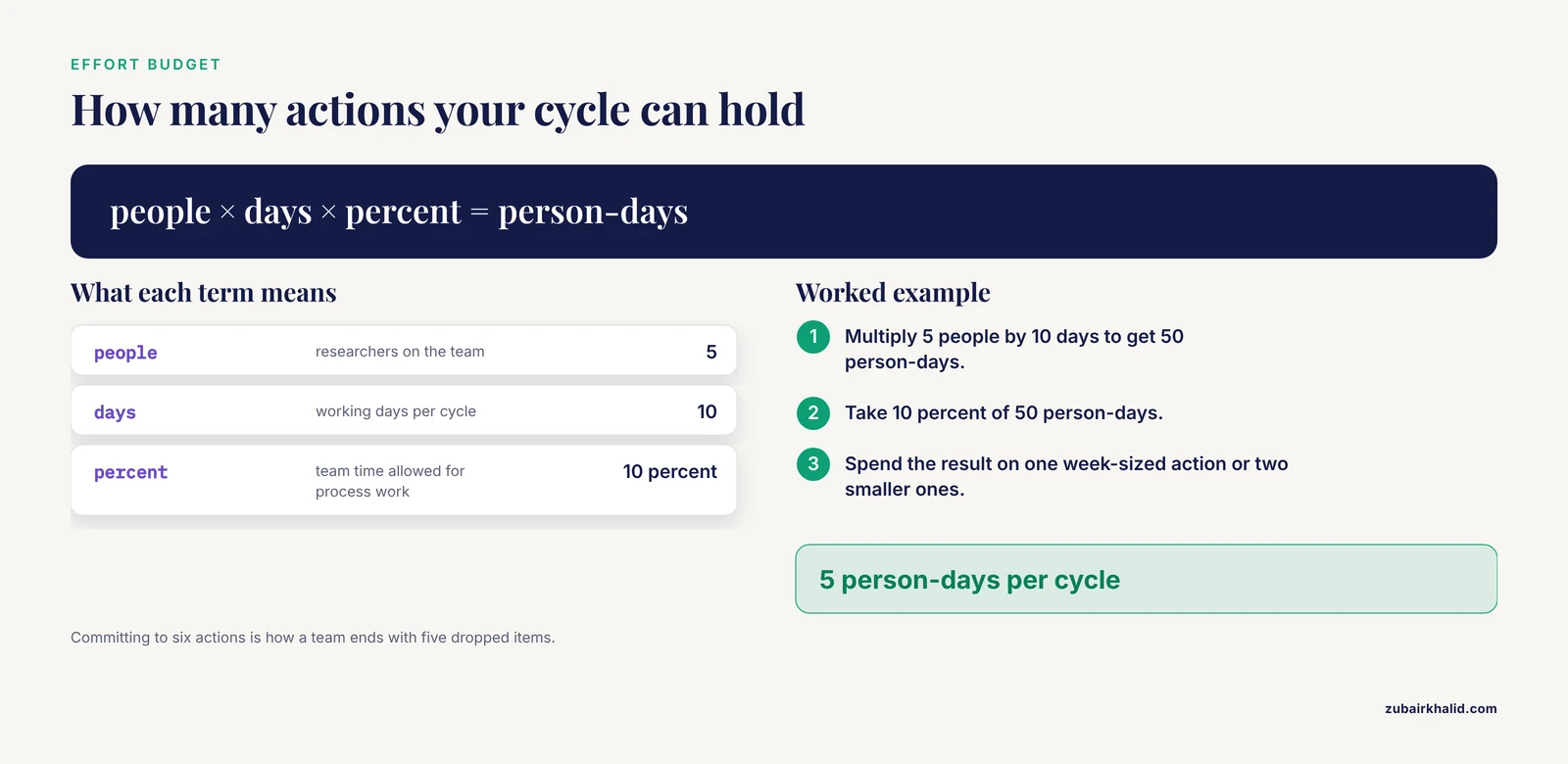
The estimate lets you sanity-check the load. Suppose your team has five researchers and a ten-working-day cycle, and you decide that process improvements may claim up to ten percent of team time. The arithmetic:
5 people × 10 days × 10 percent = 5 person-days per cycleFive person-days means you can commit to one action worth about a week of one person's time, or two smaller actions worth a couple of days each. Committing to six actions is how a team ends the next retrospective with a list of five dropped items and a bruised sense of competence.
Step 8. Close and Log (5 minutes)
The scribe pastes the final action list into the team's running log and copies the meeting date, attendance, and top three themes into the research project plan template described later in this article. End with a one-word round robin on how the meeting felt. It takes ninety seconds and it tells you whether people will come back willingly.
Choosing a Format
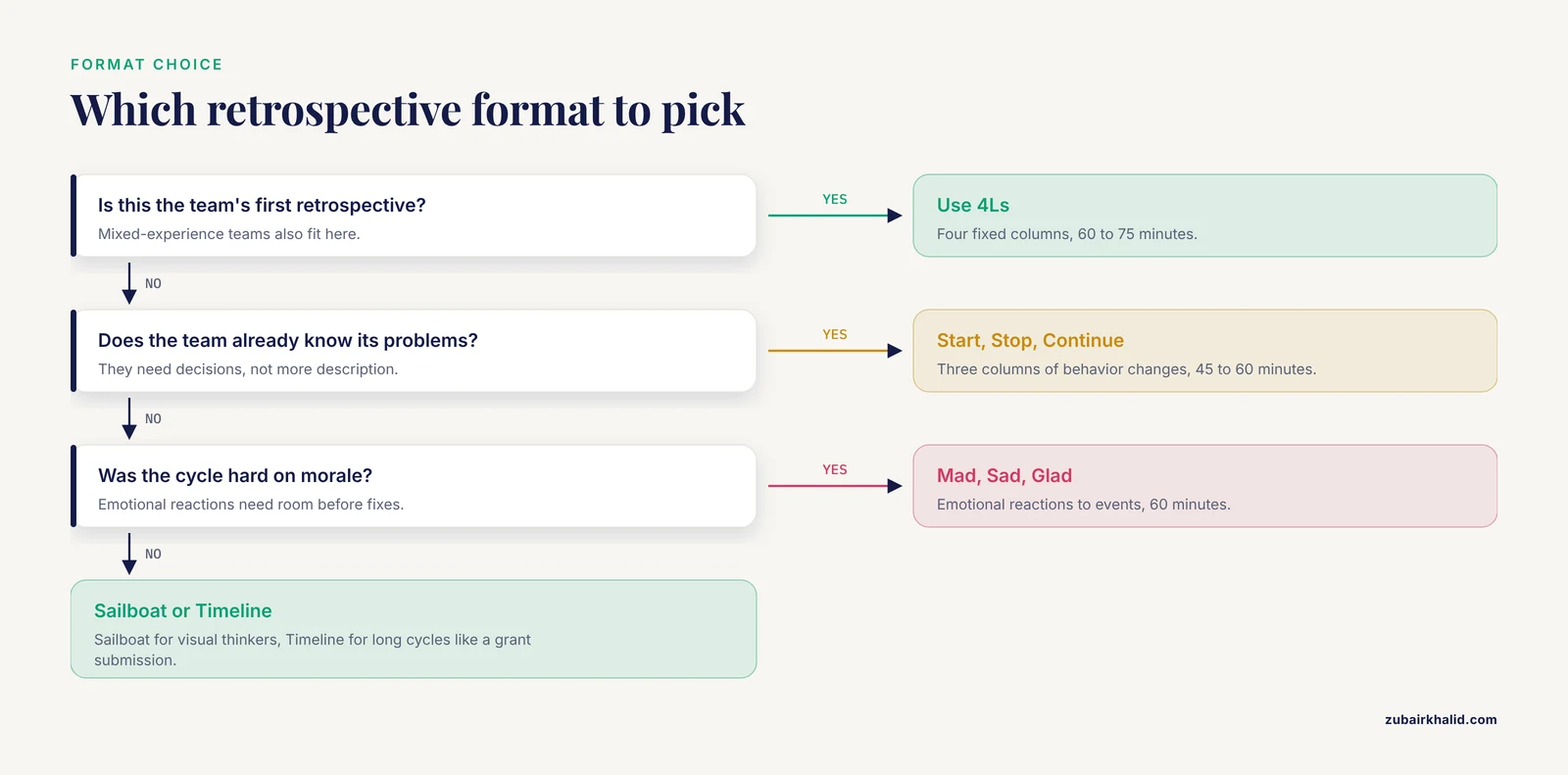
The 4Ls is a solid default, but different formats fit different situations. Pick one per meeting and resist the urge to invent structure on the fly, because lack of structure is one of the documented reasons retrospectives go badly [1].
| Format | What the team writes | Best for | Typical time |
|---|---|---|---|
| 4Ls (Liked, Learned, Lacked, Longed for) | Notes in four fixed columns | First retrospectives, mixed-experience teams | 60 to 75 minutes |
| Start, Stop, Continue | Three columns of behavior changes | Teams that already know their problems and need decisions | 45 to 60 minutes |
| Mad, Sad, Glad | Emotional reactions to events | Rebuilding morale after a hard cycle | 60 minutes |
| Sailboat | Wind (helps), anchor (holds back), rocks (risks), island (goal) | Visual thinkers, planning a new project phase | 75 to 90 minutes |
| Timeline | Events plotted along the cycle, then reactions | Long cycles such as a grant submission or field season | 90 minutes |
Agile Retrospective for Research Teams Tips
Timebox everything, especially complaints. Structured, game-like retrospective formats helped Scrum teams mitigate common problems including lack of structure, dullness, too many complaints, and unequal participation, according to an action research study that implemented six retrospective games across six Scrum teams that had experienced those problems [1]. The mechanism is simple: a visible timer forces a group to move from describing a problem toward deciding what to do about it.
Run silent writing before any discussion. Ten minutes of silent note-taking produces more ideas and more diverse ideas than an open floor. It also protects junior team members, who in academic settings often defer to the principal investigator's first stated opinion.
Rotate the facilitator every cycle. Facilitation is a career skill, and rotation prevents the role from hardening into a personality contest. It also gives the principal investigator permission to participate as an ordinary team member, which changes what people are willing to say.
Cap actions at three. The urge is always to fix everything. Three owned actions per cycle, executed, beats ten actions that evaporate. Your action backlog can hold the rest.
Check actions at the start of the next meeting. This single habit, described in Step 2 above, is the difference between a cadence and a series of one-off conversations. A retrospective whose actions are never revisited teaches the team that the meeting is theater.
Vary the format when energy drops. If attendance sags or people arrive scrolling their phones, switch to a different format from the table above or introduce a short opening game. The evidence for game-based formats comes from software teams [1], so treat them as an experiment in your own lab and judge the result in your next retrospective, which is exactly the habit the meeting is meant to teach.
Connecting Retrospectives to Research Project Management
A retrospective only pays off across cycles if its outputs live somewhere visible. That place is your research project plan. A workable research project plan template fits on one page and has these sections:
# Project Plan: [Project name]

## Objective
One sentence. What question does this project answer?

## Milestones and Dates
- [ ] Milestone 1 (target date, owner)
- [ ] Milestone 2 (target date, owner)

## Risks and Known Friction
| Friction | Source | Mitigation | Owner |
|---|---|---|---|

## Improvement Actions (from retrospectives)
| Cycle | Action | Owner | Due | Status |
|---|---|---|---|---|

## Retrospective Log
| Date | Attendance | Top themes | Decisions |
|---|---|---|---|
Two features make this template work. First, the "Improvement Actions" table is reviewed at the top of every retrospective, so process commitments sit next to scientific milestones rather than in a separate graveyard document. Second, the "Risks and Known Friction" table accumulates institutional knowledge. When a new graduate student joins, they read one page instead of absorbing three years of unwritten lessons.
If you want to go further, borrow the habit of systematic process documentation. The Pathfinder study did not rely on memory for its retrospective analysis. Its team combined document review, a survey of team members, interviews, and effort estimates, and integrated them through a structured tracker covering each stage of the research process [2]. Your version can be far lighter: keep the retrospective log current, and once per quarter have the scribe pull the logs into a one-page summary of recurring barriers. Patterns that are invisible meeting to meeting become obvious on a quarterly page.
Common Mistakes and Limitations
Skipping the retrospective when deadlines bite. Surveys report that the Sprint Retrospective is the agile practice most likely to be implemented improperly or sacrificed under delivery pressure [1]. Research teams face the same temptation during grant submissions and conference deadlines. The failure is self-reinforcing, because the busiest, most overcommitted cycles are precisely the ones generating the most process debt. If you must shorten the meeting, run a 20-minute version rather than canceling.
Collecting complaints without converting them. A board full of sticky notes and no owned actions is a gripe session with stationery. Every retrospective must end with at most three actions, each with an owner and a date.
Letting senior voices set the agenda. In labs, hierarchy is steep and junior members self-censor. Silent writing, anonymous voting, and a neutral facilitator exist to counteract this. If the principal investigator speaks first on every theme, fix that in your very next meeting.
Treating the retrospective as a performance review. The moment retrospective items become evaluations of individuals, people stop telling the truth. Keep the frame from Step 1 visible and route personnel concerns to the proper channel, not the board.
Running one retrospective and judging the method. The first retrospective of any team is awkward and produces shallow items. The value compounds over cycles as the team learns that raised problems actually change things. Judge the practice after four to six cycles, not one.
Making actions too large. "Improve data management" is not an action. "Migrate the shared sample spreadsheet to typed columns with one ID per row by March 14, owned by Priya" is an action. If an action cannot be finished inside one cycle, split it.
Overgeneralizing the evidence. The strongest published evidence on retrospective formats comes from action research in software Scrum teams [1], and the effort and difficulty figures cited here come from a single collaborative quality improvement study [2]. Your team's friction profile will differ. The correct response is not to abandon the practice but to measure your own results, which the retrospective log makes easy.
Frequently Asked Questions
How often should a research team hold a retrospective?
Hold one at the end of every work cycle, which for most lab teams means every two to four weeks. The cadence matters more than the interval, because the loop of committing to actions and checking them next time is what produces improvement.
How long should a retrospective take?
Plan 60 to 90 minutes for a full retrospective with a team of five to eight people, and no more than 20 minutes for a compressed version during a deadline crunch. Ending on time, every time, is part of how you keep people willing to attend.
What is the difference between a retrospective and a lab meeting?
A lab meeting reviews the science, meaning data, interpretations, and next experiments. A retrospective reviews how the team worked, meaning process, tools, communication, and workload. You need both, and merging them usually means the process discussion gets squeezed out by data discussion.
Do retrospectives work in academic labs with high personnel turnover?
Yes, provided the outputs are written down. High turnover makes the retrospective log and project plan template more valuable, not less, because they carry process knowledge from departing members to new ones instead of losing it.
What if my principal investigator thinks retrospectives are a waste of time?
Propose a single 45-minute trial with a clear success test, such as one completed process fix within two weeks. Frame it around the documented friction everyone already complains about, like approval delays and sample tracking, rather than around agile vocabulary.
Can we run a retrospective remotely?
Yes. Use a shared digital board with columns, keep everyone on video during discussion, and protect the silent writing phase with a shared timer. Remote retrospectives actually benefit more from strict timeboxes, because turn-taking is harder to read on a call.
What should we do when the same problem appears every cycle?
Stop treating it as a fresh item and escalate it deliberately. Ask the five whys until you reach a cause someone can actually own, then assign that person a specific change with a deadline. If the cause is genuinely outside the team's control, name it to whoever controls it and track it in the risk table.
How do we measure whether retrospectives are working?
Track three numbers in your log each cycle: the percentage of actions completed by their due date, the number of distinct themes raised, and attendance. Rising completion rates and falling repetition of the same themes are the clearest signals that the practice is working.
Sources
- Game-based Sprint retrospectives: multiple action research.
- Process mapping of a collaborative quality improvement study to optimise the use of antibiotics in intensive care units in Argentina: a Pathfinder study.
- The tricot approach: an agile framework for decentralized on-farm testing supported by citizen science. A retrospective.