How to Prioritize Research Tasks with Agile Backlogs
By Dr. Zubair Khalid, DVM, MS, PhD ·

By the end of this guide you will be able to build a prioritized backlog for a research project, score every task with a repeatable formula, load a realistic working sprint, and re-prioritize on a fixed cadence instead of reacting to whatever shouted loudest that morning. You need nothing more than a spreadsheet, a whiteboard, or a backlog tool such as Jira, Trello, or Azure DevOps, plus about one afternoon to set up the system and an hour per week to maintain it.
Research project management differs from software project management in one big way. Outcomes are uncertain. An experiment can fail, a dataset can turn out to be unusable, and a reviewer can send you back to the drawing board. That uncertainty is exactly why a ranked, continuously re-scored backlog beats a fixed Gantt chart. A research-heavy engineering team that adopted Agile for precisely these reasons described how iterative planning let them absorb late changes and release partial results early rather than waiting for a perfect final deliverable [1].
Why Research Projects Need a Prioritized Backlog
A backlog is a single, ordered list of everything a project might do. In software, the full set of requirements lives in the product backlog, and each working cycle pulls a slice of it into a sprint backlog where the team designs, builds, and tests those items [2]. Research maps onto this structure naturally if you translate experiments, analyses, manuscripts, and administrative work into backlog items.
Three properties make the backlog useful for research:
- It is ordered, not just sorted into buckets. Item one gets done before item two. Ties are broken explicitly.
- It is alive. New results change what matters next, so priorities get re-scored on a schedule, not rewritten from scratch whenever panic sets in.
- It is transparent. Anyone on the project, including a principal investigator who is not in the lab every day, can see the current ranking and argue about it with evidence rather than seniority.
That last point matters more than most researchers expect. A survey of 467 agile practitioners found that organizational hierarchy strongly shapes backlog decision-making, while active stakeholder involvement and good communication tooling improve backlog clarity and keep priorities stable, especially in remote and hybrid settings [3]. A visible backlog is the cheapest stakeholder involvement you can buy.
Key Terms, Defined
- Backlog item. One unit of work, written as an outcome rather than an activity. "Quantify reporter expression in treated versus control larvae" beats "do experiments."
- Sprint. A fixed, time-boxed working cycle. In Scrum, requirements move from the product backlog into the sprint backlog, and the team delivers them within the cycle [2].
- Backlog refinement (also called grooming). The recurring work of rewriting unclear items, splitting oversized ones, estimating effort, and reordering the list.
- Product owner. In Scrum, the person accountable for backlog content and ordering. On a research project this role usually maps to the principal investigator or project lead, who gathers input from everyone else but makes the final call on ordering.
- Velocity. The amount of work a team completes per sprint, measured in the same effort units you assign to items. It makes future sprint planning predictable.
- Lead time and cycle time. Lead time is how long an item waits from creation to completion. Cycle time is how long it takes once work actually starts. Both are standard agile performance metrics [5].
- Cost of delay. The value you lose per unit of time by postponing an item, which is why a grant report due in two weeks can outrank a fascinating side project.
Choosing a Prioritization Method
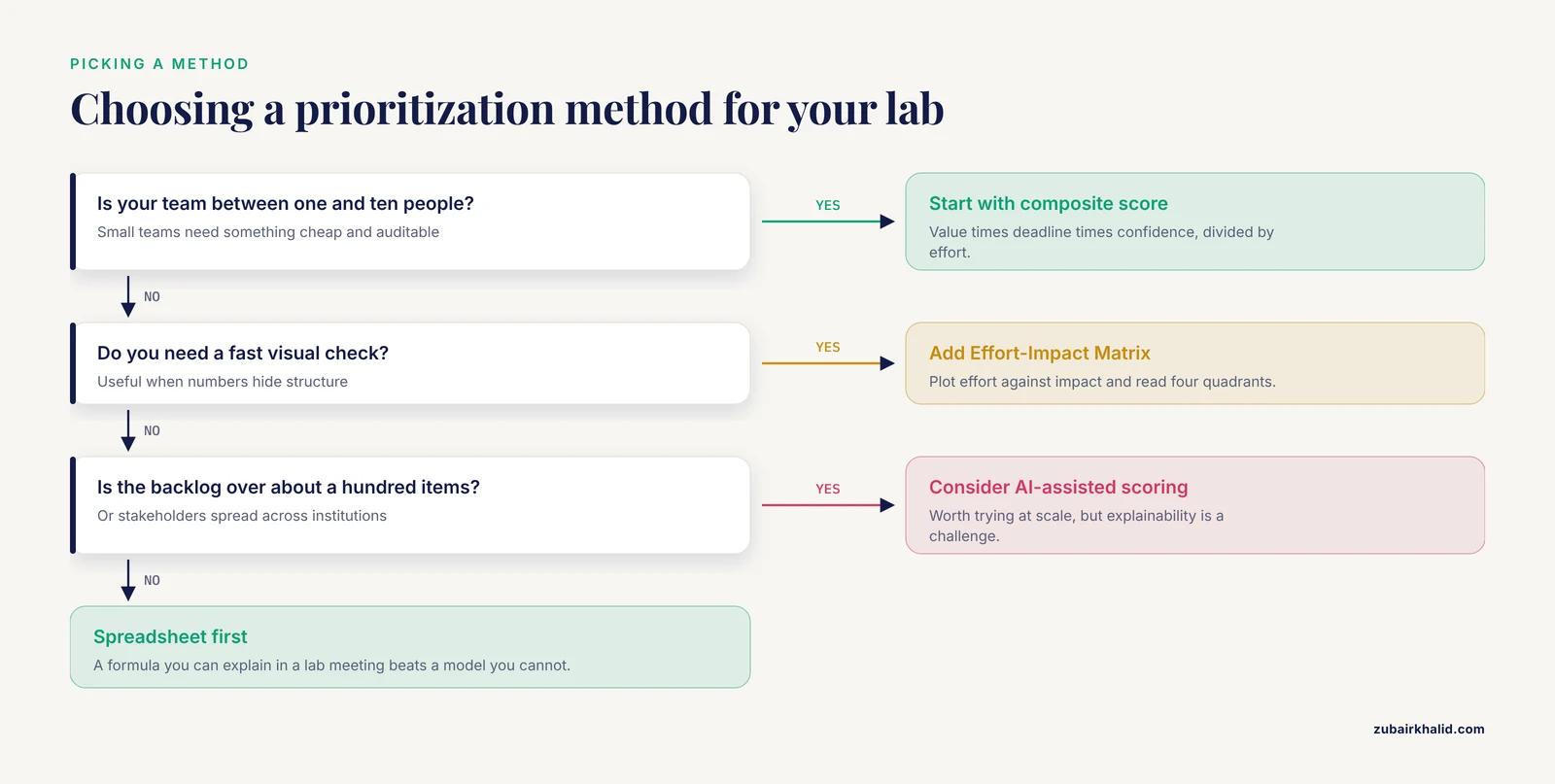
No single formula fits every project. The methods below are the ones with published support, and the table summarizes how they differ.
| Method | What it scores | Best suited for | Anchor |
|---|---|---|---|
| MoSCoW (Must, Should, Could, Won't) | Simple urgency categories | Fast triage, new projects, low tooling | [6] |
| Effort-Impact Matrix | Effort versus influence on outcomes | Small teams that need fast, visual ordering | [5] |
| Composite formula (business value, team priority, cost of delay) | Three weighted factors combined into one score | Projects balancing sponsor value with team judgment | [2] |
| Eisenhower Matrix plus AHP | Two-layer ranking, heuristic buckets then weighted criteria | Multi-level projects with dependencies and deadlines | |
| AI-assisted scoring | Automated text analysis and dynamic re-ranking | Large backlogs with many stakeholders and shifting demands | [7], [8], [6] |
A few notes on each. MoSCoW and the Analytic Hierarchy Process (AHP) are classic structured frameworks, but a systematic review of 78 peer-reviewed studies found they lack the scalability modern environments demand, which motivated newer automated approaches [6]. The Effort-Impact Matrix has an important caveat from its own case-study literature. Prioritizing items improves resource use, but prioritization alone does not guarantee long-term success. The same study found that pairing the matrix with performance metrics, agile metrics such as velocity and cycle time, and outcome metrics such as satisfaction and adoption, produced better decisions and more predictable delivery [5]. A hybrid approach from complex IT projects assigns tasks to Eisenhower quadrants by importance and urgency first, then computes a weighted score using impact, priority, deadline proximity, dependencies, and effort. The authors found this preserved the speed of heuristic judgment while adding consistency and transparency.
For a research project of one to ten people, the composite score method in the walkthrough below is the best starting point because it is transparent, auditable, and cheap to maintain.
Step-by-Step: Building and Prioritizing a Research Backlog
This walkthrough uses a running example. Imagine a small lab project: characterize gene expression changes after a drug treatment, using RNA sequencing, with a manuscript target. Everything generalizes to fieldwork, computational biology, or a dissertation.
Step 1: Capture every task as an outcome
Sweep your notebooks, email, meeting notes, and to-do apps into one list. Write each item as a sentence describing a finished state. A first pass for the example project might produce:
1. Validate new RNA extraction protocol on treated samples
2. Order depletion reagents before current stock runs out
3. Pilot one sequencing run to check library quality
4. Fix sample-mapping bug in the analysis pipeline
5. Draft methods section of the manuscript
6. Read the three new papers on batch correction
Do not worry about order, size, or wording yet. Capture first, judge later.
Step 2: Define four scoring criteria
Score every item on four criteria. Keep the definitions written down so two people scoring the same item get similar numbers.
- Value (1 to 10). How much this item moves the project's core deliverable forward. A doctoral thesis, a grant deliverable, or a publishable result is high value. Nice-to-have side analyses are low.
- Deadline pressure (1 to 3). 1 means no time constraint, 2 means it matters within the current month, 3 means a hard external deadline such as a grant report or sample expiry.
- Confidence (0 to 1). How sure you are that the item is well defined and will work as written. A routine protocol is 1.0. A pilot experiment with unknown success odds is 0.5.
- Effort (1 to 13). A coarse estimate of person-days, using a Fibonacci-like scale (1, 2, 3, 5, 8, 13) that forces you to distinguish small from medium from large rather than pretend precision.
These criteria echo the hybrid approach reported for complex projects, which weighted impact, priority, deadline proximity, dependencies, and effort in a structured scoring cycle.
Step 3: Compute a priority score
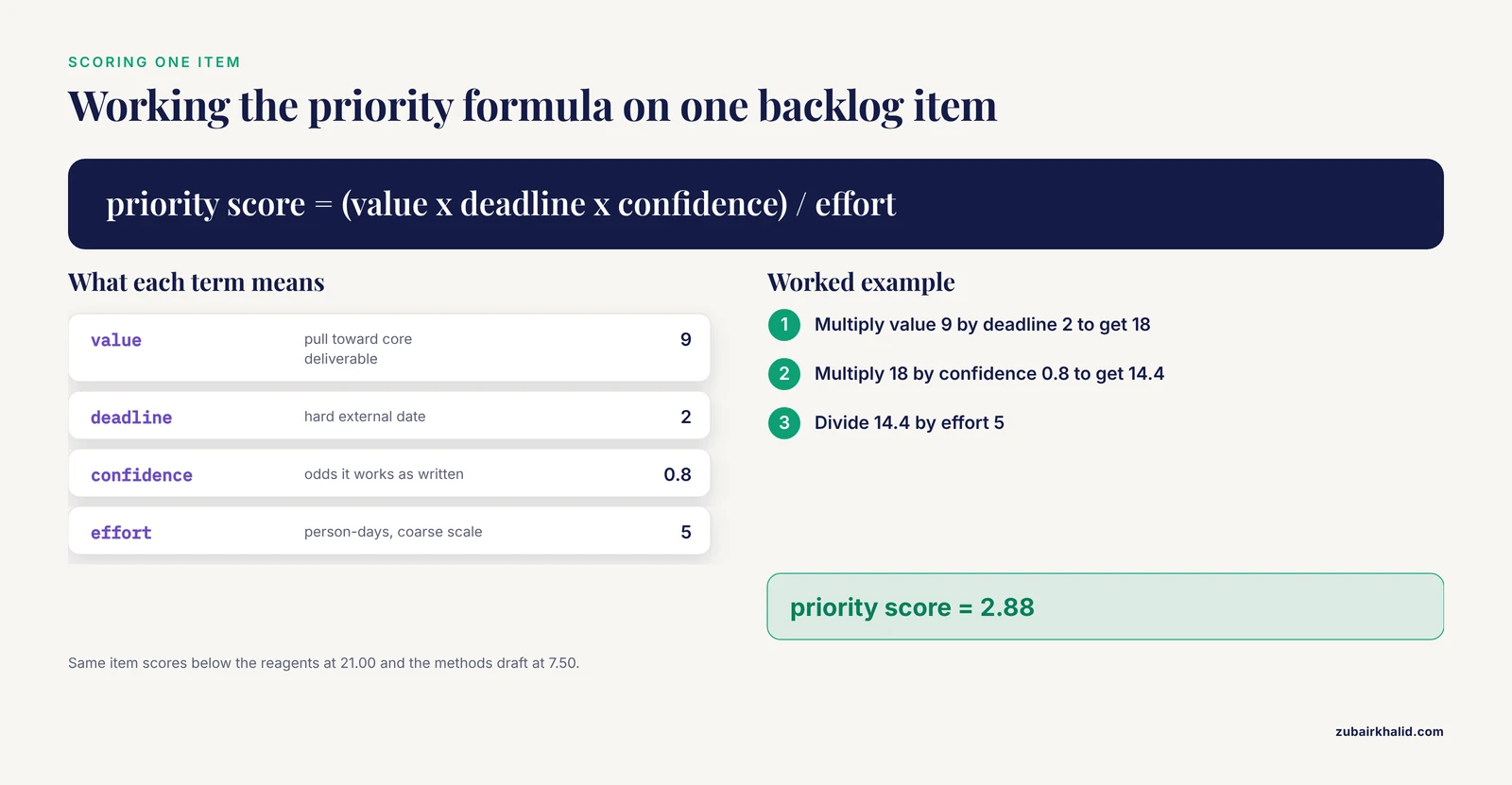
Use this formula:
priority score = (value × deadline pressure × confidence) / effortMultiplying value, deadline, and confidence rewards items that are high-stakes, urgent, and well understood. Dividing by effort breaks ties in favor of quick wins. Here is the same calculation for the example backlog, in Python:
tasks = [
    # (name, value, deadline, confidence, effort)
    ("Validate RNA extraction protocol", 9, 2, 0.8, 5),
    ("Order depletion reagents",         7, 3, 1.0, 1),
    ("Pilot sequencing run",             9, 3, 0.5, 8),
    ("Fix pipeline mapping bug",         6, 2, 0.9, 3),
    ("Draft methods section",            5, 3, 1.0, 2),
    ("Read new batch-correction papers", 4, 1, 1.0, 2),
]

for name, value, deadline, confidence, effort in tasks:
    score = value * deadline * confidence / effort
    print(f"{score:5.2f}  {name}")
Run it and sort the output. Expected result:
21.00  Order depletion reagents
 7.50  Draft methods section
 3.60  Fix pipeline mapping bug
 2.88  Validate RNA extraction protocol
 2.00  Read new batch-correction papers
 1.69  Pilot sequencing run
In a spreadsheet, the formula for row 2 is simply:
=B2*C2*D2/E2with columns for value, deadline pressure, confidence, and effort. Sort descending by the score column.
Check the output against your intuition. Reagents score highest because a hard deadline and tiny effort combine with real value. The sequencing pilot scores lowest despite high value because low confidence and high effort cut its score hard. That is the formula doing its job, telling you to reduce uncertainty cheaply first. In practice, you might rewrite the pilot as a smaller, higher-confidence item, such as "Submit two libraries for QC-only sequencing," which would raise its confidence and lower its effort, and therefore its score. That rewrite is refinement, and it is the next step.
Step 4: Bucket items with the Effort-Impact Matrix
Numbers alone can hide structure. Plot each item on a two-axis grid of effort versus impact and read the four quadrants:
- High impact, low effort. Do these immediately. Reagents, in the example.
- High impact, high effort. Plan these carefully and split them. The pilot run.
- Low impact, low effort. Batch them into filler time. Reading papers.
- Low impact, high effort. Delete or defer, explicitly and in writing.
A case study of product owners found that combining this matrix with ongoing performance metrics improved alignment between development priorities and organizational goals [5]. For a lab, the organizational goal is the manuscript or grant milestone, so check each quadrant decision against that goal.
Step 5: Refine the backlog
Once a week, hold a 30-minute refinement session. Three actions happen every time:
- Split. Any item larger than about half a sprint gets split. "Characterize expression changes" becomes "map reads to reference," "count matrix normalization," "differential expression testing," and "volcano plot review."
- Clarify. Each item gets a definition of done. For a wet-lab item that might be "raw counts deposited, QC report filed, and result entered in the project log."
- Re-score. New data changes confidence values, and approaching deadlines raise deadline pressure. Update the numbers, not just the order.
Refinement is a core Scrum practice, and the step-by-step prioritization literature treats it as inseparable from prioritization itself, because a poorly understood item cannot be honestly ranked [2]. Refinement also catches a category researchers routinely miss, discussed in Step 6.
Step 6: Rank infrastructure and quality work alongside experiments
Research backlogs fill up with functional work, the experiments and analyses, and quietly starve the supporting work. Software teams face the same failure mode with non-functional requirements, such as performance and reliability, and research has shown that prioritizing functional and non-functional user stories together, rather than treating them as separate afterthoughts, is essential from the earliest stages of a project [9].
For a research project, the non-functional items are usually:
- Data management, backups, and file naming conventions
- Sample tracking and metadata completeness
- Code and protocol versioning
- Notebook and lab record keeping
- Technical debt, meaning shortcuts you took under deadline pressure that now slow everything down
Technical debt deserves explicit tracking. A method developed for agile projects, TechDebt Tracker, provides documentation and monitoring of debt items using two formulas, a kanban board, and a feedback loop, precisely because unmanaged debt degrades long-term maintainability and contributes to project failures [10]. Your research equivalent is a backlog item that says "migrate ad-hoc scripts into the versioned pipeline," scored like any other item. If it never scores high enough, that itself is information about how much pain you have decided to accept.
Step 7: Load a sprint using your measured capacity
Pick a sprint length. For research, one or two weeks works better than the classic one-month cadence because experiment results arrive quickly and change priorities. Take your top-scored items, sum their effort values, and compare the sum to your capacity.
Capacity is what your velocity says you finish, not what your calendar says is theoretically possible. If you have never measured velocity, assume 60 percent of nominal working hours for the first two sprints, then measure. Team estimates are central to backlog ordering, and a proposed prioritization formula in the Scrum literature explicitly combines business value, the development team's own priority assessment, and cost of delay, because a ranking the people doing the work do not believe in does not survive contact with the bench [2].
An example sprint plan for a two-week sprint with a capacity of 10 effort points:
Sprint 4 (capacity: 10 points)
  Order depletion reagents          1 point   [priority 21.00]
  Draft methods section             2 points  [priority  7.50]
  Fix pipeline mapping bug          3 points  [priority  3.60]
  Validate RNA extraction protocol  5 points  [priority  2.88]
                                   ----------
                                   11 points  (slightly over, drop reading task)
Do not fill the sprint to the brim. Unplanned work, failed assays, and equipment downtime are normal in research, and a sprint planned at true capacity will fail its first week.
Step 8: Work the sprint with short, standing check-ins
An empirical study of 11 product owners in a research and development organization found that the practices they rated most critical in daily work were defining project constraints, organizing daily meetings, and avoiding scope changes, while the most frequent practices were ensuring requirements deliver value and are clearly expressed [4]. Translate that to a lab: a 10-minute daily standup where each person states what they are doing, what is blocked, and what changed, plus a firm rule that mid-sprint additions must displace something of equal effort.
Step 9: Review metrics at sprint close
At the end of every sprint, record three numbers: completed effort points (your velocity), average cycle time for finished items, and average lead time from item creation to completion. These are the agile metrics that a documented case study found, when integrated with outcome metrics such as stakeholder satisfaction, improved decision-making and delivery predictability [5]. Also record one outcome metric for your project. For the example project it might be "libraries passed QC this sprint" or "manuscript sections at draft quality."
The review meeting answers three questions. Did we predict our capacity correctly? Which items sat waiting longer than they should have? Did the sprint move the project's core deliverable, or only its busywork?
Step 10: Re-prioritize on a schedule, and keep the history
Re-score the full backlog at the start of every sprint. Because the backlog changes constantly, requirement traceability matters. A survey of Scrum practitioners on backlog change management examined how teams manage requirement changes and trace them through a project, and the practical lesson is that changed priorities should be recorded with their reasons, not silently overwritten [11]. Keep a dated copy of the ordered backlog before each re-scoring. When a collaborator asks why an experiment was deprioritized in March, you will have the answer.
A One-Page Research Project Plan Template
Use this template as the header document for your backlog. It fits on one page and makes the scoring system auditable.
PROJECT PLAN (one page)

Goal:           One sentence describing the deliverable.
Milestone:      Date and definition of "done" for the deliverable.
Sprint length:  [ ] 1 week  [ ] 2 weeks  [ ] other: ____
Team capacity:  ____ effort points per sprint (measured, not assumed)

Scoring rubric:
  Value:      1 = side curiosity, 10 = core deliverable
  Deadline:   1 = none, 2 = this month, 3 = hard external date
  Confidence: 0.3 = exploratory, 0.6 = partly tested, 1.0 = routine
  Effort:     1, 2, 3, 5, 8, 13 person-day scale

Formula:        score = (value x deadline x confidence) / effort
Tiebreaker:     lower effort wins

Backlog columns: name | value | deadline | confidence | effort | score |
                 owner | sprint | status | notes

Cadence:
  Daily:      10-minute standup (doing, blocked, changed)
  Weekly:     30-minute refinement (split, clarify, re-score)
  Per sprint: review velocity, cycle time, lead time, outcome metric
  Per sprint: re-score backlog, archive dated copy
Tools that support this workflow include Azure DevOps, which provides work item tracking, sprint planning with velocity and burndown charts, and kanban dashboards that give stakeholders a real-time view of progress [12]. A spreadsheet is a perfectly good substitute for a team of one to five people.
Where AI Tools Fit, and Where They Do Not
AI-assisted prioritization has moved from novelty to working practice, and the evidence is worth knowing in both directions.
On the promising side, a review of AI-enabled decision intelligence in large-scale projects reported task estimation accuracy improvements in the range of 82 to 98 percent and development cycle time reductions of 40 to 67 percent when AI systems supported sprint planning and prioritization [8]. A hybrid framework called AISA, which combines multi-perspective requirement elicitation with natural language processing and dynamic scoring, was evaluated on 138 real requirements and reprioritized 81.9 percent of them relative to a static equal-weighted baseline while maintaining a mean rank correlation of 0.957 with it, showing that sentiment- and dependency-aware scoring produces materially different and better-targeted orderings [7]. Machine learning models have also been used to predict task complexity, optimize resource allocation, and flag blockers before they derail a sprint [13], and generative AI tools are increasingly applied to backlog prioritization alongside coding, testing, and documentation tasks. In engineering project management specifically, AI-augmented frameworks add predictive analytics and real-time risk assessment to sprint planning and resource allocation [14].
On the cautionary side, the same literature reports persistent challenges with data quality requirements, organizational resistance, model explainability, and the need for human-AI collaboration frameworks [8]. For a small research team, the practical position is this. AI triage is worth trying once your backlog exceeds roughly a hundred items or your stakeholders multiply across institutions. Below that threshold, a spreadsheet formula you can explain in a lab meeting outperforms a model you cannot.
Communication Structure Decides Whether Any of This Works
The prioritization formula is the easy part. The hard part is the social system around it. The survey of 467 practitioners mentioned earlier, analyzed with MANOVA, chi-square, and structural equation modeling, found that Conway's Law holds in modern distributed teams. Your communication structure shapes your backlog. Hierarchical organizations concentrate backlog decisions at the top, which slows them and separates the decision from the information, while broad stakeholder involvement and rich communication channels improve backlog understanding and priority stability [3].
For a research project, three practical consequences follow. First, give every team member, including students, a standing way to propose and challenge backlog items. Second, when a senior stakeholder overrides the score, require the override to be written down next to the item. Third, keep the backlog where communication already happens, whether that is a shared channel, a lab wiki, or a project board, because a backlog nobody looks at is not prioritizing anything.
Common Mistakes and Limitations
- Scoring once and never again. A backlog scored in month one and trusted in month six is a museum exhibit. Static methods fail when stakeholder needs and project context shift, which is a central motivation for adaptive re-prioritization approaches [7]. Re-score every sprint.
- Ordering without refining. If you rank items nobody can define, do, or estimate, your ranking is fiction. Refinement must precede or accompany every re-prioritization.
- Letting hierarchy replace evidence. When the most senior voice silently determines order, you lose the input of the people closest to the experiments, and the evidence says this pattern measurably degrades backlog quality [3].
- Hiding infrastructure and debt work. Backlogs that rank only experiments will accumulate untracked maintenance work until velocity collapses. Rank data management and technical debt items in the same list as experiments [10],.
- Filling sprints to theoretical capacity. Research includes failure. Plan at measured velocity, not at wishful thinking, and leave slack for failed assays and reagents on backorder.
- Confusing the tool with the discipline. A case study of the Effort-Impact Matrix found that prioritization by itself does not ensure long-term success. The gains came from combining prioritization with performance metrics and goal alignment [5]. The spreadsheet is the smallest component of the system.
- Over-precision in scoring. Whether an experiment is a 7 or an 8 in value almost never matters. Whether the ordering is consistent and re-examined every sprint matters enormously. Resist decimal places.
- Deleting discarded items. Move rejected items to a "won't do now" section with a one-line reason. Future you, or a reviewer, will want that record.
One limitation applies to the method itself. Agile backlogs fit projects with iterative work and changing priorities. A short project with a rigid, externally imposed protocol may gain little from sprint ceremonies, and a minimal ordered list may serve it better.
Frequently Asked Questions
What is an agile backlog in a research context?
It is a single ordered list of all tasks a research project could do, including experiments, analyses, writing, data management, and maintenance, ranked by a written scoring formula and re-examined on a fixed schedule. It replaces scattered to-do lists with one auditable ranking.
How do I prioritize research tasks with agile backlogs step by step?
Capture every task as an outcome, score each on value, deadline pressure, confidence, and effort, compute a priority score by multiplying the first three and dividing by effort, refine oversized items, load a sprint at your measured capacity, then re-score the whole list every sprint.
Which prioritization method should a small lab use?
Start with the composite score formula, value times deadline times confidence divided by effort, because it is transparent and cheap. Add the Effort-Impact Matrix for quick visual checks, and consider Eisenhower-plus-AHP layering only when your project grows large enough that consistency across scorers becomes a problem.
How long should a sprint be for research work?
One to two weeks. Shorter cycles suit research because experimental results arrive quickly and change what matters next, and the literature on adapting Agile to research-heavy teams emphasizes absorbing change mid-project rather than locking a long plan.
Can I use agile backlogs for wet-lab experiments?
Yes. Write each experiment as a backlog item with a definition of done, such as QC report filed and result logged, score it with the same formula, and treat failed assays as normal sprint outcomes rather than plan violations. Sample expiry and reagent shelf life slot naturally into the deadline criterion.
Do AI tools help prioritize research tasks?
They help at scale. Published systems report large accuracy and cycle-time gains, but they demand clean historical data, and their authors flag explainability and adoption challenges. Below roughly a hundred backlog items, a simple transparent formula usually serves a small team better.
What is the difference between a backlog and a to-do list?
A to-do list records intentions. A backlog is ordered by an explicit formula, has effort estimates that make capacity planning possible, gets refined weekly, and drives fixed-length work cycles. The ordering and the estimation are what turn a list into a management tool.
How often should I re-prioritize the backlog?
Every sprint, which for most research teams means every one to two weeks. Archive a dated copy before each re-scoring so priority changes and their reasons remain traceable. Outside the schedule, re-score immediately only when a hard external deadline appears or a core assumption fails.
Sources
- How We Successfully Adapted Agile for a Research-Heavy Engineering Software Team
- A Deep Dive into Product Backlog Prioritization Technique in Scrum
- Stakeholder Hierarchy and Conway's Law: Impact on Backlog Management Strategies in Agile Teams Post-COVID
- Product Owners Perspectives on Agile Requirements Engineering Practices
- Integrating Agile and Business Metrics into Backlog Prioritization: A Case Study at PT. XYZ
- A Review of Modern Requirement Prioritization: From NLP Pipelines to Agentic AI
- AI-Driven Dynamic Requirement Prioritization in Agile Product Backlogs Using the AISA Framework
- AI-Enabled Decision Intelligence for Agile Product Management in Large-Scale Software Projects
- A Hybrid Prioritization Approach by integrating non-Functional and Functional User Stories in Agile-Scrum Software Development (i-USPA):A preliminary study
- TechDebt Tracker: Towards a Method for Monitoring Technical Debt in Agile Projects
- A survey on product backlog change management and requirement traceability in agile (Scrum)
- Leveraging Azure DevOps for Backlog Management and Sprint Planning in Supply Chain Projects
- Exploring AI-Powered Sprint Planning Optimization Using Machine Learning for Dynamic Backlog Prioritization and Risk Mitigation
- AI-augmented agile project management in engineering: A framework for smart decision-making and risk mitigation