The 5-Star Open Data Rating: How to Make Your Dataset Truly Reusable
By Dr. Zubair Khalid, DVM, MS, PhD ·

The 5-star open data rating is a five-level scoring system that describes how easy it is for other people and machines to reuse a dataset. Each additional star removes one barrier to reuse, from simply putting data on the web, up to publishing linked data that connects to other datasets through shared identifiers.
The scheme was proposed by Tim Berners-Lee, inventor of the web and director of the World Wide Web Consortium (W3C), originally to grade open government data. Life scientists have since adopted it as a quick way to judge their own datasets. This article gives a clear 5 star open data rating interpretation, explains what each star means for a biology dataset, and turns the scheme into practical steps and a reproducibility checklist you can apply to your own work.
What does the 5-star open data rating mean?
The 5-star open data rating asks one question at each level: could a stranger, or a computer program, take your data and use it without extra help from you? A dataset earns one star for being available on the web at all, two for being machine-readable, three for being in an open, non-proprietary format, four for using standard identifiers that machines can follow, and five for being connected to other datasets.
The stars are cumulative. Four-star data is also two-star data. A dataset with five stars is not necessarily better science, but it is dramatically easier to find, combine, and reanalyze, which is the foundation of reproducible research [1].
The five stars explained, one level at a time
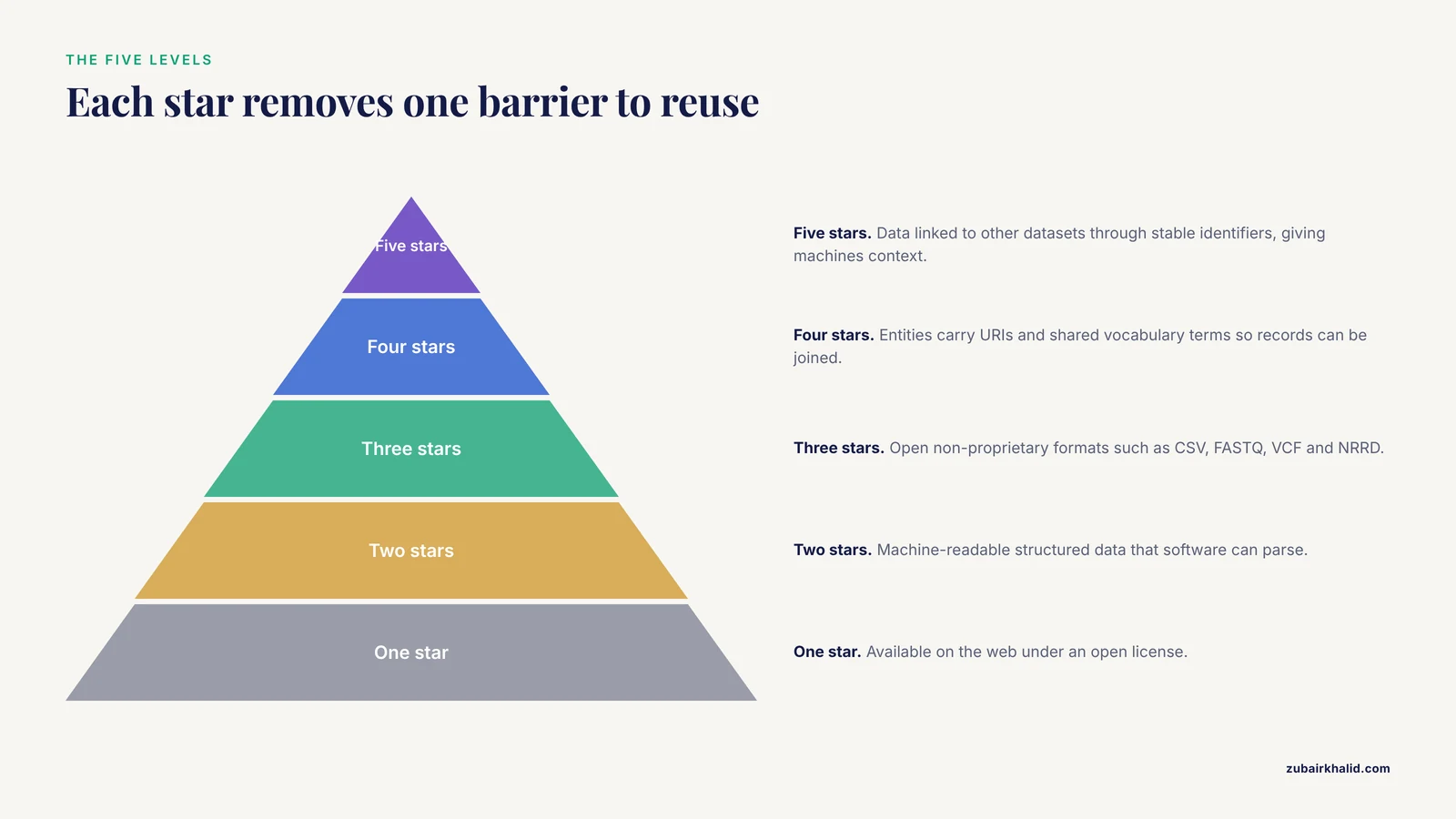
Here is the 5 star open data rating explained level by level, with a life-science example for each.
| Star | Requirement | Life science example | What still blocks reuse |
|---|---|---|---|
| , - | , - | , - | , - |
| ★ | Available on the web under an open license | A PDF supplement on a journal site | Locked in a picture, no license clarity |
| ★★ | Machine-readable | An Excel file posted on a lab website | Proprietary format, unclear column meanings |
| ★★★ | Non-proprietary format | A CSV file, or FASTQ and VCF files, on Figshare or Zenodo with a digital object identifier (DOI) | Values are not linked to any shared vocabulary |
| ★★★★ | Uses URIs and open standards to identify things | Sample attributes coded with standard ontology terms and resolvable web identifiers | No connections to related datasets |
| ★★★★★ | Linked to other data to provide context | Gene identifiers that resolve to reference databases, samples connected to linked metadata across studies | Requires ongoing maintenance |
One star: on the web with an open license
The first star only asks that the data exists online and that anyone can legally reuse it. A supplementary table buried in a PDF technically reaches this level, although barely. Many journals now expect data availability statements, and publicly funded research carries an added responsibility for transparency and sharing [1].
Two stars: machine-readable
The second star requires structured data that software can parse, such as a spreadsheet or a delimited text file. This is where most lab datasets stall. An Excel workbook with merged cells, color-coded flags, and unit annotations inside data cells is readable by humans but hostile to scripts. Machine-readable means the values themselves sit in consistent rows and columns with headers.
Three stars: non-proprietary format
The third star requires an open format that any tool can read without licensed software. Comma-separated values (CSV), plain text, and community standards such as FASTQ for sequence reads, VCF for variant calls, and NRRD for imaging all qualify. Format conversion is a real, practical step toward this level. In radiation oncology research, for example, the MedicalDataHandler tool converts complex DICOM imaging data into the deep-learning-friendly Nearly Raw Raster Data (NRRD) format without custom scripting, which makes downstream reuse far easier [2]. The general lesson applies across fields: moving data out of a vendor-specific container and into an open standard is one of the highest-value steps you can take.
Four stars: identifiers and open standards
The fourth star requires that the things described in your data, genes, samples, drugs, diagnoses, carry web addresses called URIs (Uniform Resource Identifiers) that resolve to shared definitions. In practice, this means using standard gene and protein identifiers rather than local sample nicknames, and controlled vocabulary terms rather than free-text descriptors. Work on preparing electronic health record data for machine learning shows why this matters. Curating raw records against validated definitions for variables such as age, race, and diagnosis codes reduced missingness and improved representation before any modeling began [3]. Coding against shared definitions is what makes a dataset interoperable rather than merely readable.
Five stars: linked data
The fifth star asks you to link your data to other data, providing context a machine can follow. A genomics dataset that connects sample records to a public repository, a phenotype database, and a publication, all through stable identifiers, satisfies this spirit. Full Resource Description Framework (RDF) linked data remains rare in routine biology, and many researchers consider a four-star dataset with rich cross-references a realistic ceiling. The scheme rewards direction of travel, not formal purity.
Why the stars matter for reproducible research
Reproducible research means that other scientists can arrive at your published results from your raw data and documented methods. Effective data management is a cornerstone of scientific integrity because well-organized, well-documented data allow validation and follow-on discovery [1]. The star rating is essentially a shorthand for how far along that path a dataset sits.
Consider what breaks when someone reuses a typical dataset:
- A raw file format that requires vendor software (blocks star three).
- A spreadsheet where each column's meaning lives in the author's memory (blocks stars two through four).
- Processing steps that were applied inconsistently and never documented (blocks reuse of any star level).
That third failure is the most dangerous. In toxicology, the same raw data processed through different pipelines can produce different final outcomes, which affects the robustness and regulatory acceptance of a new approach method (NAM, a non-animal test method). For that reason, the full processing pipeline is treated as an essential part of the method description and belongs in reporting templates [4]. A dataset earns its stars not only by what it contains, but by whether the path from raw output to final result is explicit.
Star ratings also compress a lot of nuance into one symbol. Studies of the Centers for Medicare & Medicaid Services star systems found that combining separate inspection components into a single overall rating can mask differences between the components [5], and that the choice of measure weights materially changes which hospitals reach the top ratings [6]. The same caution applies here. A five-star dataset is not automatically correct, complete, or well collected. The stars grade packaging, not quality.
Moving your dataset up the ladder, step by step
Step 1: Organize before you publish
Structure is the cheapest star you can buy. A validated framework for mapping REDCap (Research Electronic Data Capture) project folders, built around the logical flow from raw acquisition to processed outcomes, improved data traceability, accessibility, and retrieval time in a cardiovascular research setting [7]. Translating that principle to any lab: separate raw data, processed data, and analysis outputs into distinct directories, name files consistently, and never edit a raw file in place. High-throughput behavior genetics offers a scalable model, where raw instrument output files are automatically converted into structured tables and integrated with standardized experimental and metadata spreadsheets in a relational database [8].
Step 2: Clean and harmonize with a scripted workflow
Cleaning decisions, timestamp handling, unit conversions, and the exclusion of faulty readings must be scripted, not improvised. A reproducible R workflow for school air-quality sensor data standardized timestamps across daylight saving changes, harmonized sensor signals with activity logs, and produced summary outputs that others could regenerate [9]. If your cleaning lives in one-off clicks in a spreadsheet program, it does not travel with the data, and your third star is on borrowed time.
Step 3: Document every processing layer
Write down, for each transition in your pipeline, what was done, with what software and settings, and why. Blockchain-enabled electronic lab notebook research emphasizes that raw data, analysis scripts, workflows, and documentation must be managed together to preserve an auditable record of who did what and when [10]. You do not need a blockchain to get the benefit. A version-controlled repository with dated entries covering each processing decision captures the same accountability.
Step 4: Use workflow managers and containers
Workflow management systems execute a defined sequence of tools in a defined order, which removes manual handoffs and their errors. A Snakemake-based pipeline for whole exome sequencing, covering quality control through variant calling and annotation, was built specifically to ensure scalability and reproducibility of large genomic analyses [11]. The ILIAD suite extends this idea with Singularity and Docker containers so that the same workflow runs portably from raw sequencing files to a clean variant call format [12]. Containerized, modular designs scale well beyond genomics. PhytoOracle processes large field phenomics image and point-cloud datasets with each pipeline component packaged as a standalone container, making the whole framework transferable and extensible across computing environments [13].
Step 5: Publish in an open repository with a DOI
Deposit the dataset, the cleaned version, the code, and the documentation in a repository that issues DOIs. A structured EEG dataset project released two fully annotated, reduced-volume datasets on Figshare with working code on GitHub, and those datasets accumulated over 2,000 downloads since 2022, evidence that a well-packaged open dataset gets used [14]. A DOI makes your dataset citable, which matters for your career as well as for reuse [1].
Step 6: Add standard identifiers and links
Replace free-text descriptors with controlled vocabulary terms and stable identifiers wherever your field has them. Then connect records across resources. A FAIR-compliant bovine bioacoustics dataset, with 569 curated clips spanning 48 behavioral classes expanded to 2,900 samples, paired open data with standardized acoustic feature extraction to make the resource genuinely reusable for machine learning [15]. That pairing, open data plus shared feature definitions, is the practical heart of the fourth and fifth stars.
A reproducibility checklist for your dataset
Use this reproducibility checklist before you publish. Each item maps to a star level or to the processing transparency that underlies all of them.
- The dataset is deposited in a public repository with a DOI and a clear open license.
- Data are in machine-readable form, one value per cell, no merged cells or in-cell annotations.
- Formats are non-proprietary (CSV, FASTQ, VCF, NRRD, or your field's open standard).
- Every column has a defined meaning documented in a data dictionary, including units.
- Raw files are preserved untouched, separate from processed versions.
- Every processing step, filtering rule, and exclusion is recorded in a script or workflow file, not hidden in manual edits.
- The workflow runs end to end from raw input to final output, ideally under a workflow manager, and is shared with the data.
- Software versions and, where practical, container images are recorded.
- Samples, genes, and other entities carry standard identifiers that resolve to shared resources.
- The dataset is linked, or at least cross-referenced, to related datasets, protocols, and publications.
Datasets that pass items one through three sit at a defensible three stars. Items four through ten push a dataset toward genuine four- and five-star territory and make it usable for reanalysis, meta-analysis, and machine learning.
Common Mistakes and Limitations
- Confusing availability with usability. Posting a PDF satisfies star one and little else. Automated checks in AI-readiness work found that raw clinical data carried substantial missingness until it was deliberately curated, so getting data on the web is the start of curation, not the end [3].
- Treating cleaning as invisible labor. Undocumented harmonization is a silent failure mode. Reproducible sensor-data workflows exist precisely because timestamp errors and noisy signals otherwise corrupt downstream analysis invisibly [9].
- Assuming processing choices are neutral. As the toxicology literature shows, the same raw data can yield different final classifications depending on the pipeline, so the pipeline must travel with the data [4].
- Over-fitting to the stars. The rating grades format and linkage, not collection quality, biological validity, or statistical rigor. Star-rating systems in healthcare quality measurement demonstrate how a single symbol can obscure component-level differences [5].
- Ignoring version drift. Databases, reference genomes, and annotation versions change. Record exact versions, because reproducibility degrades when they are left implicit, a lesson embedded in large genomic data-management infrastructures built to handle raw and processed data over years [16].
- Publishing without testing reuse. Ask a labmate outside your project to run your workflow on the deposited files before release. Discovery of a broken path after publication is expensive.
What is still uncertain
No official body certifies life-science datasets against the 5-star scheme the way it grades government portals, so assigning stars to your own data involves judgment. The fit between the rating and biology is imperfect, because much biological data, especially imaging and physiological signals, resists clean RDF representation even when it is excellent science. Finally, the field continues to experiment with stronger guarantees, such as immutable audit trails for research activities [10], and it remains to be seen which combination of repositories, workflow managers, and identifiers becomes the standard route to high-star life-science data.
Frequently Asked Questions
What does the 5 star open data rating mean?
It is a five-level scale, proposed by Tim Berners-Lee, that grades how reusable a dataset is. One star means the data is on the web under an open license, two stars add machine-readability, three stars require an open non-proprietary format, four stars require standard web identifiers, and five stars require links to other datasets that provide context.
Who created the 5-star open data rating?
Tim Berners-Lee, the inventor of the web and director of the World Wide Web Consortium, proposed the scheme in 2010 to grade open government data. Researchers in many fields, including the life sciences, now use it as a self-assessment tool.
What is the difference between a three-star and a four-star dataset?
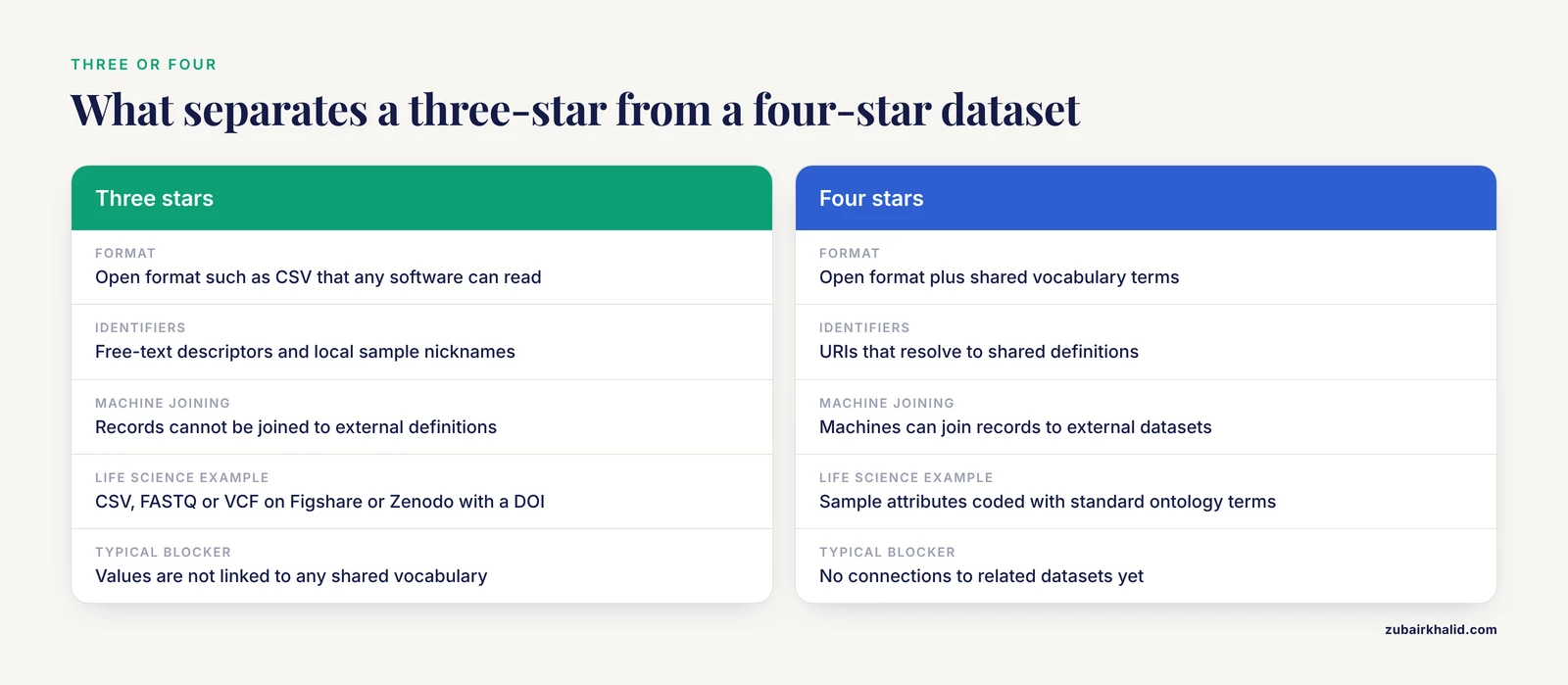
Three stars means the data is in an open format such as CSV that any software can read. Four stars adds standard identifiers, meaning the entities in your data carry web resolvable URIs or shared vocabulary terms, so machines can join your records to external definitions and datasets.
Does five-star open data have to be in RDF?
The classic definition of the fifth star uses RDF linked data, but the underlying goal is machine-traceable connections to other data. In biology, using standard identifiers and cross-linking to public resources achieves most of the practical benefit, and many researchers treat a well-linked four-star dataset as a realistic target.
How does the 5-star rating relate to FAIR principles?
The FAIR principles, which state that data should be findable, accessible, interoperable, and reusable, are broader and more detailed. The star scheme is a simpler, cumulative packaging score. A dataset can be FAIR-compliant while sitting at roughly three or four stars, and the two frameworks push in the same direction [15].
Is a 5-star rating required for journal data sharing?
No. Journals and funders typically require deposition in an accessible repository with appropriate documentation, which corresponds to about three stars. They rarely require RDF linked data, though higher star levels make your data more attractive for reuse and citation.
What is the quickest way to add a star to an existing dataset?
Export a proprietary spreadsheet to CSV with clean headers and a data dictionary, then deposit it in a repository with a DOI and an open license. That single step usually moves a dataset from two stars to three and takes an afternoon.
Do star ratings measure data quality?
No. The stars measure how reusable the packaging of a dataset is, not whether the data was collected well or whether the conclusions drawn from it are correct. A five-star dataset of poor experiments is still five stars, and a crucial low-throughput dataset may earn fewer stars while remaining scientifically valuable [1].
Sources
- Best practices for data management and sharing in experimental biomedical research.
- MedicalDataHandler, a research-oriented graphical user interface for DICOM data management.
- A roadmap to artificial intelligence (AI): Methods for designing and building AI ready data to promote fairness.
- The long way from raw data to NAM-based information: Overview on data layers and processing steps.
- Assessment of Consumer Complaint Investigation Scores, Recertification Survey Scores, and Overall Nursing Home Health Inspection Star Quality Rating.
- Simulating the Overall Hospital Quality Star Ratings With Random Measure Weights.
- An Automatic Data Extracting Method for REDCap Folder Mapping: An Example for Cardiological Clinical Case.
- Automated pipeline for operant behavior phenotyping for high-throughput data management, processing, and visualization.
- A reproducible R workflow for harmonizing indoor air quality sensor data and cleaning activity logs in school-based field campaigns.
- IntegriLAB: a blockchain-enabled electronic lab notebook for reproducible neuroimaging research.
- A Comprehensive Integrated Pipeline for Detection and Annotation of Variants in Whole Exome Sequencing Data.
- ILIAD: a suite of automated Snakemake workflows for processing genomic data for downstream applications.
- PhytoOracle: Scalable, modular phenomics data processing pipelines.
- Meta-EEGs: A structured approach for processing high-volume EEG data.
- Big data approaches to bovine bioacoustics: a FAIR-compliant dataset and scalable ML framework for precision livestock welfare.
- Addressing data management and analysis challenges in viral genomics: The Swiss HIV cohort study viral next generation sequencing database.