How to Prepare for Your Dissertation Defense in 30 Days
By Dr. Zubair Khalid, DVM, MS, PhD ·

By the end of this article you will have a day-by-day 30 day dissertation defense preparation plan, a timed presentation deck, a rehearsed answer bank for the questions your committee is most likely to ask, a technical backup routine, and a checklist for the final week. You will know exactly what to do on each day, what to produce, and how to tell whether you are actually ready.
Before you start, have these on hand:
- A complete or near-complete dissertation draft. This plan assumes the writing is finished. If it is not, see the note on finishing the manuscript in the Common Mistakes section.
- Your graduate school's dissertation handbook or the program website page that describes the defense format, paperwork, and deadlines.
- A calendar with your defense date marked, plus the dates your committee members have confirmed.
- Presentation software you already know (PowerPoint, Keynote, or LaTeX Beamer) and a timer, either a phone stopwatch or a kitchen timer.
- A way to record yourself, such as a phone voice memo app or a video call.
- Two or three colleagues willing to serve as mock committee members.
What a Dissertation Defense Is, in Plain Terms
A dissertation defense is an oral examination in which the candidate presents and defends completed doctoral research to a faculty committee. In the United States the event usually has two parts: a public seminar where you present your work, followed by a closed session where the committee questions you and then deliberates. In the United Kingdom and many Commonwealth countries the whole examination is called a viva voce, Latin for "with the living voice," and it happens across a table with one or two examiners and no public audience.
Three roles matter. The committee chair runs the meeting and usually cannot vote in some programs. The committee members have read your dissertation and will question you on it. The graduate school administrator, where one attends, verifies paperwork and room booking. Exact rules differ by institution, so read your program's handbook in week one and confirm the format, the length of the public talk, whether outsiders may attend, and which forms must be filed before and after the event.
The defense is a very old format
The ritual you are preparing for has been running for centuries. In October 1674, the Transylvanian physician Ferenc Pápai Páriz defended his medical thesis and was inaugurated as a doctor at the University of Basel, an event whose 350th anniversary scholars marked in 2024 [1]. His Latin-language thesis summarized three gynecological cases he had observed [1]. The structure was recognizably the same as today's: a written document, a public oral examination before faculty, and a formal certification at the end.
Two lessons carry over from that history. First, the defense is a public performance, not a private reading of your document, so your preparation should center on speaking and answering, not on rereading. Second, the dissertation is a permanent record. Historians still translate and publish old medical dissertations precisely because the observations in them remain useful long after the defense is forgotten [1]. Your document will outlive your nervousness, which is a useful perspective when the event feels enormous.
Your 30 Day Dissertation Defense Preparation Plan, Step by Step
The table below is the whole plan on one page. Each phase gets a detailed walkthrough after it. The single most used formula in the plan is the slide budget:
slides = (talk length in minutes x 0.9) / 1.2 minutes per slideThe 0.9 factor builds in a buffer so you finish early, and 1.2 minutes per slide is a realistic pace for a content slide that you explain rather than read.
| Days | Phase | Main deliverable |
|---|---|---|
| 1-3 | Audit the manuscript and the rules | Chapter inventory, committee requirement list |
| 4-7 | Draft the talk outline | One-page story outline, slide list |
| 8-11 | Build the deck | Complete slide deck with speaker notes |
| 12-16 | Solo rehearsals | Recorded run-through within time limit |
| 17-21 | Mock defenses | Question log with practiced answers |
| 22-25 | Revision pass | Corrected deck, tightened answers |
| 26-28 | Tech dry run and logistics | Backup files tested, forms confirmed |
| 29-30 | Taper | Light review only, early night |
Days 1 to 3: Audit the manuscript and the rules
On day one, run an inventory of what you actually have. A short script makes this mechanical instead of anxiety-driven. Save the following as defense_audit.py in the folder that holds your dissertation files, adjust the chapter list and the defense date, and run it with python3 defense_audit.py:
import datetime

defense_date = datetime.date(2026, 12, 11)
today = datetime.date.today()
print(f"Days until defense: {(defense_date - today).days}")

chapters = ["intro", "lit_review", "methods",
            "results_a", "results_b", "discussion"]
for ch in chapters:
    with open(f"thesis/{ch}.tex") as f:
        words = len(f.read().split())
    print(f"{ch:12s} {words:>7,} words")
Expected output looks like this:
Days until defense: 30
intro          8,412 words
lit_review    14,880 words
methods       11,206 words
results_a      9,530 words
results_b      8,744 words
discussion    10,215 words
The one parameter that matters is defense_date. Set it to the real date, because every later decision in the plan keys off that number. If the script prints FileNotFoundError: [Errno 2] No such file or directory: 'thesis/intro.tex', your file names do not match the list. Fix the list, not the filenames, since renaming files thirty days out risks breaking cross-references.
On days two and three, do three non-writing tasks. First, read the program handbook entry on defenses and write down the answers to five questions: how long is the public talk, who attends the closed session, which forms need signatures, what is the submission deadline for the dissertation to the committee, and is there a pre-defense meeting. Second, confirm every committee member has the final document, because many schools require distribution a set number of days before the defense. Third, email the chair to confirm the agenda and time limits.
Days 4 to 7: Draft the talk outline
A defense talk is a story with a fixed skeleton: background and gap, research questions, methods in brief, results in the order they answer the questions, and conclusions with limitations. Write the whole talk as one page of bullet points before you open any slide software. The single-page constraint forces you to find the narrative instead of drowning in detail.
A useful drafting rule for dissertation planning of the talk itself: each chapter becomes at most two or three sentences in the outline. If a chapter needs five sentences, you have not decided what its one message is. For a typical five-chapter STEM dissertation, the outline should compress to roughly fifteen bullets.
Also write down, in one sentence each, the two or three findings you would still want the committee to remember if the projector died. Everything in the deck serves those sentences.
Days 8 to 11: Build the deck
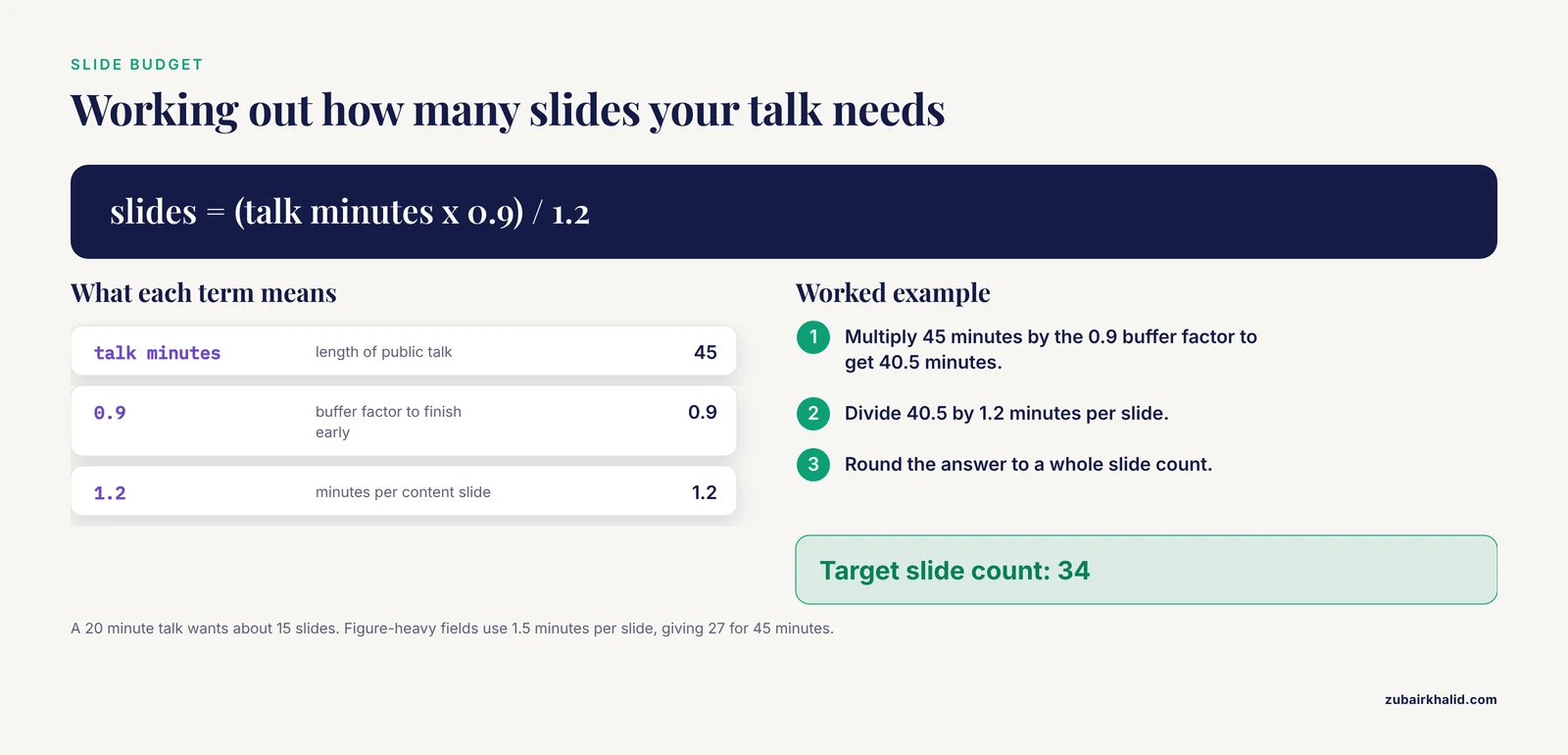
Turn the outline into slides using the budget formula. For a 45 minute talk:
talk_minutes = 45
buffer_factor = 0.9
minutes_per_slide = 1.2

budgeted_minutes = talk_minutes * buffer_factor
slide_count = budgeted_minutes / minutes_per_slide
print(f"Target slide count: {slide_count:.0f}")
Expected output:
Target slide count: 34So a 45 minute talk wants about 34 slides, including the title slide and the thank-you slide. A 20 minute talk wants about 15. If your program's handbook states a different talk length, substitute it in the first line. If your field runs dense figure-heavy talks, such as single-slide multi-panel results figures, use 1.5 minutes per slide instead of 1.2, which drops the 45 minute target to 27 slides.
Build rules that hold up under examination:
- One message per slide, stated in the slide title as a claim, not a topic. "Knockout mice showed 40% lower tumor burden" beats "Results, part 2."
- Every figure needs a takeaway arrow, box, or caption word. Never show raw output without annotation.
- Put your full speaking script in the speaker notes field of every slide, not on the slides.
- Number your slides. Committees say things like "back on slide 12" constantly.
- Build the appendix section after the closing slide: backup slides with extra data, the full methods detail, and the statistical tables you cut from the main deck. These are your ammunition during questioning.
Days 12 to 16: Solo rehearsals, out loud, recorded
Starting day 12, run the full talk aloud, standing, with a timer, once per day. Record it on your phone. Then log the timings so the trend is visible instead of remembered:
rehearsal_minutes = [49.5, 47.0, 45.5, 44.2, 43.8]
average = sum(rehearsal_minutes) / len(rehearsal_minutes)
fastest = min(rehearsal_minutes)
print(f"Average: {average:.1f} min, fastest: {fastest:.1f} min")
Expected output:
Average: 46.0 min, fastest: 43.8 minIf you are more than 10 percent over the limit after two sessions, cut slides rather than talking faster. Talking faster is the most common cause of a defense talk that the committee cannot follow.
Watch one recording per day and check three things: do you say "um" in a pattern you can break, do you read the slides instead of explaining them, and do your hands and eyes behave when you face the camera. Each rehearsal should target one of those fixes.
Days 17 to 21: Mock defenses with a real audience
Days 17 through 21 are the highest-value days in the plan. Recruit two or three colleagues or labmates, hand them your dissertation chapter summaries a few days ahead, and run a full mock defense: 45 minute talk, then at least 45 minutes of hostile questioning. Ask your mock committee to interrupt you mid-slide, because real committees do.
Set up a question log the first day so every question gets captured and answered once:
mkdir -p defense_prep/rehearsals defense_prep/questions
printf "date,question,who_asked,my_answer,needs_work\n" > defense_prep/questions/log.csv
Expected result is a file containing the header row:
date,question,who_asked,my_answer,needs_workAfter each mock defense, fill in one row per question the same day while your answers are still fresh. Mark needs_work with a simple yes or no. By day 21 this log is your personalized study guide, and it is far more valuable than any generic list of "common defense questions" because it contains what your own committee's field actually cares about.
Run at least two mocks, ideally three, and make at least one mock mean: tell your colleagues beforehand that the goal is a hard examination, not encouragement. A soft mock teaches you nothing about your failure modes.
Days 22 to 25: Fix what the rehearsals exposed
Work the question log. Every question marked needs_work gets a rehearsed answer of 60 to 90 seconds, structured as: restate the question in your own words, give your direct answer, give the evidence, acknowledge the honest limitation if there is one. Practice these answers out loud, not on paper. Written answers read like written answers when spoken.
Also fix the deck. The typical revision list at this stage: delete any slide you consistently skip, retitle vague slide titles as claims, move any content you keep apologizing for into the appendix, and re-run the timing script to confirm you are inside the window.
Days 26 to 28: Tech dry run and logistics
Spend day 26 on the room and the equipment. If your defense is in person, go to the actual room, connect your laptop to the actual projector, and click through the deck. If it is remote or hybrid, do a full video-call dry run with one colleague, testing screen share, audio, and the chat window for questions.
Day 27 is the backup day. Export the deck to PDF as well as the native format, because PDF survives font substitution. Store copies in three places: your laptop, a USB drive, and cloud storage. If you write in LaTeX, compile a final clean PDF and fix every missing reference.
Day 28, confirm the paperwork and people: forms signed, room booked, chair briefed, committee attendance confirmed, water and clock arranged. Then stop working.
Days 29 and 30: Taper
Do a single light run of the talk on day 29 and nothing new on day 30. Review your one-page outline and your top ten question answers. Sleep. An under-rehearsed candidate who slept cannot be rescued by a final all-nighter, and an over-rehearsed candidate who slept performs better than either.
Answering the Committee's Questions Well
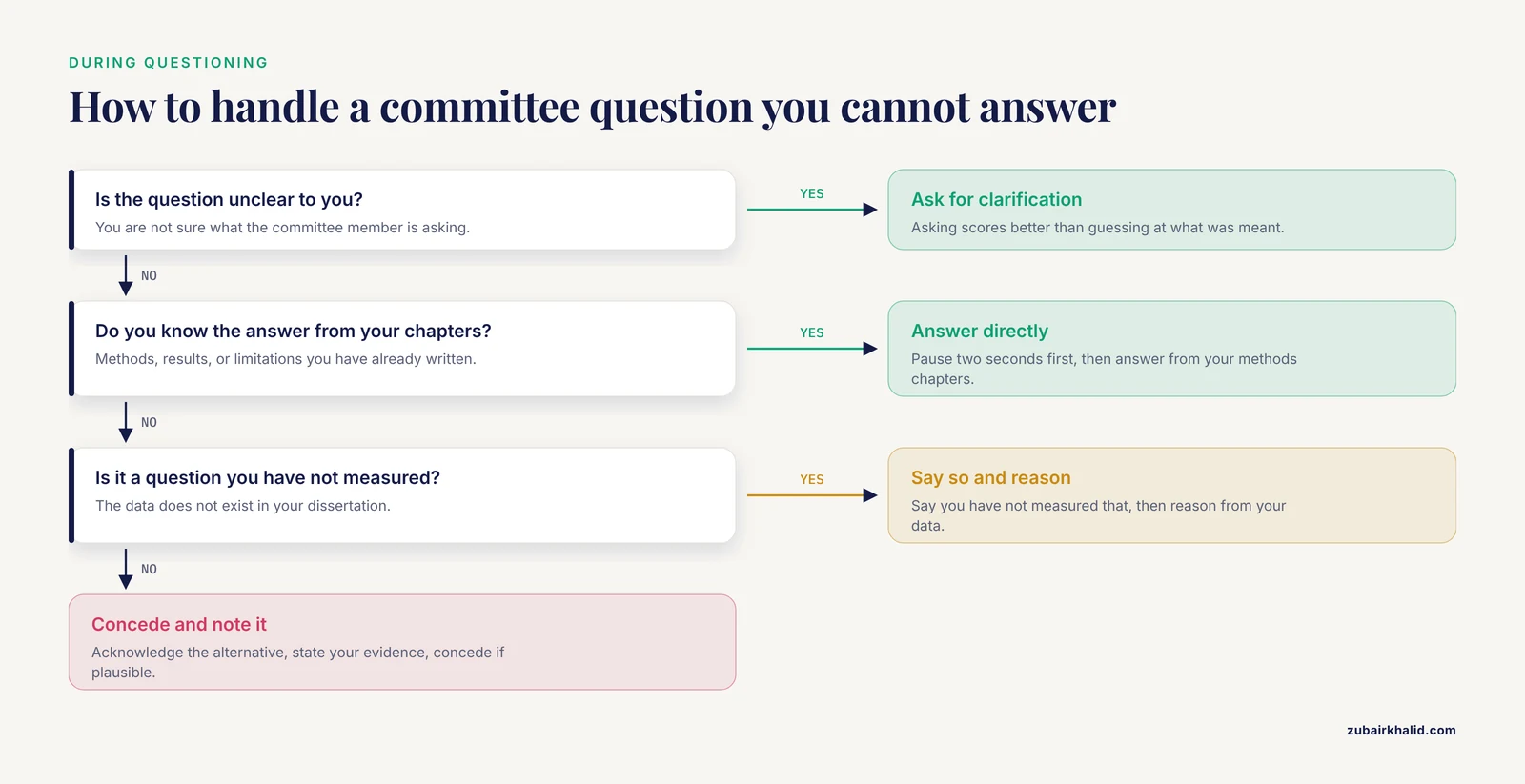
Committee questions fall into predictable categories, and you can prepare one answer skeleton for each:
- Clarification questions about what you did. Answer directly from your methods chapters.
- Alternative interpretation questions, such as "could this result be explained by a confounder." Acknowledge the alternative, state your evidence against it, and concede gracefully if the alternative is plausible.
- Limitation and generalization questions. Never defend a limitation as if it were not a limitation. Name it, explain its likely size, and state how you would address it in future work.
- Future direction questions. Have two concrete next experiments ready.
- Field context questions that reach beyond your chapters. Answer honestly at the level you know, and say "I have not worked on that directly, but my understanding is" when you need to.
The strongest general behavior during questioning is to pause before answering. Two seconds of silence feels long to you and thoughtful to the committee, and it stops the most common error, which is answering a question the committee did not actually ask. If a question is unclear, asking for clarification scores better than guessing.
Common Error Messages and Technical Failures, and Their Fixes
! LaTeX Error: File 'results_fig4.pdf' not found.This appears during the final compile when a figure was renamed or lives in another folder. Fix it by correcting the filename in the source or adding the folder with a graphics path command, then recompile and confirm the PDF has zero errors. Do this on day 27 at the latest, never the morning of the defense.CONFLICT (content): Merge conflict in chapter3.texfrom Git. A version-control conflict surfacing in the final week means two copies of the manuscript were edited in parallel. Resolve it immediately, then freeze the repository and work on exported copies only until after the defense.- Fonts rendering differently on the podium computer. Slides built in PowerPoint or Keynote often lose custom fonts on another machine, which shifts text and overflows boxes. Fix it by embedding fonts in the file settings or by presenting the exported PDF, which freezes the layout.
- The talk runs over time only when projected in the room. This is usually caused by a display that changes your slide aspect ratio, forcing impromptu re-explanation. The dry run in the actual room on day 26 exists precisely to catch this.
- Microphone or screen-share failure at the start. Arrive 20 minutes early, start the recording or call, and share one trivial slide before anyone else arrives, so the failure happens when it costs nothing.
How to Verify You Are Actually Ready
Objective readiness signals, not feelings:
- Three consecutive rehearsals land inside your time window, ideally 5 to 10 percent under the limit.
- Every slide has speaker notes and a numbered title.
- Your question log has at least 40 questions from mocks, and none of them are still marked
needs_work. - The deck, the PDF export, and the dissertation PDF open correctly from the USB drive and the cloud copy on a computer that is not yours.
- Your paperwork is signed and filed per the program handbook.
- You can state your dissertation's central finding in one sentence, from memory, under five seconds.
If any item fails, you still have the corresponding day in the plan to fix it. That is the point of a dated checklist over a vague intention.
Common Mistakes and Limitations
- Preparing the manuscript during the 30 days. The plan above only works if the dissertation is essentially finished. If it is not, the honest priority is how to finish the dissertation first, and the defense date should move. Most graduate schools allow rescheduling with the committee's agreement, and defending on a manuscript you are ashamed of is worse than defending six weeks later on one you are proud of.
- Rehearsing silently. Reading slides at your desk is not rehearsal. Speaking is a physical skill, and it only improves out loud, standing, under time pressure.
- Treating the mock defense as a courtesy review. If your colleagues are kind for 45 minutes, you learn nothing. Ask them in advance to be adversarial.
- Rereading the dissertation cover to cover in the final week. You wrote it. Rereading produces dread, not readiness. Work from your outline and question log instead.
- Answering the question you wished they had asked. Committees notice this immediately, and it costs more credibility than any wrong answer.
- Arguing with the committee. Defend your decisions with evidence, concede reasonable points quickly, and remember that the committee approved you into this exam in the first place. The examination is a verification step, not an ambush.
- Ignoring the talk length rules. A 60 minute talk in a 45 minute slot cuts your question time, and committees penalize it.
- Overloading slides with dissertation text. The deck is a visual aid for a story, not the document in bullet form.
- One limitation of any plan like this: formats vary by institution and by country. Some programs include a separate pre-defense or candidacy meeting, some require a public lecture with outside attendees, and some conduct the entire examination privately. Individual situations also differ, and your graduate program's handbook and your committee chair are the authoritative sources for your specific requirements. When the handbook and any general guide, including this one, disagree, the handbook wins.
Frequently Asked Questions
How long should my defense presentation be?
Match the length your program's handbook specifies, which is commonly 20 to 45 minutes in US programs. Use the slide formula in this article to set your slide count, and rehearse to finish about 10 percent under the limit.
What should I do if I do not know the answer to a committee question?
Say so directly, then reason out loud from what you do know. "I have not measured that, but based on my data I would expect" is a strong answer, and a confident guess dressed up as knowledge is a weak one.
Should my advisor do a mock defense with me?
Yes if they are willing, and also run at least one mock with people who are not your advisor, because your advisor already knows your work and will not reproduce a stranger's questions.
How many times should I rehearse my defense talk?
Plan on at least five full run-throughs: four solo sessions in days 12 to 16 and at least one full mock in days 17 to 21, with two or three mocks if you can recruit the audience.
What do I bring to the defense?
Bring your laptop, the USB drive with the PDF export, a printed copy of your one-page outline and top questions, water, and any signed forms the handbook requires. Confirm whether the school wants printed copies of the dissertation in the room.
Can committee members fail you at the defense?
Yes, though outright failure after a committee has allowed the defense to proceed is uncommon. The realistic risks are a verdict of pass with revisions, where you receive required corrections to the manuscript, so listen carefully during the deliberation results and write down every requested change.
What is the difference between a defense and a viva voce?
They are the same examination under different national traditions. The US defense usually includes a public talk plus a closed committee session, while the UK-style viva voce is a private oral examination with one or two examiners and no public presentation.
How far in advance should I schedule my defense?
Schedule it as soon as your committee agrees the manuscript is close, because committee calendars and room bookings fill up and many schools require the dissertation to be distributed weeks before the date. Give yourself at least the 30 days in this plan after the final document goes to the committee.
Sources
- [[Translation from Latin to Hungarian of the thesis of Ferenc Pápai Páriz at the 350th anniversary of his defense and medical inauguration at the University of Basel].](https://pubmed.ncbi.nlm.nih.gov/39550727/)