
Bioinformatics vs. Computational Biology: What's the Difference (and Which Should You Choose)?
Search this and you will find ten answers that contradict each other, and people insisting the terms are identical. From someone who works across both: they overlap heavily, the job market often uses the labels interchangeably, and there is a real, useful distinction underneath. Knowing it helps you pick the right courses, the right programs, and the right way to describe yourself to employers.
The short answer
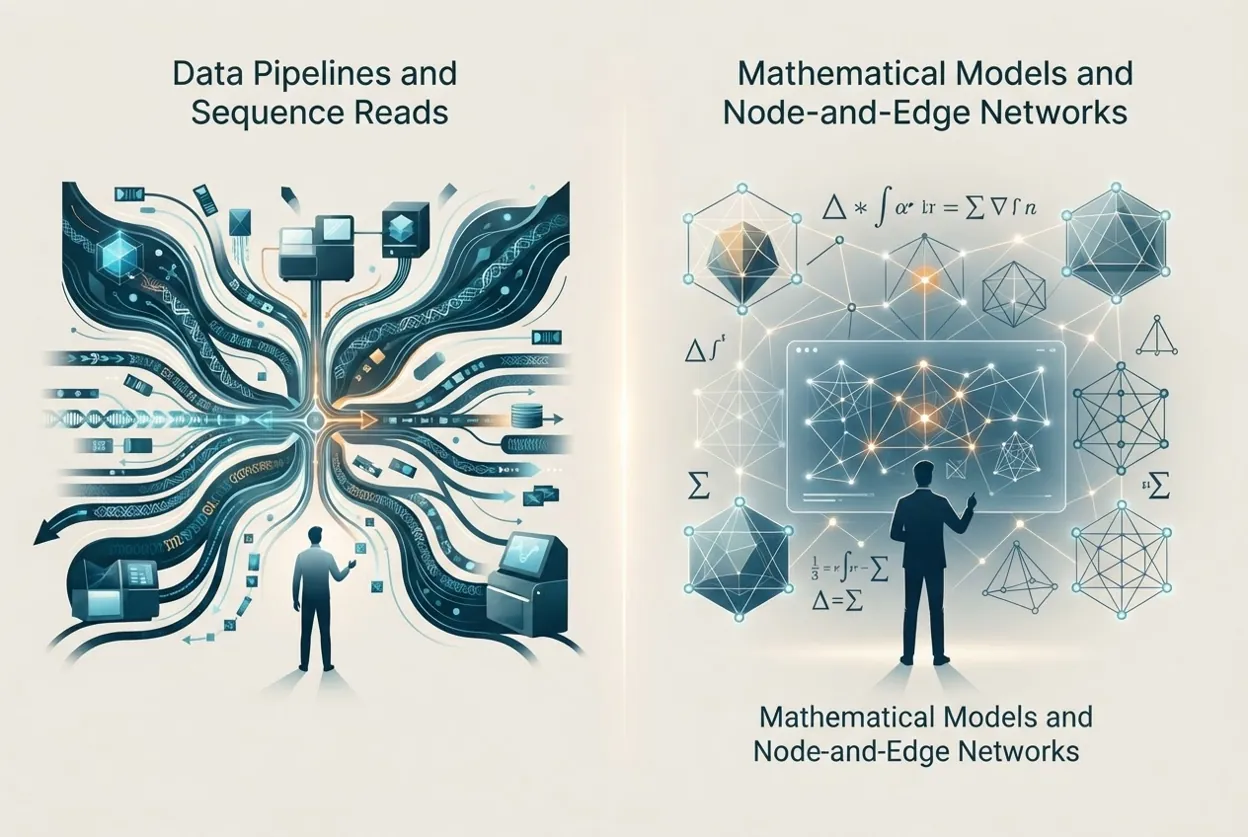
- Bioinformatics is primarily about building and applying tools and pipelines to process, manage, and analyze biological data. It's data-first and method-application-heavy: aligning sequences, calling variants, quantifying gene expression, managing databases, running workflows.
- Computational biology is primarily about using computation, math, and modeling to understand biological systems. It's question-first and theory-heavy: modeling how a protein folds, how a population evolves, how a network behaves.
A rough analogy: bioinformatics leans toward the engineering and analysis of biological data; computational biology leans toward the modeling and theory of biological systems. One builds and runs the machinery that turns data into results; the other builds models that explain why biology behaves as it does. In practice, most people do some of both.

Where they overlap (which is most of the time)
The confusion is understandable. In real labs and real jobs, the line blurs constantly. A single project might involve aligning sequencing reads (bioinformatics) and then modeling the evolutionary process that produced them (computational biology). Job titles use both words for the same role. University programs are frequently named "Bioinformatics and Computational Biology" precisely because separating them is artificial at the working level.
So if you're early in your journey, don't agonize over which one you're "doing." The foundational skills, programming, statistics, biology, the command line, are shared. You can specialize later, and you'll likely drift across the line depending on the problem in front of you.
A concrete way to tell them apart
When you're not sure which side a task falls on, ask: am I processing data, or modeling a system?
- Processing data (bioinformatics): "Align these reads to the reference and find the variants." "Quantify gene expression across these samples." "Build a pipeline to run this on 500 genomes."
- Modeling a system (computational biology): "Predict this protein's 3D structure." "Simulate how this drug binds its target." "Model how this trait spreads through a population."
Both require code and biology. The difference is whether the deliverable is a processed result from data or a model that explains or predicts behavior.
Skills and background
The overlap is large, but the emphasis differs:
- Bioinformatics rewards data engineering: fluency in Python/R, the command line, workflow managers, file formats, and domain analysis (genomics, transcriptomics, microbiome). Strong biologists who learn to code do well here.
- Computational biology rewards quantitative depth: more mathematics, statistics, physics, and modeling. People from math, physics, or CS backgrounds often gravitate here.
If your strength is biology and you want to be productive quickly, bioinformatics is usually the more natural on-ramp. If you love mathematics and modeling, computational biology will feel like home.
Salary and job market
For practical purposes, salaries are similar because the roles overlap and employers use the titles loosely. What moves pay is the specific skills you bring. Software engineering and machine learning command the highest salaries in either field, and industry pays more than academia across the board. Choose based on the kind of work you want to do, and build the high-value skills within it.
Which should you choose?
- Choose bioinformatics if you come from biology, want to be hands-on with real data quickly, and prefer building/running analyses to deriving models. It's the faster on-ramp for most life scientists.
- Choose computational biology if you love math and modeling, come from a quantitative background, and want to work on the theory of how biological systems behave.
- Honestly? Learn the shared foundation first, then let the problems you enjoy pull you toward one side. The core skills are the same, and the most valuable people can move between them.
Frequently asked questions
Is bioinformatics the same as computational biology?
Not exactly, but they overlap heavily and are often used interchangeably in jobs and programs. Bioinformatics leans toward building and applying tools to analyze biological data; computational biology leans toward modeling and theory to understand biological systems. Most practitioners do some of both.
What is the main difference between bioinformatics and computational biology?
The clearest test: bioinformatics is usually about processing and analyzing data (alignment, variant calling, expression quantification), while computational biology is usually about modeling systems (protein folding, evolutionary dynamics, drug binding). One is data-first and engineering-flavored; the other is question-first and theory-flavored.
Does bioinformatics or computational biology pay more?
Pay is similar because the roles overlap and titles are used loosely. What drives salary is your specific skills, software engineering and machine learning pay most in either field, and whether you are in industry (higher) or academia (lower).
Which is better, bioinformatics or computational biology?
Neither is universally better. Bioinformatics is the more natural, faster on-ramp for biologists who want to work with data; computational biology suits those who love math and modeling. Choose based on the work you enjoy, since the foundational skills are shared.
Do I need to know a lot of math for bioinformatics?
Less than for computational biology. Bioinformatics needs solid statistics (distributions, hypothesis testing, multiple-testing correction) more than advanced math. Computational biology is more mathematics- and modeling-heavy.
Where to go next
Whichever side attracts you, the starting skills are the same. Begin with How to Learn Bioinformatics from Scratch, a roadmap for biologists with no coding background that covers the shared foundation. To weigh programs and funding, see the degrees, certificates, and scholarships guide, and to understand the job roles, read the bioinformatics jobs guide. For the methods in action, browse the bioinformatics knowledge base.
Don't let the terminology paralyze you. Learn the shared foundation, do real work, and the distinction will sort itself out as you discover which problems you can't stop thinking about.
Written by Zubair Khalid, DVM, MS, PhD, a researcher who works across data analysis and modeling in virology, bioinformatics, and comparative medicine.