Online DNA Translation Tool: Options Compared
By Dr. Zubair Khalid, DVM, MS, PhD ·
An online DNA translation tool converts a nucleotide sequence into a protein sequence by applying a codon table, and the available options differ mainly in how much they build around that conversion, from bare paste-and-translate pages to open reading frame finders and full workflow platforms. The rule of thumb is simple. If you already know where your coding sequence starts and stops, use a simple translator. If you do not, use an ORF finder. If you will repeat the task on many sequences or chain it to other analyses, use a workflow platform.
This guide is written for biology students, researchers, and anyone building a life science skill set. It compares the main options, sets out the pros and cons of each, walks through worked scenarios, and shows where translation fits in a larger analysis pipeline.
What a DNA Translation Tool Actually Does
Translation reads a nucleotide sequence in triplets called codons and writes the matching amino acid for each one. The standard genetic code contains 64 codons, 20 amino acids, and 3 stop codons (TAA, TAG, and TGA in DNA notation). The code is degenerate, meaning several codons can specify the same amino acid. Leucine, for example, has six codons. Under the standard code, ATG encodes methionine and usually marks the start of a gene.
A quick example shows why precision matters. The sequence ATG GAA TCC translates as methionine, glutamate, serine. Read one base later, the same stretch gives TGG AAT, which encodes tryptophan and asparagine. Every downstream amino acid changes with the frame.
Three details decide whether a translation is correct.
Reading frame. Any double-stranded DNA molecule can be read in six frames, three on each strand. Shifting the start position by one base changes every codon that follows. A six-frame translation shows all six possibilities at once and is the default output for many tools.
Genetic code table. The standard code covers most nuclear genes, but variants exist. In the vertebrate mitochondrial code, UGA encodes tryptophan rather than stop. In bacteria, GUG and UUG can act as start codons and are read as methionine at initiation, even though they encode valine and leucine during elongation. A tool that lets you pick the code table prevents silent errors.
Strand handling. A gene can sit on the strand you pasted or on the opposite strand. Tools handle this with a reverse complement operation, which flips the sequence and swaps A with T and C with G. Good translators do this automatically when you request the reverse frame.
Two output conventions appear everywhere. FASTA is the standard text layout for sequences, with a description line beginning with ">" followed by the sequence itself. Outputs use the one-letter amino acid code, so methionine appears as M and tryptophan as W, and stop codons appear as a dash or an asterisk depending on the tool. Ambiguity codes from the IUPAC notation, such as N for any base and R for a purine, translate to X, because no single amino acid matches an uncertain codon.
Translation itself is deterministic. Given the same sequence, frame, and code table, every correct tool returns the same protein. That is why the choice between options depends on workflow fit rather than on which tool computes codons correctly.
The Main Options at a Glance
The online DNA translation tool options fall into five groups, and each group has distinct pros and cons. The table compares them side by side.
| Option | What it is | Best for | Pros | Cons |
|---|---|---|---|---|
| ExPASy Translate | Single-sequence web translator | One known coding sequence | No login, accepts DNA or RNA, frame and code selection, instant result | One sequence at a time, nothing saved, minimal output options |
| EMBOSS Transeq | Translator from the EMBOSS suite, offered through EMBL-EBI | Formatting-sensitive jobs and unusual code tables | Six-frame output, many codon tables, standard formats, scriptable | Utilitarian interface, more parameters to set |
| NCBI ORFfinder | Graphical open reading frame finder | Locating genes in unannotated sequence | Scans all six frames, lists ORFs with coordinates, forwards candidates to BLAST | Needs interpretation, short ORFs add noise |
| EBWS applets | Lightweight suite of sequence analysis applets | Quick side tasks around translation | Free without restrictions, regex pattern search, restriction cutting [1] | Prokaryotic ORF finder focus, simple interface |
| Galaxy | Open workflow platform | Batch translation and multi-step pipelines | Point-and-click, saved histories, reusable workflows, domain toolsets such as PDAUG [2] | Learning curve, free public servers can be busy |
| Benchling and SnapGene | Annotation and cloning platforms | Construct design and lab teamwork | Translation tied to features, primers, and maps, shared projects | Accounts required, more tool than a one-off translation needs |
| Jalview with DRSASP | Desktop workbench connected to web services | Translation feeding alignment and structure prediction | Multitool interactive workflows plus APIs [3] | Desktop install alongside the web services |
The sections below explain each group on its own terms.
Option Profiles
Simple Single-Sequence Translators
ExPASy Translate, part of the ExPASy bioinformatics portal run by the Swiss Institute of Bioinformatics, is the classic example. You paste a DNA or RNA sequence, choose one, three, or six frames, pick the genetic code table, and read the protein sequence immediately. Stop codons appear as separator characters in the output. The Sequence Manipulation Suite, an older collection of small single-purpose web tools, sits in the same family, and back-translation tools that work from protein back to degenerate DNA belong to this group as a separate task.
The pros are speed and zero setup. Nothing to install, no account, works from any browser, and ideal for checking that a cloned insert reads through in frame or for pulling a protein sequence to feed a parameter calculator. The cons are just as clear. You translate one sequence at a time, nothing is saved between sessions, and the output is a bare protein sequence without coordinates, features, or annotations. If your work grows past a handful of sequences, you will outgrow this group quickly.
ORF Finders
An open reading frame (ORF) is a run of codons that begins with a start codon, ends with a stop codon, and contains no internal stops. ORF finders scan all six frames of your sequence and list every ORF they detect, usually with coordinates and lengths.
NCBI ORFfinder is the reference tool in this group. You paste a nucleotide sequence, select the genetic code, and the tool draws all six frames, lists the ORFs it finds, and lets you send a selected ORF straight to BLAST (Basic Local Alignment Search Tool, the standard similarity search program). The Essential Bioinformatics Web Services (EBWS) suite offers a prokaryotic ORF finder among its nine web applets, alongside a pattern searcher that accepts regular expressions (regex), a compact notation for describing sequence motifs [1].
The pro is that ORF finders answer the question a plain translator cannot, namely where a gene might start and stop in sequence you know nothing about. The cons are interpretation burden and noise. Real genes produce long ORFs that start with ATG (or GUG and UUG in bacteria) and end with a single terminal stop, while most short ORFs are random. An ORF finder also cannot splice, so genomic DNA that contains introns shows a coding sequence broken across several ORFs. Use cDNA, DNA copied from a mature mRNA transcript, when you want a clean protein product.
Suite Translators
EMBOSS Transeq is the workhorse of this group. EMBOSS is a long-established open-source sequence analysis package, and Transeq is its translation program. It performs six-frame translation, accepts many genetic code tables, handles reverse strand output, and writes results in the standard formats that downstream tools expect. You can run it through web forms or on the command line, which makes it the natural choice when output formatting matters or when the job belongs to a script.
Jalview, connected to the Dundee Resource for Sequence Analysis and Structure Prediction (DRSASP), extends the same idea into a workbench. DRSASP provides web services for multiple sequence alignment, disorder prediction, amino acid conservation, and secondary structure prediction, and integrates them into Jalview so multitool interactive workflows can be composed in one place [3]. Its services have completed over 1.5 million jobs since 2016, a sign of how much routine sequence analysis now runs through servers of this kind [3]. Translation inside Jalview feeds those downstream views directly, so a nucleotide sequence you paste can become an aligned, annotated, structure-predicted protein without leaving the workbench.
The pros are flexibility, formatting control, and a path into downstream analysis. The cons are a plain interface and more parameters to understand before the first run.
Workflow Platforms
Galaxy is the leading open workflow platform for life science. You chain tools through a point-and-click interface, every step is recorded in a history, and histories can be saved, shared, and rerun as reproducible workflows. Translation tools from the EMBOSS family run inside Galaxy, so batch translation of dozens or hundreds of sequences becomes a routine job rather than a browser marathon.
Galaxy also hosts domain-specific toolsets. PDAUG, a Galaxy-based collection for peptide library analysis, adds library generation, feature calculation, visualization, and machine learning modeling through a graphical interface, with no programming required [2]. GENAVi, a Shiny web application (built with Shiny, a framework for interactive web applications in the R language) for gene expression analysis, shows the same design philosophy in another domain, making complex workflows usable by scientists without programming expertise [4].
The pros are batch processing, reproducibility, and chaining. The cons are a real learning curve for workflow building and occasional queues on free public servers.
Annotation and Cloning Platforms
Benchling, a web platform, and SnapGene, a desktop program with a free viewer, treat translation as one layer inside a fuller model of a construct (an engineered DNA molecule such as a plasmid). Sequences carry annotations, features, primers, and maps, and translated reading frames display directly on the map. Shared projects let a lab work on the same constructs together.
The platform idea has reached protein analysis as well. PROFASA is a protein workstation that combines structure visualization with one-click model construction through I-TASSER or AlphaFold2, protein parameter calculation, and real-time collaboration with shared projects and note sharing [5].
The pros are context and teamwork. Translation sits next to the primers you will order and the restriction sites you will cut, which prevents design errors. The cons are accounts, platform lock-in, and more machinery than a one-off translation needs.
Cloud-Scale and API-First Services
A final group matters when translation feeds searches or predictions at scale. ElasticBLAST runs BLAST on cloud infrastructure, handling anywhere from a few to many thousands of queries on thousands of virtual processors, on Amazon Web Services and Google Cloud Platform, and it deletes its resources when finished [6]. PERCEPTRON-PTMKB, a server for scoring post-translational modification sites, exposes its search and scoring pipelines through a RESTful API, an interface that other programs can call over the web [7]. DRSASP likewise offers its services through conventional web interfaces and APIs [3].
The pros are scale and automation, since APIs let you pipe translated sequences into downstream services without manual copy and paste. The cons are setup effort and, for cloud options, cost management.
Translation and the Wider Biology Calculator Family
Translation rarely stands alone. The web servers that host translators usually host a panel of biology calculator applets as well, and the protein you produce becomes the input for a second tier of bioinformatics calculator tools.
EBWS illustrates the pattern on the nucleotide side. Its applets include melting temperature calculators for DNA/DNA, RNA/RNA, and DNA/RNA hybrids, an annealing temperature calculator for multiplex PCR, a restriction cutter backed by a database of 1,502 restriction enzymes, and random sequence and mutation generators [1]. On the protein side, dedicated resources calculate molecular weight, isoelectric point (pI, the pH at which a protein carries no net charge), and the mass shifts caused by post-translational modifications (PTMs), the chemical changes such as phosphorylation that are added to proteins after translation [8]. PROFASA folds these parameter calculations into its workstation alongside structure modeling [5].
A practical habit follows. Treat translation as the first step in a short calculation chain. Translate the coding sequence, compute the protein's molecular weight and pI, and compare the values against expectations for the protein family you expect. A mismatch often flags a wrong frame or a wrong code table before you go further.
Choosing an Online DNA Translation Tool
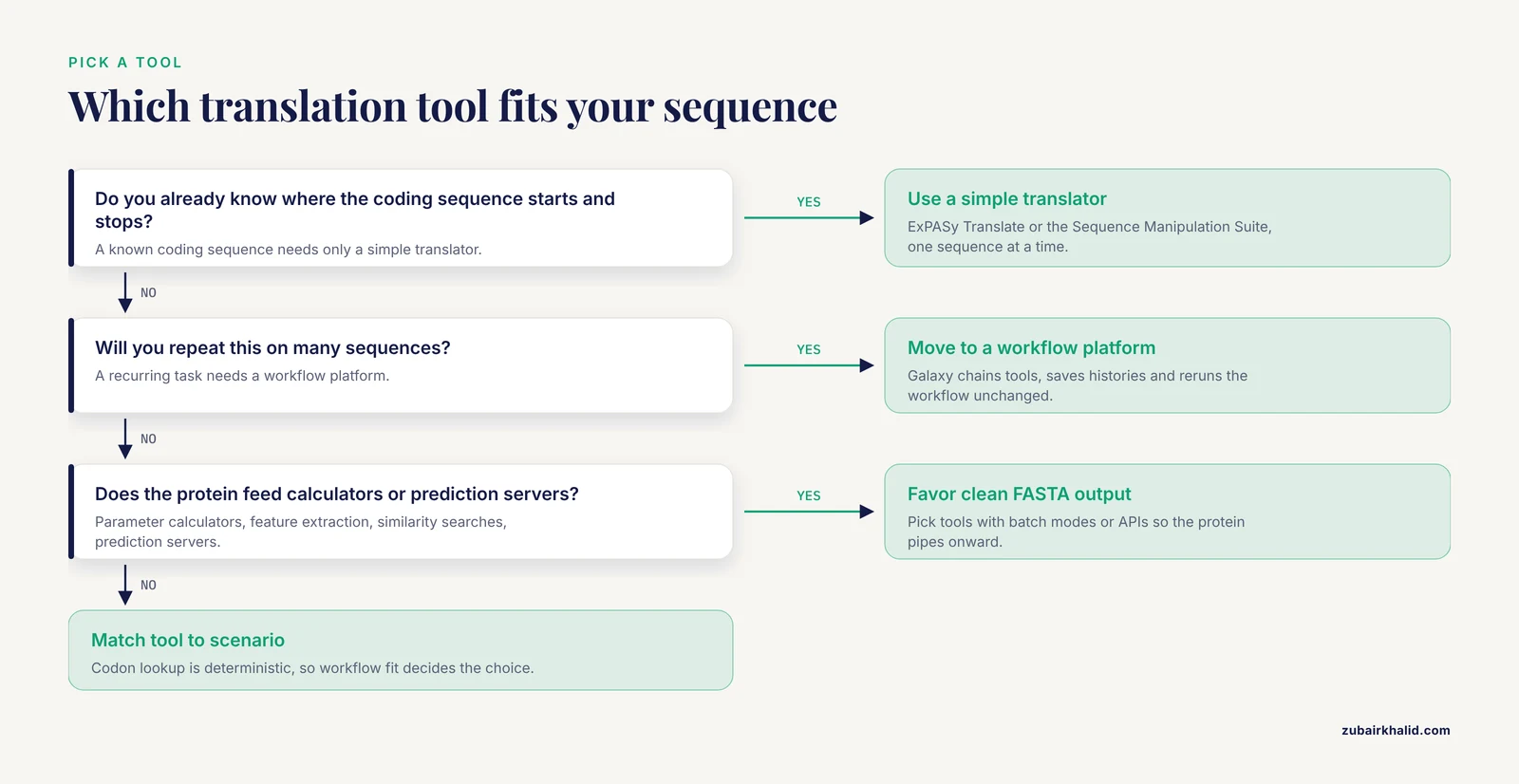
Translation accuracy will not decide the choice, because codon lookup is deterministic and every correct tool returns the same protein. Workflow fit decides it. The review literature on sequence analysis tools frames selection the same way, as scenario-driven decision-making that weighs consistency, efficiency, robustness, and computational cost for each use case [9].
Work through five questions.
- What do you already know? A known coding sequence needs only a simple translator. Unannotated sequence needs an ORF finder. A recurring task needs a workflow platform.
- Which genetic code applies? The standard code for most nuclear genes, a mitochondrial code for mitochondrial sequences, and the bacterial code when bacterial initiation codons are in play.
- What shape is the input? cDNA translates cleanly. Genomic DNA with introns produces broken ORFs. Ambiguity codes produce X residues. RNA is accepted by most translators, which read U as T.
- What happens next? If the protein sequence feeds parameter calculators [8][5], feature extraction [10], similarity searches [6], or prediction servers [7][11], favor tools with clean FASTA output, batch modes, or APIs.
- How sensitive is the data? Paste-based pages process the sequence and typically discard it, while account platforms store data in projects. For unpublished sequences, check a server's data policy before uploading.
The pros and cons across all groups reduce to one trade. Paste-and-go tools win on immediacy. Platforms win on reproducibility, scale, and downstream reach. For coursework, simple translators also teach the codon table fastest, because you see every codon beside its amino acid. Finally, prefer maintained services with documented performance, and when a tool makes predictions rather than plain conversions, check whether it has been benchmarked on independent data, as the leading HLA peptide-binding predictors have been on 21,101 experimentally verified ligands across 19 HLA-I allotypes [12].
Worked Scenarios
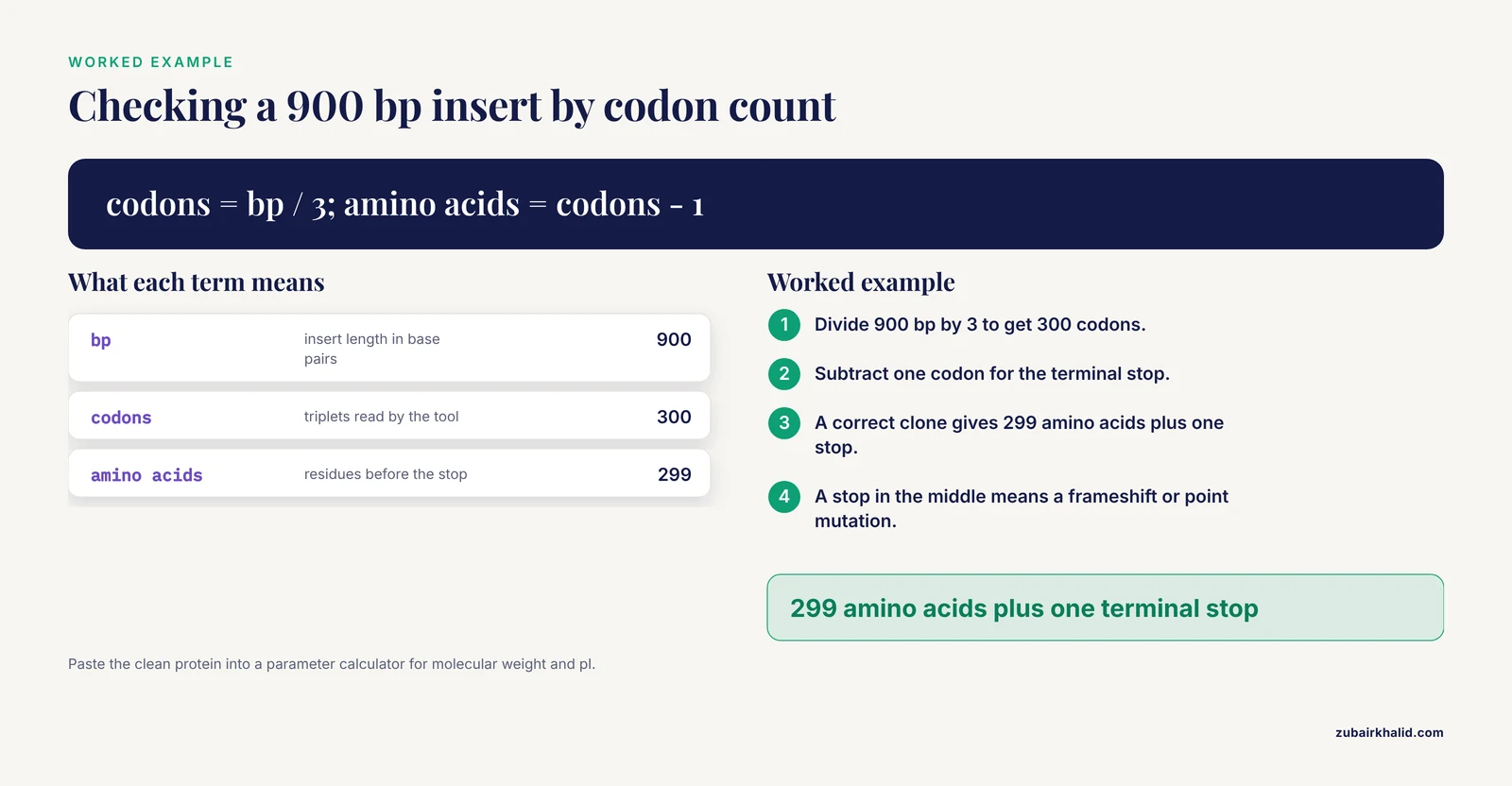
Scenario 1. Verifying a cloned insert. You sequenced an insert expected to be 900 base pairs (bp). Paste it into a simple translator, select the forward frame, and apply the standard code. 900 bp equal 300 codons, so a correct clone gives 299 amino acids plus one terminal stop. A stop codon in the middle means a frameshift or an unwanted point mutation. Once the protein reads clean, paste it into a parameter calculator for molecular weight and pI [8][5].
Scenario 2. Hunting genes in a 5 kb bacterial fragment. Paste the fragment (5,000 bp) into NCBI ORFfinder, select the bacterial code table, and review the six-frame output. Long ORFs that start with ATG, GUG, or UUG and end with a single stop are candidates. Send the top candidates to BLAST to confirm identity against known sequences. Ignore the swarm of short ORFs, which are random noise. If several candidates overlap on opposite strands, look at expression data or conservation before trusting either one.
Scenario 3. A recurring batch with machine learning downstream. A lab translates 200 coding sequences each month and trains classifiers on the products. In Galaxy, upload the FASTA files, run Transeq for batch translation, then pass the proteins to iLearn, which integrates feature extraction, clustering, normalization, selection, and dimensionality reduction for DNA, RNA, and protein sequences, with 16 algorithm types and four output formats [10]. Function classifiers such as SubFeat, an ensemble method for predicting the function of DNA, RNA, and protein sequences, consume the resulting features [13]. The saved workflow reruns next month unchanged.
Scenario 4. Designing a synthetic construct. Annotate the construct in Benchling or SnapGene and confirm the intended reading frame on the map before ordering DNA. Plan primers with melting temperature and annealing temperature calculators [1], and check restriction sites against the enzyme database in the same suite [1]. Translation here is a design check, not a discovery step, and catching a wrong frame before synthesis is far cheaper than catching it after sequencing the built clone.
Common Mistakes and Limitations
Off-by-one frame errors. One extra leading base from a sloppy copy-paste shifts every codon. Six-frame output shows many short peptides, and almost all of them are noise. Real ORFs are long, start with a start codon, and end with exactly one stop.
Wrong code table. Running the standard code on a mitochondrial sequence produces the wrong protein. In the vertebrate mitochondrial code, UGA encodes tryptophan rather than stop. Always match the table to the source of the sequence.
Genomic DNA with introns. Translation tools do not splice. A eukaryotic gene pasted as genomic DNA shows a broken ORF interrupted by stops. Translate cDNA or mRNA instead.
Ambiguity codes. IUPAC ambiguity letters such as N, R, and Y translate to X. Runs of X mean the underlying sequence is uncertain. Fix the source sequence rather than ignoring the X.
RNA input assumptions. Most translators accept RNA and read U as T. For RNA-specific questions, such as how a point mutation changes secondary structure, use dedicated tools like RNA2DMut, which evaluates every possible point mutation against the predicted RNA structure ensemble rather than requiring a preexisting structure model [14].
Treating translation as prediction. Translation is deterministic and says nothing about function, modification, localization, or stability. Those questions need dedicated servers for PTM propensity [7], variant impact [11], or sequence function [13].
Batch limits in browser forms. Paste boxes choke on long sequences and on lists of sequences. When the job outgrows the form, move to a workflow platform or the command line.
Server longevity. Small lab-hosted pages change or disappear without notice. For work you will repeat, prefer maintained services with APIs and track records [3], and for prediction tools, prefer ones validated on independent data [12].
The overall limitation is scope. A translation tells you what protein a sequence would encode. Whether that protein exists in the cell, carries modifications, or behaves as expected are experimental questions.
Where Translation Fits in a Larger Pipeline
Translation sits at the head of most protein analysis pipelines.
The protein sequence a translation produces feeds parameter calculations such as molecular weight and pI [8][5]. It feeds feature engineering for machine learning, where iLearn packages extraction, clustering, selection, and dimensionality reduction for DNA, RNA, and protein sequences in one toolkit [10]. It feeds structure work, where PROFASA builds models with one click through I-TASSER or AlphaFold2 [5]. It feeds similarity searches, where BLASTx applies the same codon-table logic on the fly to compare a nucleotide query against protein databases, and where ElasticBLAST scales that search to thousands of queries in the cloud [6].
Specialized servers then take over. PERCEPTRON-PTMKB scores per-residue propensity for post-translational modifications [7]. PredictONCO models the structural and functional impact of cancer mutations in an automated, low-barrier workflow, and its machine-learning predictor reached ROC AUC values of 0.97 and 0.94 (a ROC AUC near 1.0 indicates near-perfect discrimination between true and false calls) on held-out validation data [11]. Function classifiers such as SubFeat extend prediction to whole-sequence function [13].
Two selection principles carry through the whole chain. Match tools to scenarios rather than chasing a single best program [9], and favor services that publish validation on independent datasets [12]. The broader trend is toward graphical interfaces that remove programming barriers, a direction visible in platforms from GENAVi to PROFASA [5][4].
Frequently Asked Questions
What is the best online DNA translation tool?
There is no single best tool, because the right choice depends on the task. For one known coding sequence, a simple translator such as ExPASy Translate is fastest. For unknown reading frames, use NCBI ORFfinder. For repeated or batch work, use a workflow platform such as Galaxy.
Can an online DNA translation tool handle RNA input?
Yes, most translators accept RNA and treat uracil as thymine before translation. For RNA-specific questions such as how mutations affect secondary structure, use a dedicated RNA tool instead.
How do I choose the correct genetic code table?
Match the table to the source of the sequence. Use the standard code for most nuclear genes and a mitochondrial code for mitochondrial sequences, because the codes differ. In the vertebrate mitochondrial code, for example, UGA encodes tryptophan rather than stop.
Why does my translation show dashes or asterisks?
Those marks are stop codons in the frame you selected. One stop at the end of a full-length open reading frame is expected. Stops scattered through the sequence usually mean the frame is wrong or the sequence is not coding.
Do online translation tools store my sequence data?
Paste-based pages typically process the sequence without storing it, while account-based platforms keep data in your projects. Policies vary, so check a server's data policy before uploading unpublished sequences.
Do I need to install software to translate DNA?
No. Every option described here runs in a browser, which is the main advantage of web-based bioinformatics services. Desktop programs such as SnapGene add translation to plasmid design but remain optional.
Sources
- EBWS: Essential Bioinformatics Web Services for Sequence Analyses.
- PDAUG: a Galaxy based toolset for peptide library analysis, visualization, and machine learning modeling.
- The Dundee Resource for Sequence Analysis and Structure Prediction.
- GENAVi: a shiny web application for gene expression normalization, analysis and visualization.
- PROFASA-a web-based protein fragment and structure analysis workstation.
- ElasticBLAST: accelerating sequence search via cloud computing.
- PERCEPTRON-PTMKB: A Web Server for Residue-Based Post-Translational Modification Analysis and Propensity Scoring.
- Web-Based Computational Tools for the Prediction and Analysis of Posttranslational Modifications of Proteins.
- Revisiting Algorithms, Tools, and Applications for Sequence and Phylogenetic Analyses in the NGS-Based Omics Era.
- iLearn: an integrated platform and meta-learner for feature engineering, machine-learning analysis and modeling of DNA, RNA and protein sequence data.
- Analysis of mutations in precision oncology using the automated, accurate, and user-friendly web tool PredictONCO.
- A comprehensive review and performance evaluation of bioinformatics tools for HLA class I peptide-binding prediction.
- SubFeat: Feature subspacing ensemble classifier for function prediction of DNA, RNA and protein sequences.
- RNA2DMut: a web tool for the design and analysis of RNA structure mutations.