Free Bioinformatics Calculators: Best Tools and Examples
By Dr. Zubair Khalid, DVM, MS, PhD ·

By the end of this guide, you will be able to calculate the melting temperature of a primer, convert a DNA sequence into its reverse complement, find open reading frames, estimate a protein's molecular weight and isoelectric point, predict secondary structure, and score how point mutations reshape an RNA molecule, all with free tools. You need a web browser, a plain-text editor, and your sequences saved in FASTA format. Python 3 is optional and appears in only one example.
Free bioinformatics calculators come in two shapes. Single-purpose applets answer one question at a time. The Essential Bioinformatics Web Services (EBWS) collection, for example, implements nine web applets covering melting temperature, open reading frames, restriction digestion, pattern searching, and CRISPR guide generation, all permanently available online without restrictions [1]. Platform-scale resources bundle dozens of calculators behind one interface. The Dundee Resource for Sequence Analysis and Structure Prediction has completed more than 1.5 million analysis jobs since 2016 [2]. This guide covers both, with worked examples you can copy and run today.
What a Bioinformatics Calculator Does
A bioinformatics calculator takes a biological input, usually a DNA, RNA, or protein sequence, and returns a computed value: melting temperature, GC content, molecular weight, isoelectric point, or the coordinates of open reading frames. A biology calculator is the broader term and also covers general lab and genetics math such as solution dilution or allele frequencies. A bioinformatics calculator is the sequence-focused subset of that family.
Three properties separate a useful calculator from a toy:
- A stated method. The tool documents which formula or algorithm it applies, for example the Wallace rule versus nearest-neighbor thermodynamics for melting temperature.
- A defined input format. Most accept FASTA or raw sequence text.
- Reproducible output. The same input returns the same numbers, and you can cross-check against a second tool.
Calculators differ from full analysis platforms. GENAVi, a web application for gene expression work, chains normalization, differential expression analysis, clustering, and principal component analysis for RNA-Seq data in one graphical interface built for scientists without programming backgrounds [3]. A calculator gives you one of those numbers. A platform gives you the whole chain. Both are free, and most researchers use calculators for quick checks and platforms for full datasets.
The Best Free Bioinformatics Calculators, Task by Task
Nucleic Acid Sequence Calculators
EBWS runs nine applets for DNA, RNA, and peptide work on a PHP-based server [1]. The relevant tools:
- Melting temperature (Tm) calculators for DNA/DNA, RNA/RNA, and DNA/RNA hybrids. Tm is the temperature at which half of a duplex has separated into single strands.
- An annealing temperature calculator for multiplex PCR, in which several primer pairs amplify different targets in one tube.
- A reverse complementary DNA generator plus random DNA, RNA, and peptide oligomer generators for controls and test data.
- A pattern sequence searcher that accepts regular expression (regex) quantifiers, symbols that control how many times a pattern element may repeat, and places no limit on the number of motif inputs.
- A prokaryotic ORF finder. An open reading frame (ORF) is a run of codons between start and stop codons that can encode a protein.
- A DNA restriction cutter backed by a database of 1,502 restriction enzymes.
- A guide RNA generator for CRISPR/Cas9 with a database of 25 bacterial genomes and an option to search any genome the user supplies.
- A random DNA/RNA mutation generator for building test datasets.
Protein Parameter and PTM Calculators
The two most requested protein numbers are molecular weight and isoelectric point (pI), the pH at which a protein carries no net charge. Web resources for post-translational modifications (PTMs, chemical changes such as phosphorylation added to proteins after translation) support querying PTM databases, locating PTM sites in sequences and structures, and calculating the pI and molecular mass of PTM isoforms [4]. The isoform point matters in practice: a phosphate adds mass and negative charge, so modified and unmodified forms of the same chain give different values.
PROFASA extends parameter calculation into a full workstation. It combines structure visualization with one-click model construction through I-TASSER or AlphaFold2, generates new protein sequences and models, and calculates protein parameters, with real-time collaboration, note sharing, and shared projects aimed at researchers and teaching [5].
For residue-level questions, PERCEPTRON-PTMKB scores each residue's propensity for modification using empirical PTM datasets and exposes the search and scoring pipelines through a RESTful API so they can plug into protein sequence search engines [6]. The server is freely available at https://perceptronptmkb.lums.edu.pk.
Structure, Feature, and RNA Calculators
JPred4, the flagship service of the Dundee Resource for Sequence Analysis and Structure Prediction, predicts protein secondary structure (alpha helix, beta strand, or coil) and solvent accessibility, meaning how exposed each residue is to water. Its companion JABAWS 2.2 webserver covers multiple sequence alignment, disorder prediction, amino acid conservation calculations, and specificity-determining site prediction, and both integrate into the Jalview sequence analysis workbench [2].
iLearn is a Python toolkit for feature engineering on DNA, RNA, and protein sequences. It covers feature extraction, clustering, normalization, selection, dimensionality reduction, predictor construction, ensemble learning, and visualization, supports four feature output formats, and includes 16 types of feature algorithms, with automatic settings for users who only want to upload a dataset and pick the calculations they need [7].
PlaToLoCo is a meta-server for low complexity regions (LCRs), stretches of protein sequence with less diverse amino acid composition than the surrounding chain. It integrates five state-of-the-art LCR detection tools and adds annotations such as domain detection, transmembrane segment prediction, and amino acid frequency calculation, and it can return the union or intersection of the underlying methods' results [8]. The platform is hosted at http://platoloco.aei.polsl.pl/.
RNA2DMut evaluates how every possible point mutation changes RNA secondary structure, the base-pairing pattern that governs many RNA functions. Its metrics rest on Boltzmann structure ensemble calculations, the set of possible foldings weighted by thermodynamic probability. Users can constrain mutations to specific residues or to purines and pyrimidines, and typical uses include designing mutants for assays, probing RNA-protein interactions, and improving RNA crystallization [9].
Expression, Microbiome, and Cloud-Scale Tools
GENAVi provides a graphical interface for normalization and differential expression analysis of human or mouse feature-count RNA-Seq data. It ships with a panel of 20 breast and ovarian cancer cell lines as a foundation for user data and supports expression visualization, clustering by expression or correlation, principal component analysis, and gene set enrichment [3].
The Galaxy mothur Toolset wraps more than 125 mothur command-line tools into Galaxy's point-and-click interface, with end-to-end workflows for 16S rRNA gene analysis (profiling bacterial communities from sequencing reads) plus a Docker image and a full training manual [10].
When a similarity search outgrows a laptop, ElasticBLAST runs BLAST, the Basic Local Alignment Search Tool that is the standard for sequence similarity searching, on Amazon Web Services or Google Cloud. It scales from a few queries to thousands across thousands of virtual CPUs and uses discounted instances to control cost [11].
Variant Impact and Immune-Binding Calculators
For missense variants (single amino acid substitutions), the CAGI5 blind challenge compared Provean, FoldX, and ELASPIC on predicting stability changes expressed as Gibbs free energy. ELASPIC achieved the highest accuracy and offers a web interface, FoldX is slightly less accurate but runs locally without external dependencies, and Provean needs no protein structure and less computing power [12].
PredictONCO automates a variant pipeline in one web tool aimed at non-specialists. It models the mutant protein structure, calculates stability change, pocket-level information, evolutionary conservation, and ionization changes of catalytic residues, and feeds these features to an XGBoost machine-learning predictor. On held-out validation data the predictor reached ROC AUC values of 0.97 and 0.94 and average precision values of 0.99 and 0.94 for structure-based and sequence-based predictions, and the tool also calculates docking of approved small molecules [13].
For immunotherapy target selection, a benchmark spanning 21,101 experimentally verified ligands across 19 HLA class I allotypes found that MixMHCpred 2.0.1 performed best overall, NetMHCpan 4.0 best among machine-learning tools, and NetMHCcons 1.1 best among consensus tools for predicting peptide binding [14].
PDAUG brings peptide library analysis into Galaxy, with tools for library generation, sequence retrieval, feature calculation, visualization, and machine-learning modeling, demonstrated by predicting anticancer peptide properties across four feature sets [15].
Free Bioinformatics Calculator Examples: A Numbered Walkthrough
Each step below lists the input, the action, the expected output, and a check.
Step 1: Prepare a FASTA input
FASTA is the standard text format for biological sequences. A record has a header line beginning with ">" followed by the sequence:
>primer_candidate_1
ATGCGTACGTAA
Two rules prevent most input errors. Keep the sequence on its own lines below the header, and use only valid characters. DNA uses A, C, G, and T (plus ambiguity codes such as N for any base), RNA uses U in place of T, and proteins use standard one-letter amino acid codes. Save records as plain text, because word processors insert hidden characters that break parsing.
Step 2: Compute GC content, melting temperature, and reverse complement
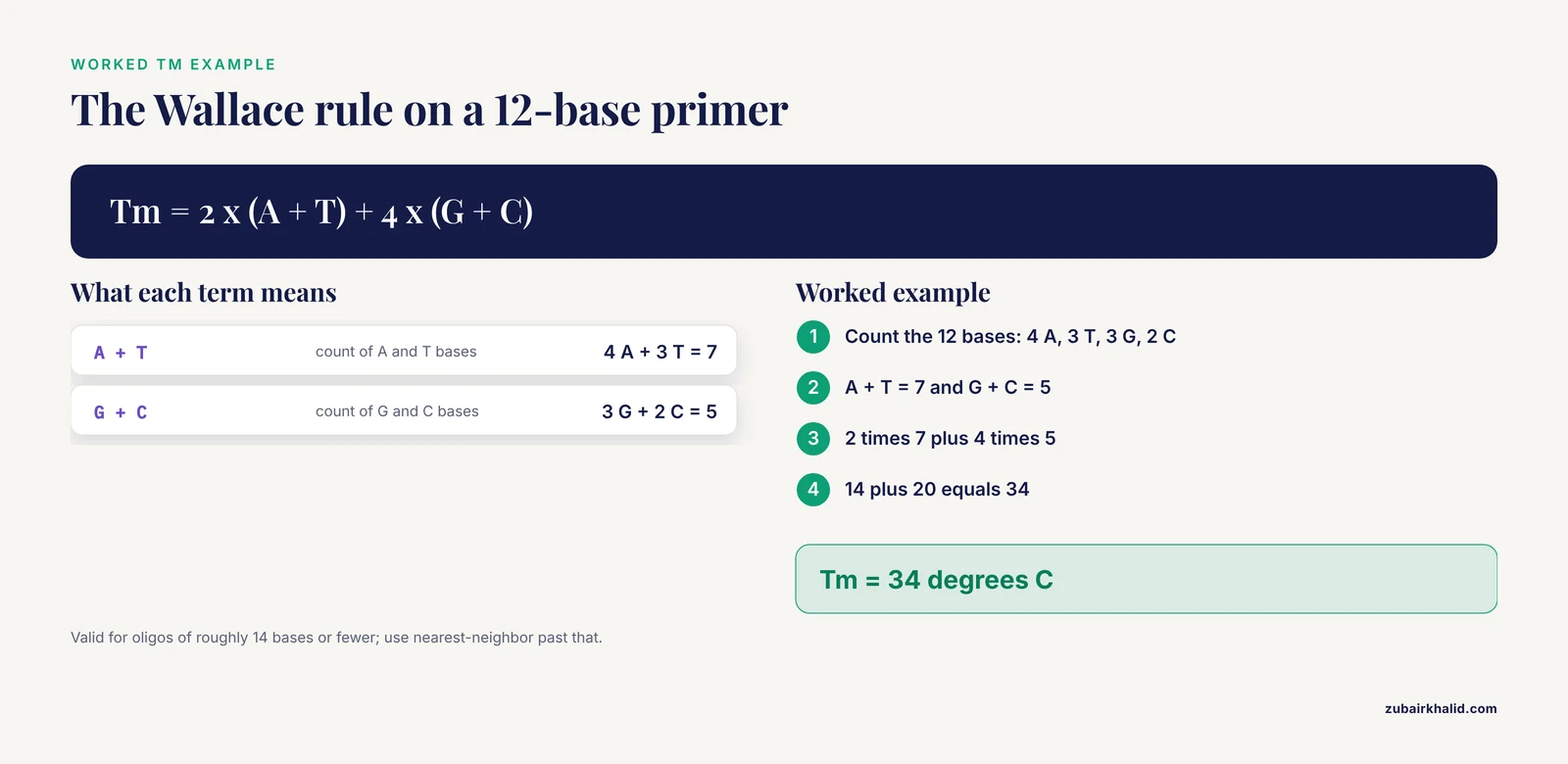
This short Python script is a biology calculator you fully control:
seq = "ATGCGTACGTAA".upper().replace(" ", "").replace("\n", "")
length = len(seq)
gc_percent = (seq.count("G") + seq.count("C")) / length * 100
tm_wallace = 2 * (seq.count("A") + seq.count("T")) + 4 * (seq.count("G") + seq.count("C"))
revcomp = seq.translate(str.maketrans("ACGT", "TGCA"))[::-1]

print("Length:", length, "nt")
print("GC content:", round(gc_percent, 1), "%")
print("Tm (Wallace rule):", tm_wallace, "degrees C")
print("Reverse complement:", revcomp)
Expected output:
Length: 12 nt
GC content: 41.7 %
Tm (Wallace rule): 34 degrees C
Reverse complement: TTACGTACGCAT
The Tm line uses the Wallace rule, valid for oligonucleotides of roughly 14 bases or fewer. The reverse complement is the sequence read in the opposite direction with each base swapped for its pairing partner, which is what a polymerase or a binding protein sees on the opposite strand.
Check the result three ways. Hand-count the 12 bases (4 A, 3 T, 3 G, 2 C) and confirm that 5 of 12 is 41.7 percent. Confirm the Tm arithmetic: 2 times 7 plus 4 times 5 equals 34. Apply the reverse complement twice and confirm you recover the original sequence.
Step 3: Cross-check the melting temperature with a web calculator
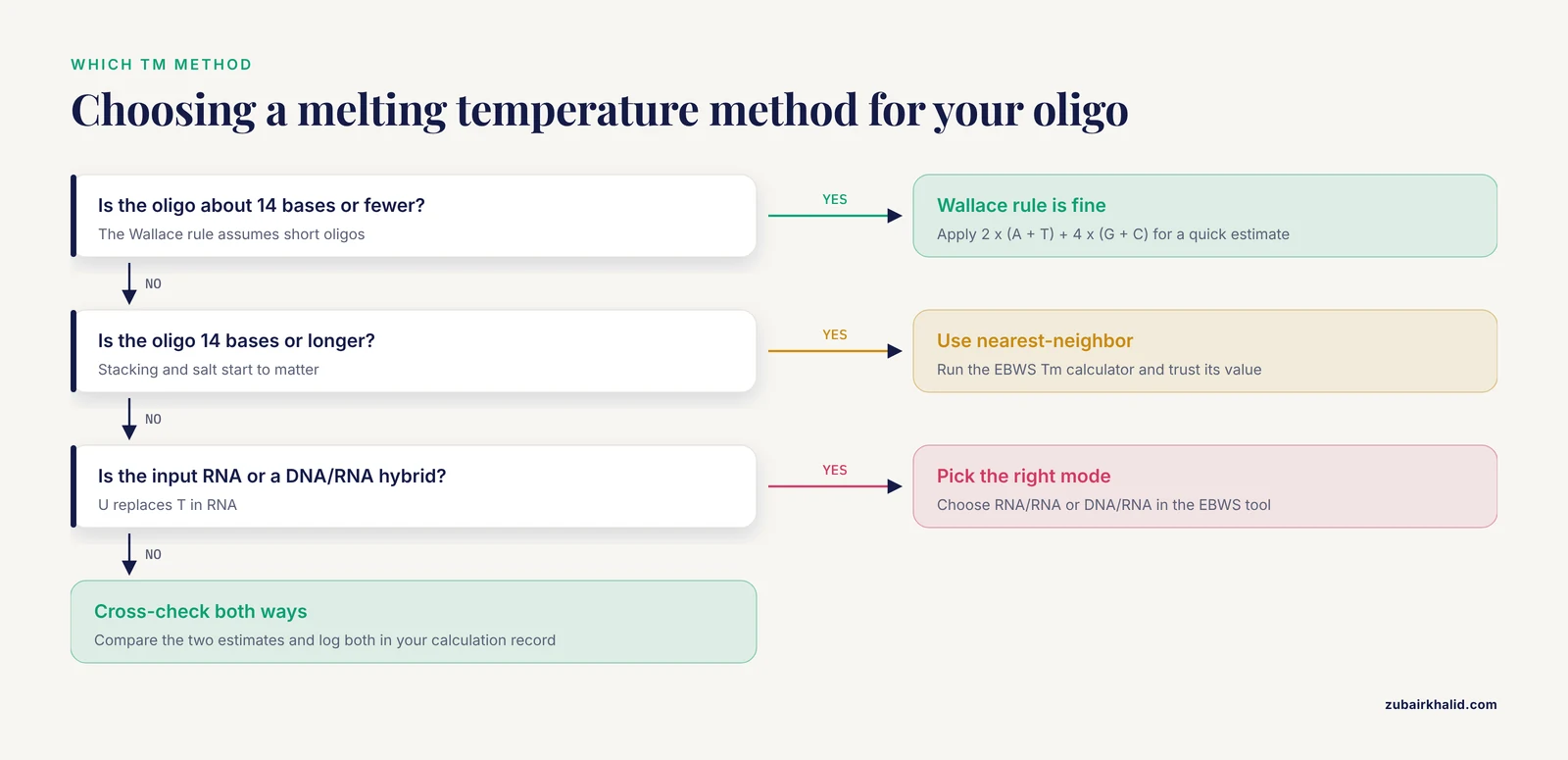
Paste the same 12-mer into the EBWS melting temperature calculator in DNA/DNA mode [1]. For an oligo this short, a nearest-neighbor calculation should land within a few degrees of the Wallace estimate. The methods diverge as oligos get longer, because nearest-neighbor thermodynamics accounts for salt concentration and stacking interactions between adjacent bases. Past roughly 14 bases, trust the nearest-neighbor value. Applying the Wallace rule to a 25-mer is the most common Tm mistake and yields an estimate several degrees too low.
Step 4: Find ORFs and restriction sites
Paste a longer DNA fragment, for example a 500 to 1,000 base gene sequence, into the EBWS prokaryotic ORF finder [1]. The tool scans all six reading frames (three forward, three reverse) and reports start and stop coordinates. Expected output is a list of ORFs with positions and lengths, for example an ORF from position 41 to 358 encoding 105 amino acids. Verify one hit by hand. Count in frame from the reported start codon and confirm a stop codon at the reported position.
Run the same sequence through the EBWS restriction cutter [1]. Output lists each enzyme with its cut positions. A quick validity check is that the fragment lengths sum to the input length.
Step 5: Move from DNA to protein parameters
Translate the longest ORF (many ORF finders report the translation directly) and paste the amino acid sequence into a protein parameter calculator. PTM-aware web resources calculate molecular mass and pI, including values for modified isoforms [4]. For a sanity check, multiply the residue count by the average amino acid mass of about 110 Da. A 105-residue protein should land near 11.5 kDa, and the exact calculator value will differ modestly because residues have different individual masses.
Once the numbers look sane, PROFASA offers the same parameter calculations alongside one-click structure models through I-TASSER or AlphaFold2 [5].
Step 6: Predict structure and score mutations
Submit the protein sequence to JPred4 for secondary structure and solvent accessibility prediction [2]. Output is a per-residue annotation string, for example a helix spanning residues 12 to 24. Two plausibility checks help. Hydrophobic stretches often map to buried helices or strands, and a prediction that flags nearly the whole chain as disordered deserves a second look against conservation data from JABAWS [2].
For RNA, paste your sequence into RNA2DMut, which scores the structural effect of every possible point mutation using Boltzmann ensemble calculations [9]. Constrain the analysis to purines or pyrimidines if you want transitions only. The output ranks positions by how strongly each mutation destabilizes or reorganizes the structure, which is exactly what you need before ordering mutant oligos for an assay.
Step 7: Scale up to batch analysis
Single-sequence calculators stop being practical past about 20 sequences. Two free routes scale up:
- iLearn accepts a dataset, applies feature extraction and its 16 supported feature algorithms with automatic settings, and exports results in four output formats for downstream tools [7].
- Galaxy hosts point-and-click workflows such as the Galaxy mothur Toolset for 16S rRNA analysis, with more than 125 wrapped tools and published training materials [10]. For similarity searches at scale, ElasticBLAST moves BLAST to cloud virtual machines [11].
A reasonable rule: calculators for one-off numbers, iLearn or Galaxy for dozens to thousands of records, and ElasticBLAST when the database itself is the bottleneck.
Input Formats and a Reusable Calculation Template
Formats you will meet
- FASTA. Header line starting with ">", sequence below. The default for nearly every tool in this article.
- Raw sequence. Just the letters, no header. Common in small single-purpose applets such as Tm calculators.
- Multi-record FASTA. Many records in one file, each with its own header. Required for batch tools such as iLearn [7].
Two format traps cause most rejected submissions. First, text copied from PDFs or spreadsheets often carries line numbers, spaces, or smart quotes, and a server either rejects the input or silently strips characters, which changes the length without warning. Join multi-line sequences into one string before raw-format counting. Second, RNA pasted into a DNA field leaves the T count at zero and inflates the A count, which corrupts any composition-based calculation. Running the RNA version of our 12-mer (AUGCGUACGUAA) through a DNA-only Wallace counter returns a value 6 degrees too low because the three U residues are invisible to it.
A calculation log template
Record every calculator run the way you would record a bench experiment:
Tool and URL:
Date run:
Input name:
Input format (FASTA or raw):
Polymer type (DNA, RNA, or protein):
Parameters set:
Key output values:
Cross-check tool and result:
Notes:
Filling the cross-check line with a second independent tool is what turns a number into a defensible result. Web servers change over time, so the date and URL lines protect reproducibility.
Calculator Formulas and Options at a Glance
| Calculation | Formula or method | Typical input | Watch out for |
|---|---|---|---|
| Primer Tm, short oligos | Tm = 2 x (A + T) + 4 x (G + C) | DNA oligo up to about 14 nt | Ignores salt and stacking |
| Primer Tm, longer oligos | Nearest-neighbor thermodynamics with salt correction | DNA or RNA duplex, 14 nt and up | Web tools such as EBWS cover DNA/DNA, RNA/RNA, and DNA/RNA hybrids [1] |
| GC content | (G + C) / total bases x 100 | DNA or RNA sequence | Ambiguity codes such as N are not G or C |
| Reverse complement | Complement each base, then reverse the order | DNA sequence | Apply to the correct strand |
| Protein molecular weight | Sum of individual residue masses | Protein sequence | The average-residue estimate of about 110 Da is only a sanity check |
| Protein pI | pH where net charge equals zero | Protein sequence | PTM isoforms shift both mass and pI [4] |
| ORF detection | Scan all six frames for start and stop codons | Prokaryotic DNA sequence | Prokaryotic ORF finders do not model introns [1] |
Common Mistakes and Limitations
- Pasting the header into the sequence box. A leading ">" or a gene name inside the sequence inflates the length and breaks composition math. Keep headers on their own FASTA line and delete them entirely for raw-format boxes.
- Empty input after cleanup. If a paste contains only a header, the cleanup step strips everything and the script fails with "ZeroDivisionError: division by zero" because it divides by a length of zero. Check that the string contains letters before calculating.
- Wrong polymer type. Selecting DNA when the input is RNA, or the reverse, corrupts Tm, GC, and mutation calculations. Check the U versus T rule before every run.
- Wallace rule beyond its range. The 2 and 4 degree coefficients assume short oligos. For primers of 14 bases and up, use a nearest-neighbor calculator such as the EBWS Tm tool [1].
- Ignoring ambiguity codes. IUPAC codes such as N, R, and Y are not counted as G or C by most calculators, and some tools reject them. Resolve or remove them before calculating.
- Strand confusion. Primer and probe calculations need the correct strand. If a result looks impossible, run the reverse complement and compare.
- Treating prokaryotic ORF output as eukaryotic gene structure. The EBWS ORF finder is explicitly prokaryotic and does not model introns [1], so long ORFs in eukaryotic genomic DNA are usually not genes.
- Overreading point predictions. Stability and pathogenicity scores are estimates with method-specific strengths, and the CAGI5 evaluation found no single method superior on every metric [12]. Use them to prioritize experiments, not to replace them.
- Assuming a web tool stays unchanged. Record the URL, date, and any version information in the calculation log so results remain reproducible.
One general limitation applies across every tool in this guide. Calculator output supports planning and interpretation, and individual research decisions still require domain expertise and, where relevant, experimental validation.
Frequently Asked Questions
What is a free bioinformatics calculator?
A free bioinformatics calculator is a web tool or script that takes a DNA, RNA, or protein sequence, or a numeric input, and returns a computed biological value such as melting temperature, GC content, molecular weight, or isoelectric point at no cost.
Do I need to install software to use these calculators?
No. Most run entirely in a browser. A plain-text editor helps with FASTA files, and Python is optional and only needed for batch or custom calculations.
What input format do bioinformatics calculators expect?
Most accept FASTA or raw sequence text. FASTA has a header line starting with ">" followed by the sequence on the lines below, and raw format is just the letters.
How do I calculate the melting temperature of a primer for free?
Use a web melting temperature calculator such as the EBWS tool, which handles DNA/DNA, RNA/RNA, and DNA/RNA hybrids, or apply the Wallace rule for oligos shorter than about 14 bases.
Can a bioinformatics calculator predict whether a mutation is harmful?
Some can estimate it. Tools such as Provean, FoldX, ELASPIC, and PredictONCO score the likely effect of amino acid substitutions on protein stability or function, and their predictions are meant to prioritize experiments rather than replace them.
How accurate are free online biology calculators?
The underlying methods are published and peer reviewed, so the math is sound when the input is correct. Accuracy depends on matching the method to your sequence, for example using nearest-neighbor rather than Wallace calculations for longer oligos.
What is the difference between a biology calculator and an analysis platform?
A calculator returns one value from one input, such as the melting temperature of one primer. A platform chains many steps, for example normalization, differential expression, clustering, and visualization for RNA-Seq data, in a single interface.
How do I calculate protein molecular weight and isoelectric point for free?
Paste the amino acid sequence into a free protein parameter calculator, including PTM-aware resources that report values for modified isoforms, and sanity-check the mass against the residue count.
Sources
- EBWS: Essential Bioinformatics Web Services for Sequence Analyses.
- The Dundee Resource for Sequence Analysis and Structure Prediction.
- GENAVi: a shiny web application for gene expression normalization, analysis and visualization.
- Web-Based Computational Tools for the Prediction and Analysis of Posttranslational Modifications of Proteins.
- PROFASA-a web-based protein fragment and structure analysis workstation.
- PERCEPTRON-PTMKB: A Web Server for Residue-Based Post-Translational Modification Analysis and Propensity Scoring.
- iLearn: an integrated platform and meta-learner for feature engineering, machine-learning analysis and modeling of DNA, RNA and protein sequence data.
- PlaToLoCo: the first web meta-server for visualization and annotation of low complexity regions in proteins.
- RNA2DMut: a web tool for the design and analysis of RNA structure mutations.
- Galaxy mothur Toolset (GmT): a user-friendly application for 16S rRNA gene sequencing analysis using mothur.
- ElasticBLAST: accelerating sequence search via cloud computing.
- Predicting changes in protein stability caused by mutation using sequence-and structure-based methods in a CAGI5 blind challenge.
- Analysis of mutations in precision oncology using the automated, accurate, and user-friendly web tool PredictONCO.
- A comprehensive review and performance evaluation of bioinformatics tools for HLA class I peptide-binding prediction.
- PDAUG: a Galaxy based toolset for peptide library analysis, visualization, and machine learning modeling.