Body Surface Area Calculators for Veterinary Research
By Dr. Zubair Khalid, DVM, MS, PhD ·
A body surface area (BSA) calculator converts an animal's weight, and sometimes its body length, into an estimate of total skin surface in square meters (m²), and the core choice in veterinary work is between weight-only allometric calculators and length-based formulas adapted from human medicine. The rule of thumb is straightforward. For routine chemotherapy scaling in dogs and cats, use a weight-only allometric calculator with the species constant (10.1 for dogs, 10.0 for cats). If a research protocol names a formula, use that formula exactly, because changing the formula changes the number and therefore the dose.
Body surface area calculators for veterinary research come in a handful of forms, and picking among them affects drug doses, indexed measurements, and the reproducibility of a dataset. This guide explains how the calculators work, compares the main options side by side, weighs the pros and cons with published evidence, walks through worked examples, and lists the mistakes that most often corrupt a calculation.
What a Body Surface Area Calculator Does
BSA is the total area of an animal's skin, reported in square meters. Nobody measures it directly on a live patient. A calculator estimates it from one or two body dimensions, and the estimate stands in for the real thing.
The estimate matters because many biological variables track surface area rather than body weight. A 3 kg cat carries about 0.21 m² of skin, roughly 0.07 m² per kilogram, while a 40 kg dog carries about 1.2 m², roughly 0.03 m² per kilogram. Small patients therefore have more than twice as much skin per kilogram, which is one reason they lose body heat faster and why the tissue exposure produced by some drugs per kilogram differs with size. In veterinary research and clinical work, a BSA value feeds three main tasks:
- Dose calculation. Chemotherapy and some sedative protocols express doses per square meter (for example, mg/m²). The calculator supplies the m² value.
- Indexing measurements. Researchers divide organ sizes, valve areas, or other measurements by BSA so animals of different sizes can be compared on equal footing.
- Risk planning. A high surface area to mass ratio flags patients that cool quickly under anesthesia.
Within the working scientist's toolkit, a BSA calculator is one member of the biology calculator family, alongside dilution, molarity, and unit conversion tools. In research pipelines it often sits next to statistics and sequence-analysis utilities, which is where the bioinformatics calculator label comes in.
Body Surface Area Calculator Options for Veterinary Research
Two design questions separate the body surface area calculator options veterinary teams use. First, which inputs does the calculator take, weight only or weight plus length? Second, where does it run, on a laminated card, a website, a spreadsheet, or a scripted pipeline? The first table compares the formulas. The second compares the implementations.
| Formula | Inputs | Equation | Typical veterinary use | Pros | Cons |
|---|---|---|---|---|---|
| Allometric weight-only | Weight in grams | BSA = K × W^(2/3) ÷ 10,000, with K = 10.1 for dogs and 10.0 for cats | Canine and feline chemotherapy charts | Needs only a scale, fast, reproducible | Ignores body shape, constants are species specific |
| Du Bois and Du Bois | Weight (kg) and length (cm) | 0.007184 × W^0.425 × L^0.725 | Cardiac indexing, protocols that mirror human conventions | Captures body shape, long publication record | Human derived, needs a length measurement |
| Mosteller | Weight (kg) and length (cm) | √(W × L ÷ 3600) | Quick hand or spreadsheet math | Simplest to compute and audit | Human derived, less validated in animals |
| Haycock | Weight (kg) and length (cm) | 0.024265 × W^0.5378 × L^0.3964 | Small patients in human-derived datasets | Better fit for small bodies in its derivation data | Human derived, needs length |
| Gehan and George | Weight (kg) and length (cm) | 0.0235 × W^0.42246 × L^0.51456 | Oncology datasets standardized on it | Widely used in cancer literature | Human derived, needs length |
| Implementation | What it looks like | Pros | Cons |
|---|---|---|---|
| Nomogram or laminated chart | Printed weight-to-m² lookup on the treatment room wall | Zero arithmetic errors, fastest at the cage side | Fixed rounding, limited species and weight ranges |
| Standalone web calculator | Enter weight (and length), read m² on screen | Free and accessible on any device | Formula choice varies by site, no audit trail |
| Spreadsheet template | One row per animal, formula in a column | Batch processing, transparent math, archivable | Transcription errors, version drift |
| Scripted pipeline (R or Python) | A function applied to the study dataset | Reproducible, integrates with statistics and other bioinformatics calculator tools | Requires coding skill and code review |
| Record-system integration | BSA computed inside the practice management system | Removes retyping, doses attach to the record | Formula choice locked behind the vendor |
Weight-Only Allometric Calculators
The allometric formula estimates BSA from body weight alone. Allometric scaling is the mathematical relationship between body size and a biological variable, and for surface area the relationship follows a 2/3 power law: if bodies kept the same shape at every size, skin area would scale with the 2/3 power of mass.
BSA (m²) = K × W^(2/3) ÷ 10,000
Here W is body weight in grams and K is a species constant, 10.1 for dogs and 10.0 for cats in standard veterinary formularies and chemotherapy charts. Constants published for other species vary by source, so the protocol or a veterinary formulary is the place to confirm them.
The strengths are speed and repeatability. A scale reading is quick, the formula reproduces the same answer for the same weight every time, and the output matches the precomputed charts used in most oncology suites. The weakness is that the constant assumes a typical body shape for the species, so a very lean sighthound and an overweight Beagle at the same weight receive the same BSA, and constants are not interchangeable between species.
Length-Based Formulas
Four formulas dominate when a protocol wants length in the calculation. The oldest is Du Bois and Du Bois, published in 1916, which remains the most cited human BSA formula. Mosteller reduces the calculation to a square root and is the easiest to audit by hand. Haycock was derived with emphasis on small bodies. Gehan and George is common in oncology datasets.
All four were derived from human measurements. They run fine on animal numbers, but they were not built from canine or feline data, so their output can disagree with the species constants. Their advantage is shape sensitivity, which matters in studies that index measurements to BSA or compare against human literature conventions. Their disadvantage is practical: measuring body length on a wiggling, unanesthetized patient adds error, and the formulas disagree with each other by several percent for the same animal.
Nomograms and Precomputed Charts
A nomogram is a printed lookup table that lists BSA for each weight, sometimes with a sliding scale for length. Laminated charts remain the fastest tool in a busy treatment room and eliminate arithmetic slips entirely. The tradeoffs are fixed rounding steps, limited weight ranges, and usually one species per chart.
Spreadsheet, Scripted, and Integrated Calculators
For research datasets, the calculator becomes a column in a spreadsheet or a function in a script. A one-line formula computes BSA for a whole cohort, and the same function ports directly into R or Python, where it sits beside the statistics and sequence tools of a bioinformatics calculator workflow. Record-system integration removes retyping but locks the formula choice behind the vendor.
Before trusting any calculator, check five things: which formula it runs, which units it expects (grams versus kilograms, centimeters versus inches), which species constant it applies and whether that constant was published for your species, how it rounds and whether it caps doses, and whether it saves the calculation for the study record.
How the Options Compare on the Criteria That Decide Real Choices
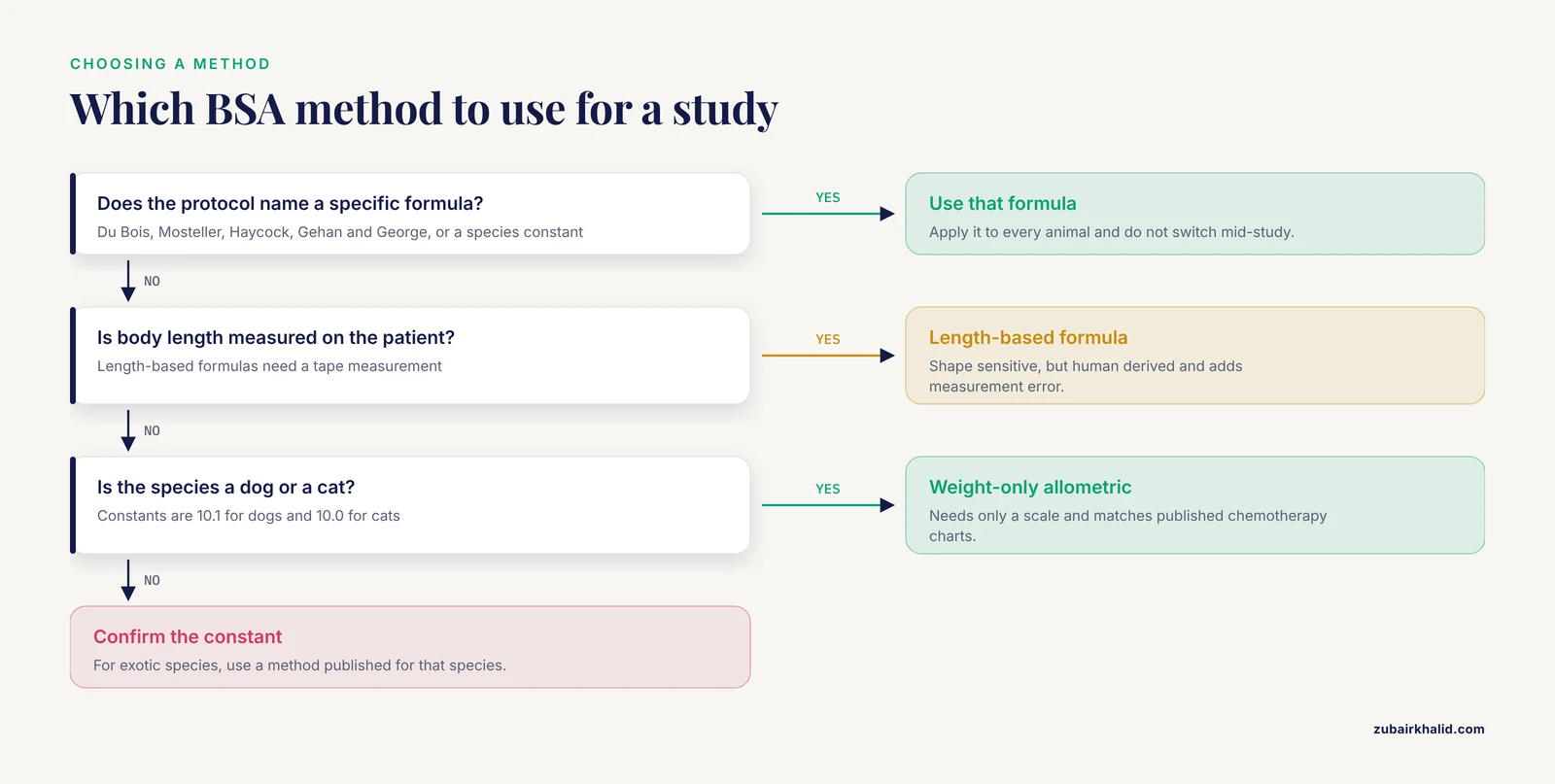
Reproducibility. Weight-only calculators win. A scale reading is more repeatable than a tape measurement on a moving patient, and reproducibility is what a methods section needs.
Accuracy across body sizes. Length-based formulas hold an advantage at the extremes of size in human data, but in dogs and cats the allometric constants were derived from the species themselves, which matters more than formula elegance.
Speed. Nomogram first, weight-only calculator second, length-based formulas last.
Protocol compliance. The protocol always wins. If a study specifies Du Bois, you use Du Bois, even when the clinic chart uses the allometric constant. Mixing formulas mid-study is a silent source of variance that no statistical analysis can repair after the fact.
Species coverage. Weight-only constants are well established for common companion and laboratory species. For exotic species, confirm that the constant you are using was actually published for that species.
Pros and Cons of BSA-Based Dosing
The calculator is only half the story. The other half is whether dosing per square meter is the right scaling rule for the drug at hand, and the evidence cuts both ways.
The classic caution comes from doxorubicin, a cytotoxic (cell-killing) drug used in canine lymphoma. In a 17-dog comparison of a single doxorubicin dose given on a surface area basis versus a weight-based dose, small dogs weighing 10 kg or less had higher peak plasma concentrations, greater total drug exposure measured as the area under the plasma concentration versus time curve, longer elimination half-lives, and larger volumes of distribution than large dogs [1]. Six of the seven small dogs became clinically ill after the surface area dose, while seven of ten large dogs remained clinically normal, and five of nine small dogs developed severe myelosuppression, a suppression of bone marrow blood cell production, with granulocyte counts falling below 1 × 10³ cells per microliter [1]. When small dogs received the weight-based dose instead, drug levels and toxicity looked similar across sizes, and severe myelosuppression did not appear [1].
Vincristine tells a more nuanced story. A multicenter retrospective study of 138 dogs with newly diagnosed lymphoma compared adverse events between dogs weighing 15 kg or less and dogs over 15 kg, all treated on a surface area basis with a median dose of 0.6 mg/m² in both groups [2]. Neutropenia, a drop in the neutrophils that fight bacterial infection, occurred in 12.3% of treatments with no significant difference in frequency or grade between the weight groups [2]. Gastrointestinal adverse events were recorded in 29.4% of initially asymptomatic (substage A) dogs, though a weight-group comparison was not possible because so many patients received supportive gastrointestinal medications [2]. The small-dog overdose problem, in other words, is drug specific rather than universal.
Surface area dosing also extends beyond cytotoxic drugs. Asparaginase, an enzyme used in canine lymphoma treatment, has been dosed by surface area in trials comparing subcutaneous with intramuscular injection [3]. Medetomidine, an alpha-2 adrenergic sedative and analgesic, was dosed at 750 micrograms/m² intravenously or 1,000 micrograms/m² intramuscularly in a randomized trial of 184 dogs, where it produced higher posture and noise-response sedation scores than weight-dosed xylazine (1.1 mg/kg intravenously, 2.2 mg/kg intramuscularly) and drew significantly more "excellent" ratings from clinicians [4].
For a researcher choosing a calculator, the practical pros and cons look like this. BSA-based dosing with a consistent calculator keeps a protocol internally consistent and comparable with the published literature that used the same convention. The con is that a fixed scaling rule can overexpose small patients for certain drugs, so the calculator must always be paired with the scaling rule that the protocol and the drug's evidence base support.
BSA as an Indexing Variable in Research
Indexing means dividing a measurement by BSA so that animals of different sizes can be compared. Two examples show why the calculator matters even when no drug is involved.
In cardiac research, a longitudinal study followed 38 Golden Retrievers from puppyhood (2 to 6 months) into adulthood (12 to 18 months) to identify early predictors of subaortic stenosis (SAS), a narrowing of the outflow tract just below the aortic valve [5]. The researchers indexed the effective orifice area (EOA), the opening blood actually passes through at the aortic valve, to BSA. Every puppy whose effective orifice area indexed to BSA (EOAi) fell below 1.46 cm²/m² developed SAS as an adult [5]. Puppy peak velocity through the left ventricular outflow tract, measured with Doppler echocardiography (ultrasound that quantifies blood flow velocity), above 2.3 m/s was 63% sensitive and 100% specific for adult SAS, and combining the two criteria raised sensitivity to 69% while keeping specificity at 100% [5]. The indexed value held steady as the dogs grew, which is precisely the property that makes an index comparable across body sizes and ages.
Imaging research relies on the same logic. Across 72 healthy dogs spanning Toy Poodles, Beagles, Akitas, and Golden Retrievers, ultrasonographic total thyroid volume correlated with body weight (r = 0.73) and slightly more tightly with BSA (r = 0.74), where r is the correlation coefficient [6]. Correlations that tight are what allow researchers to express organ size relative to surface area when comparing across breeds.
BSA, Heat Loss, and Metabolism
The surface area to mass ratio explains patterns far from the pharmacy. Body heat leaves a patient through four routes, radiation, convection, conduction, and evaporation, and perianesthetic hypothermia is among the most common complications of veterinary anesthesia, striking small patients hardest because of their large surface area relative to mass [7]. In callimicos (Callimico goeldii), a small New World primate, researchers compared three warming strategies under isoflurane (an inhaled anesthetic) anesthesia, a reflective blanket alone, a reflective blanket plus a heated anesthetic circuit warming inspired air to 40 °C, and a forced-air warming blanket at 43 °C, and found the rate of heat loss did not differ between the reflective blanket groups [7].
Bats push the ratio to an extreme, which is why species with a large body surface area to mass ratio, such as Chiroptera, are notoriously hard to keep warm under anesthesia [8]. In nine anesthetized large flying foxes (Pteropus vampyrus), esophageal temperature readings tracked rectal readings closely (P < 0.0001), while axillary infrared readings correlated only weakly, leading the authors to recommend esophageal thermometry where practical [8].
Nutrition research sees the same scaling from the inside. Miniature Schnauzers fed an identical diet to Labrador Retrievers had a higher calorie requirement per kilogram, driven by their high surface area to volume ratio, along with significantly higher intake of dietary minerals per kilogram, lower urine volume, and higher urinary calcium concentration [9]. Those differences feed into relative supersaturation (RSS) calculations, which estimate the tendency for crystals such as calcium oxalate to form in urine [9].
Worked Scenarios
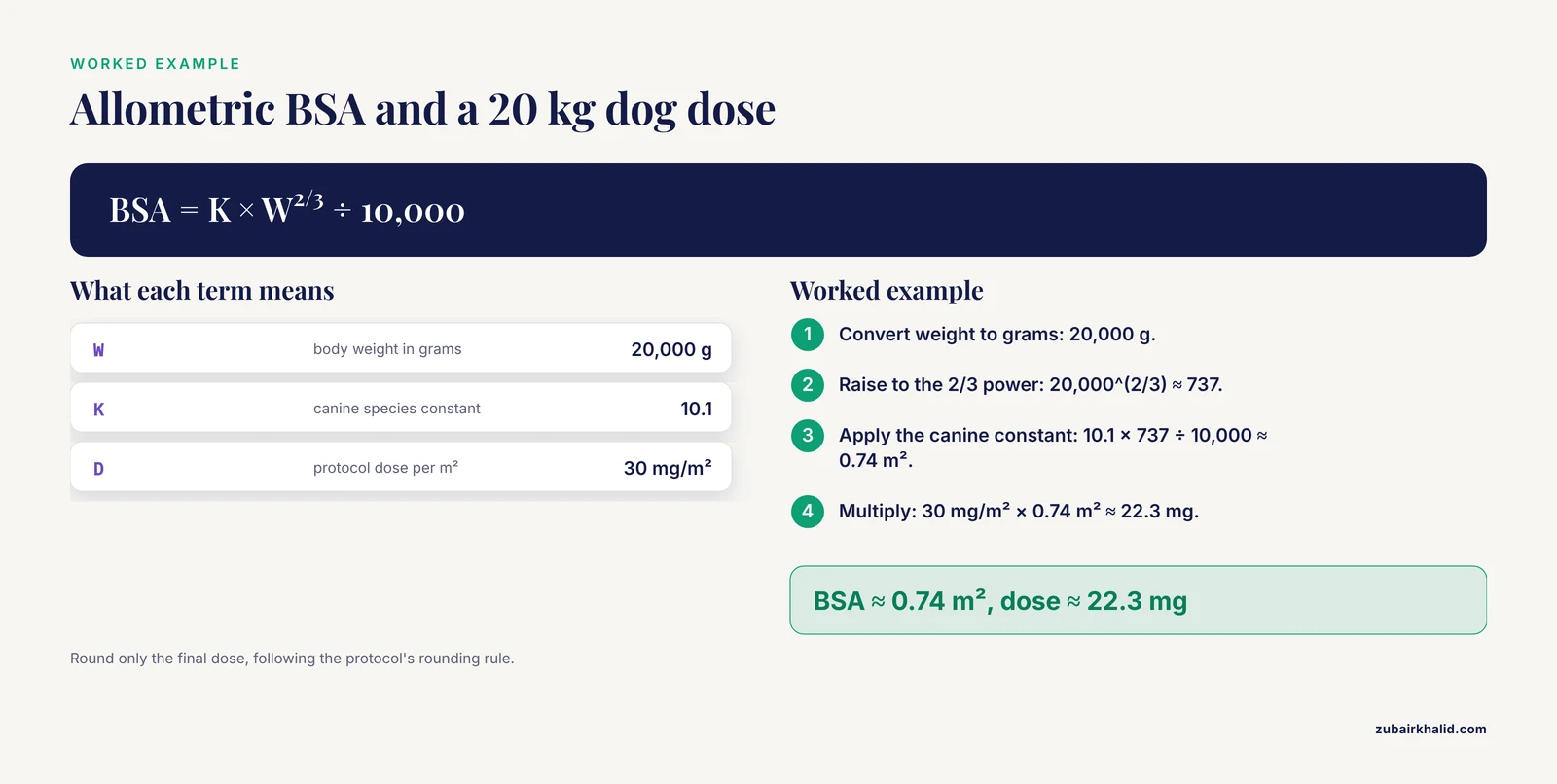
Scenario 1: Chemotherapy dose for a 20 kg dog. The protocol specifies doxorubicin at 30 mg/m², the surface area dose used in the 17-dog comparison discussed above [1].
- Convert weight to grams: 20,000 g.
- Raise to the 2/3 power: 20,000^(2/3) ≈ 737.
- Apply the canine constant: 10.1 × 737 ÷ 10,000 ≈ 0.74 m².
- Multiply: 30 mg/m² × 0.74 m² ≈ 22.3 mg.
The final syringe volume depends on the drug concentration and the protocol's rounding rule.
Scenario 2: Biologic dose for a 4 kg cat. Asparaginase protocols dose at 10,000 U/m² [3].
- 4,000^(2/3) ≈ 252.
- Feline constant: 10.0 × 252 ÷ 10,000 ≈ 0.25 m².
- Dose: 10,000 U/m² × 0.25 m² = 2,500 U.
Carrying full precision through the BSA step gives 2,520 U, which illustrates why rounding belongs at the end, not the middle.
Scenario 3: Batch calculation for a study cohort. Put weights in kilograms in column A of a spreadsheet and enter =10.1*(A2*1000)^(2/3)/10000 in column B, then fill down. Column C multiplies by the protocol dose. The identical function in R or Python drops straight into an analysis script, which keeps the BSA step inside the same pipeline as the statistics and makes the whole calculation reproducible from one archived file.
Common Mistakes and Limitations
Reading "surface area" in a paper as BSA. Veterinary literature uses the phrase for many quantities. Dental studies quantify root surface area (RSA), the attachment surface of a tooth root available for orthodontic anchorage, and in 68 brachycephalic (short-nosed) dogs quantified with cone-beam computed tomography, RSA ratios were positively associated with body weight [10]. Radiographic studies measure projected organ areas, such as the air sac surface area of African grey parrots, which differed significantly between two radiographic views [11]. Neither quantity is BSA. Check the methods section before importing a number into your work.
Switching formulas mid-protocol. Length-based formulas disagree with each other and with the species constants by several percent. Pick the formula the protocol names and stay with it for every animal in the study.
Unit slips. Entering pounds as kilograms is the most common single error. A 20 lb (9.1 kg) Beagle entered as 20 kg receives a BSA of about 0.74 m² instead of about 0.44 m², roughly 70% too high, and every dose derived from it inherits the error.
Rounding too early. Carry full precision through the BSA step and round only the final dose, following the protocol's rounding rule.
Ignoring body composition. Every formula in this article uses total body weight. Obesity inflates the estimate and extreme leanness deflates it, and no formula in common use can tell the difference.
Borrowing constants across species. The canine constant 10.1 does not describe a ferret, a rabbit, or a parrot. For exotic species, use a method published for that species.
Treating the estimate as a measurement. BSA calculators model skin area from one or two dimensions. Direct measurement exists for cadaver studies and specialty applications, but it is impractical for routine dose work, so every calculator output carries model error.
Individual dosing decisions, especially for patients starting chemotherapy or living with organ disease, belong with a veterinarian who can weigh the whole case.
Frequently Asked Questions
What does a body surface area calculator do in veterinary research?
It converts a weight, and sometimes a body length, into an estimated skin area in square meters. Researchers use that value to scale drug doses expressed per m² and to index measurements so animals of different sizes can be compared.
Which is the best body surface area calculator for veterinary work?
The one your protocol specifies. For routine canine and feline chemotherapy outside a named protocol, the weight-only allometric calculator with the species constant is the standard default because it needs only a scale and matches published charts.
Why do some protocols dose by body weight instead of BSA?
Because for certain drugs, weight-based dosing produces more consistent drug exposure across patient sizes. The choice is drug specific and belongs to the protocol, not to the calculator.
Do I need to measure body length for a BSA calculation?
Only for length-based formulas such as Du Bois, Mosteller, Haycock, and Gehan and George. Weight-only allometric calculators need nothing but an accurate scale reading.
Can I use a human BSA calculator for an animal?
The arithmetic runs on any numbers, but human formulas were derived from human measurements and can disagree with species constants. Use them only when the protocol calls for that specific formula.
How accurate are BSA estimates in obese or very lean animals?
Less accurate than in average-bodied patients. The formulas use total body weight and cannot account for composition, so estimates skew high in obesity and low in emaciation. Follow the protocol and document the weight used.
Sources
- Comparison of body surface area-based and weight-based dosage protocols for doxorubicin administration in dogs.
- Vincristine-induced adverse events related to body weight in dogs treated for lymphoma.
- Comparison of the effects of asparaginase administered subcutaneously versus intramuscularly for treatment of multicentric lymphoma in dogs receiving doxorubicin.
- Multicenter clinical comparison of sedative and analgesic effects of medetomidine and xylazine in dogs.
- Comparison of peak flow velocity through the left ventricular outflow tract and effective orifice area indexed to body surface area in Golden Retriever puppies to predict development of subaortic stenosis in adult dogs.
- Comparison of ultrasonographic characteristics of the thyroid gland in healthy small-, medium-, and large-breed dogs.
- Comparison of 3 Methods for Preventing Perianesthetic Hypothermia in Callimicos (Callimico goeldii).
- COMPARISON OF AXILLARY, RECTAL, AND ESOPHAGEAL THERMOMETRY IN ANESTHETIZED LARGE FLYING FOXES (PTEROPUS VAMPYRUS).
- Comparison of urine composition of healthy Labrador retrievers and miniature schnauzers.
- Quantitative Assessment of Maxillary Canine, Fourth Premolar, and First Molar Root Surface Areas and Ratios in 68 Brachycephalic Dogs Using Cone-Beam Computed Tomography.
- Comparison of Dorsoventral Erect and Ventrodorsal Supine Radiographic Views for the Evaluation of Intracoelomic Organs in Clinically Normal African Grey Parrots (Psittacus erithacus).