PhD Fellowship Research Proposal Example and Requirements
By Dr. Zubair Khalid, DVM, MS, PhD ·

A PhD fellowship research proposal is the written plan you submit to win dedicated funding for your doctoral research. In the United States, the most common federal route is the Ruth L. Kirschstein National Research Service Award (NRSA) individual fellowship from the National Institutes of Health (NIH). The F31 mechanism supports predoctoral students, the F30 supports dual-degree students such as MD-PhD candidates, and the F32 supports postdoctoral fellows. Foundations, professional societies, and universities run their own fellowship programs with similar proposal structures.
Entry requirements are consistent across most programs. You need to be enrolled in or accepted to a PhD program, a sponsor (your dissertation advisor) who commits to mentoring you, transcripts, reference letters, and a research plan with a defined training plan. Some programs require citizenship or permanent residency, so check the funding opportunity announcement before you invest months of work.
Pay is stipend-based rather than salary-based. NIH sets NRSA fellowship stipend levels each year and publishes the current amounts in the NIH Guide for Grants and Contracts, so you should always check the most recent notice rather than rely on older figures. Institutional and foundation fellowships set their own stipend levels, which vary widely. Job outlook is competitive. Fellowships are prestigious, they strengthen your record, but they are not guaranteed income, and most applicants revise and resubmit at least once.
This guide walks through the requirements, gives you a worked example of a proposal, explains grant proposal planning step by step, and describes what reviewers actually reward.
At a Glance
| Item | Details |
|---|---|
| Education | Enrollment in a PhD program (or a dual-degree program for F30) at the time of award |
| Certifications | None required. Eligibility is academic and citizenship-based, not credential-based |
| Typical funders | NIH (F31, F30, F32), NSF graduate research fellowships, disease-focused foundations, professional societies, university internal fellowships |
| Salary range | Stipend-based. NIH publishes NRSA fellowship stipend levels annually in the NIH Guide for Grants and Contracts. Institutional and foundation stipends vary by program |
| Job outlook | Competitive. Fellowships improve competitiveness for postdocs, faculty positions, and industry roles, but award rates are limited and vary by institute and field |
| Typical timeline to apply | 6 to 12 months of grant proposal planning before the submission deadline |
What a PhD Fellowship Research Proposal Actually Is
A fellowship is money awarded to you as an individual, usually to support your stipend, tuition, and research costs for one to three years. A grant proposal is the document that convinces the funder to give you that money. The proposal has two jobs at once. It must show that your science is sound and significant, and it must show that the fellowship will train you into an independent researcher.
That second job is what separates a fellowship proposal from a standard research grant. Reviewers for an F31 evaluate the applicant, the sponsor, the training environment, and the research plan as a package. A brilliant project with a weak training plan can lose. A modest project with a strong mentor and a clear career trajectory can win.
The core document is the research plan, which in NIH-style applications contains a Specific Aims page followed by a research strategy organized around significance, innovation, and approach. Current NIH limits for individual fellowships are one page for the Specific Aims and six pages for the research strategy, but you must confirm the exact limits in the funding opportunity announcement for your cycle, because formats change.
PhD Fellowship Research Proposal Requirements
Most fellowship programs, whether federal or private, ask for the same core pieces. Here is what you will assemble.
Specific Aims page. One page. This is the single most important page in the application. It states the long-term goal, the immediate objective, the central hypothesis, and three or four numbered aims with a short description of the approach for each. Reviewers often form their impression of the whole application from this page.
Research strategy. Roughly six pages for NIH fellowships. It covers why the problem matters (significance), what is new about your idea (innovation), and how you will execute each aim (approach), including study design, methods, expected outcomes, potential problems, and alternative strategies.
Bibliography. Cited references supporting the proposal, usually in a standard format with a page limit.
Sponsor and co-sponsor statements. Your primary advisor writes a letter describing your qualifications, the training you will receive, and how the fellowship fits your development. A co-sponsor is expected when you need expertise your sponsor lacks, for example a statistician or a clinician.
Training plan. A section describing the skills you will acquire during the fellowship, such as advanced statistics, animal models, bioinformatics, or scientific writing, and how each activity maps to your career goals.
Biosketches. Short CVs for you, your sponsor, and any co-sponsors, in the format specified by the funder.
Environment and institutional commitment. A description of the labs, equipment, and resources available to you, plus any letters or statements from the department confirming support.
Transcripts and reference letters. Usually three to five letters for individual fellowships, submitted separately by the writers.
Data and compliance items. Depending on the work, you may need vertebrate animal sections, human subjects protections, or documentation of training in the responsible conduct of research.
Every funder publishes its own requirements. Read the funding opportunity announcement line by line before you write a single sentence, because formatting errors and missing items are among the most common reasons applications are rejected without review.
A Worked Example of a Specific Aims Page
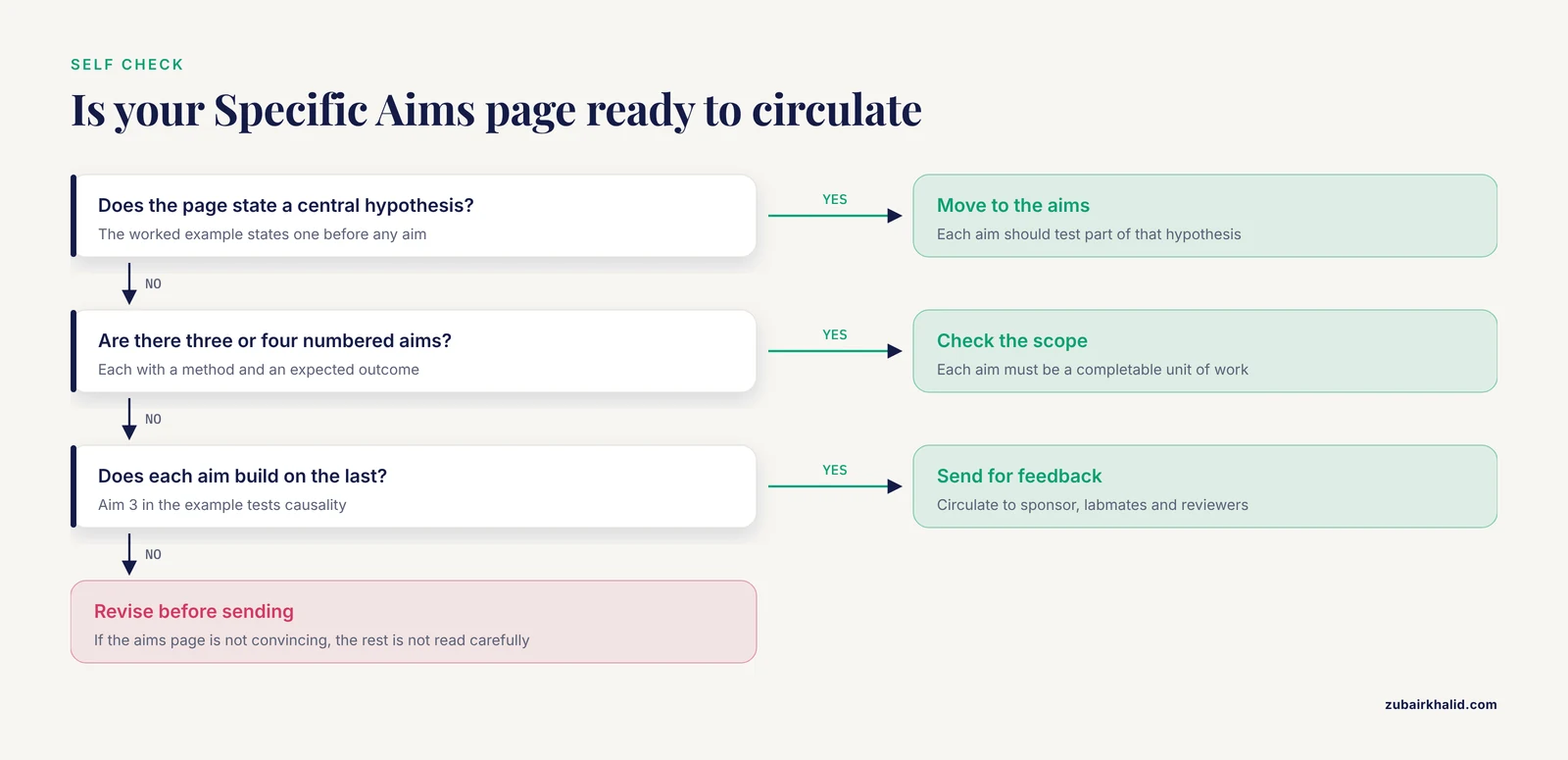
The fastest way to understand the format is to see a skeleton. Below is a realistic structure for a hypothetical predoctoral project on gut microbiota and recurrent infection. The science is illustrative, but the architecture is exactly what reviewers expect.
Title: Microbiome signatures of Clostridioides difficile recurrence in hospitalized patients.
Long-term goal: To become a physician-scientist studying host-microbiome interactions in infectious disease.
Objective: To identify fecal microbiome features that predict recurrent C. difficile infection after antibiotic treatment.
Central hypothesis: Loss of specific bile acid-metabolizing bacterial taxa after antibiotic treatment creates a gut environment that permits C. difficile spore germination and recurrence.
Aim 1: Determine whether fecal bile acid profiles differ between patients with primary versus recurrent C. difficile infection. Approach: measure bile acid concentrations in stored stool samples using liquid chromatography-mass spectrometry and compare groups. Expected outcome: recurrent cases show depleted secondary bile acids.
Aim 2: Identify bacterial taxa associated with protective bile acid profiles. Approach: sequence 16S rRNA genes from the same samples and correlate taxon abundance with bile acid measurements. Expected outcome: specific Clostridium clusters correlate with protective profiles.
Aim 3: Test causality in a mouse model. Approach: administer candidate bacteria to antibiotic-treated mice challenged with C. difficile spores and measure colonization and disease. Expected outcome: reconstitution of protective taxa reduces recurrence.
Payoff: This work will identify microbiome features that predict recurrence and suggest probiotic or enzyme-based strategies to prevent it, establishing the foundation for the applicant's independent research program.
Notice the pattern. Each aim has a hypothesis, a method, and an expected outcome. Each aim builds on the previous one. The whole page fits on one sheet and ends with a sentence about why the work matters beyond the PhD. When you write your own version, replace the content with your project but keep this architecture.
Grant Proposal Planning: A Realistic Timeline
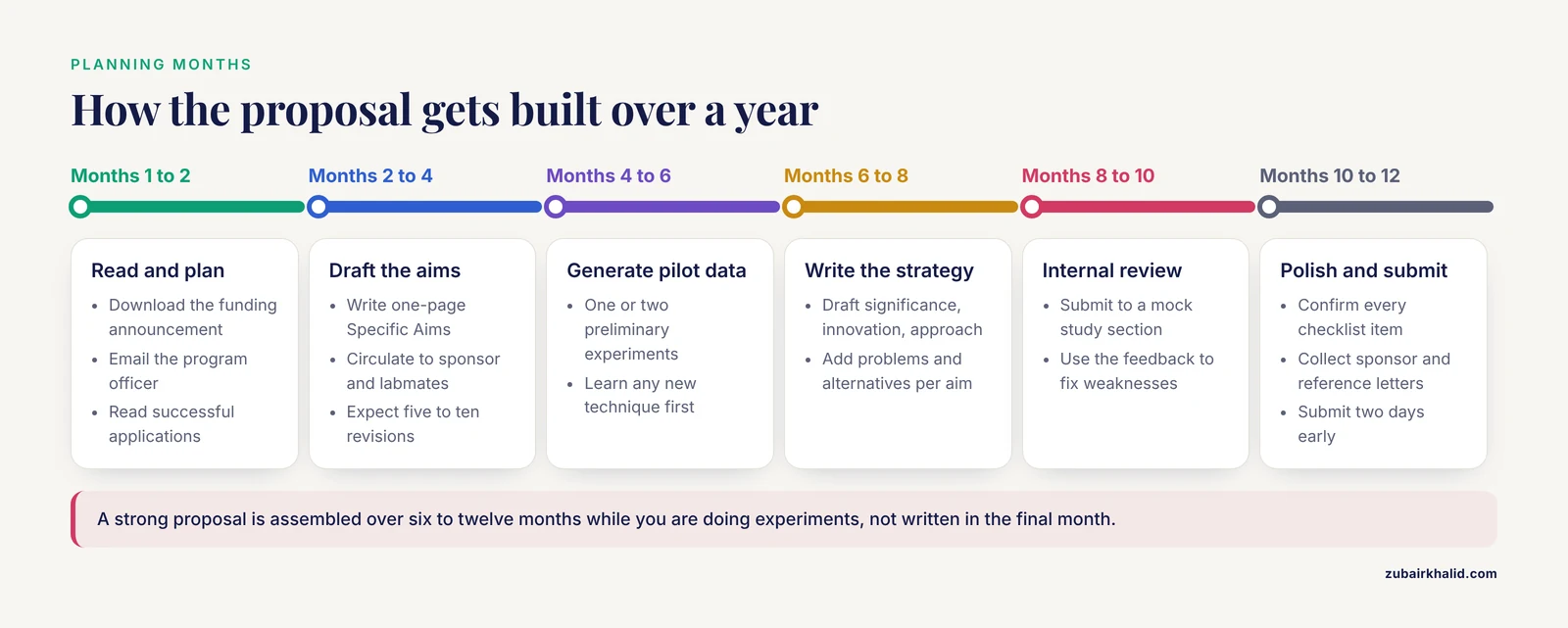
Grant proposal planning is the part most applicants underestimate. A strong proposal is not written in the final month. It is assembled over six to twelve months while you are doing experiments. Here is a timeline that works for most students.
Months 1 to 2: Read and plan. Download the funding opportunity announcement. Read successful applications from your department if they are available. Email the program officer listed in the announcement with a short paragraph describing your idea and ask whether it fits the program's scope. Program officers answer these questions and their guidance can save you from applying to the wrong mechanism.
Months 2 to 4: Draft the Specific Aims. Write the one-page aims, then circulate it to your sponsor, senior labmates, and anyone who has served on a study section. Expect to revise it five to ten times. A common rule among experienced mentors is that if the aims page is not convincing, the rest of the application will not be read carefully.
Months 4 to 6: Generate pilot data. Reviewers want evidence that the project is feasible. Even one or two preliminary experiments, a figure from a pilot dataset, or a proof-of-concept result dramatically strengthens the approach section. If your project depends on a technique you have never used, learn it before you propose it.
Months 6 to 8: Write the full research strategy. Draft the significance, innovation, and approach sections. For each aim, include a paragraph on potential problems and alternative strategies. Reviewers expect you to anticipate failure modes.
Months 8 to 10: Internal review. Most universities run mock study sections or internal review programs for fellowship applicants. Submit your near-final draft to this process. Feedback from a mock review is the cheapest way to find the weaknesses reviewers will find anyway.
Months 10 to 12: Polish and submit. Fix formatting, confirm every requirement on the checklist, collect the sponsor letter and reference letters, and submit at least two days before the deadline. Submission systems fail, and a late application is a dead application.
What Reviewers and Funders Actually Look For
Research on how funding decisions get made offers useful guidance. A study published in the International Journal of Integrated Care examined how healthcare executives decided whether to commit organizational funding to a grant-funded pilot of Project ECHO, a telementoring model for integrating care across pediatric, education, and primary care services in Queensland, Australia [1]. The researchers interviewed key stakeholders and analyzed project documentation, then used qualitative thematic analysis to identify five themes that shaped the investment decision: personal experiences, benefits, risks, partnerships, and timing [1].
The study also found that the executives' confidence depended heavily on the team behind the proposal. The intrapreneurial project team, meaning the group of employees driving the project from inside the organization, was treated as an indicator of future sustainability. The team's aims of financial sustainability, ongoing improvement, and scalability of the proposal positively influenced investment confidence [1].
Translate those five themes into fellowship terms and you get a practical checklist:
- Personal experience. Funders invest in people. Your proposal should show why you are the right person for this project, through your coursework, prior research, and the sponsor's assessment of your potential.
- Benefits. State the payoff clearly. What will the field gain if your hypothesis is correct?
- Risks. Name the risks yourself before reviewers do. Every aim should have a contingency plan.
- Partnerships. Show that your environment supports you. A co-sponsor with the missing expertise, a core facility, a clinical collaborator, all count as evidence.
- Timing. Explain why now. New technology, a new dataset, or a recent discovery that makes the question answerable today rather than five years ago.
And the team lesson applies directly. A fellowship application is a bet on the applicant plus the mentor plus the environment. Invest visible effort in the sponsor statement and the training plan, because reviewers read them as evidence of sustainability.
How to Become a Competitive Fellowship Applicant
If you are asking how to become a PhD fellowship applicant, the honest answer is that the work starts in your first year, long before you write the proposal.
Step 1: Choose a sponsor deliberately. Your sponsor's track record matters. Reviewers check whether your sponsor has funded research, mentored fellows successfully, and published in your area. A sponsor who has trained previous fellowship winners is a strong signal.
Step 2: Do rotations and pick a project with a clear question. A fundable project has a testable hypothesis, available models or datasets, and a scope that fits two to three years of work. Overly broad projects are the most common fatal flaw.
Step 3: Generate pilot data early. As described above, preliminary results are the cheapest credibility you can buy. Aim to have at least one figure or dataset that supports your central hypothesis before you submit.
Step 4: Build your record. Take advanced coursework in your methods area. Attend a research grant writing course if your university offers one. Present at a conference. Any authorship, even a middle authorship, shows you can finish projects.
Step 5: Draft in your second year. Most successful F31 applicants submit during their second or third year, after they have pilot data but before they are deep into dissertation writing.
Step 6: Use every feedback mechanism. Sponsor, co-sponsor, mock study section, writing center, program officer. Each round of critique makes the next version stronger.
Step 7: Submit, and expect to revise. NIH fellowship applications receive a summary statement with reviewer critiques. If your score is not fundable, you can revise and resubmit, and many eventual winners needed two attempts. Treat the first submission as a draft of the winning one.
Training Options: Research Grant Writing Courses and Resources
You do not have to learn proposal writing by trial and error. Several structured options exist.
- University courses. Many PhD programs offer a semester-long research grant writing course in which students draft a real fellowship proposal and receive peer and faculty critique. Ask your graduate program director whether one exists.
- NIH resources. NIH's Office of Extramural Research publishes grant writing guidance, sample applications, and recorded webinars aimed at fellowship applicants. These are free and written by the agency that runs the review.
- Mock study sections. Most research universities and some professional societies run internal review panels that simulate the real study section experience. This is the highest-value feedback you can get.
- Writing groups. A small peer group that meets weekly to exchange aims pages and strategy drafts keeps you on schedule and normalizes revision.
If your program offers a formal research grant writing course, take it. Students who draft a proposal inside a course with structured deadlines consistently finish earlier than students drafting alone.
Salary and Stipend Reality
Fellowship pay is a stipend, not a salary. The distinction matters for taxes, benefits, and planning.
NIH sets NRSA fellowship stipend levels annually and publishes them in the NIH Guide for Grants and Contracts. The levels differ for predoctoral and postdoctoral fellows and are adjusted over time, so check the current notice for the exact figures. NIH also typically provides an institutional allowance toward tuition, fees, and health insurance, and a small training-related expense allowance for supplies and travel.
Institutional fellowships, meaning those awarded by your university from its own funds, set stipends that usually match the department's standard graduate stipend. Foundation and society fellowships vary widely, from modest supplements to full packages. Some private fellowships pay a supplement on top of your existing funding rather than replacing it.
Plan for the following realities. First, fellowship stipends are modest relative to what you could earn outside academia, and the fellowship is an investment in training rather than a market-rate wage. Second, stipend income is taxable, and tax treatment differs between salary and stipend income, so talk to your institution's financial aid office about withholding. Third, a fellowship can reduce the teaching duties your program might otherwise require, which buys you research time. That time is often the real financial value of the award.
Day-to-Day Work of a Funded Fellow
Once funded, your days look like any other PhD student's days, with a few differences. You spend most of your time on your dissertation research: running experiments, analyzing data, reading literature, and writing. You attend lab meetings and meet your sponsor regularly. You may have lighter teaching obligations than unfunded peers, depending on your program's rules.
Fellowship-specific duties are modest but real. NIH requires annual progress reports, and you must follow the training plan you proposed, including any courses or workshops you committed to. If your project changes substantially, you may need to request approval for a significant change. Keep records of your training activities, because they feed the progress report and your eventual job applications.
Skills That Matter Most
Four skills separate funded applicants from unfunded ones, and none of them is raw intelligence.
Writing. The proposal is a writing exercise. Clarity, logical flow, and the discipline to cut unnecessary detail matter more than vocabulary. Read your aims page aloud. If a sentence takes two breaths, split it.
Experimental design. Reviewers scrutinize your controls, sample sizes, and statistical approach. A single aim with a fatal design flaw can sink the application. Take a statistics or experimental design course before you draft.
Project management. A fellowship is a multi-year project with milestones. Learn to plan backward from deadlines and to break aims into monthly tasks.
Resilience. Rejection is normal. Reviewers reject strong applications for reasons of budget, fit, or simple competition. The skill is extracting the useful critique from the summary statement and resubmitting.
Advancement and Adjacent Roles
A fellowship is a launchpad, not a destination. The most common paths after a PhD fellowship are a postdoctoral position, a transition award such as the NIH K99/R00 pathway to independence, a faculty position, or a move into industry, data science, regulatory affairs, or science policy.
One lesson from the health professions literature applies here. The clinical nurse leader (CNL) is a nursing role introduced in 2003 through the American Association of Colleges of Nursing. A narrative review of the CNL literature examined 25 implementation reports, one job analysis, seven qualitative or survey studies, and three quantitative studies. Every implementation report and study described improved care quality outcomes after the role was introduced into a care delivery microsystem, yet the review concluded that CNLs still struggle to define the role to themselves and to the healthcare field at large, and that further research is needed to delineate the role in practice and develop indicators of its specific contributions [2].
The takeaway for early-career scientists is direct. A new role can produce real, measurable value and still fail to advance if it cannot articulate its own contribution. Whatever path you take after your fellowship, invest early in defining what you uniquely do, and gather evidence of your impact. That habit, more than any single credential, determines advancement.
Who Thrives and Who Does Not
Certain traits predict success in the fellowship path. You thrive if you enjoy writing and rewriting, tolerate delayed gratification, can work independently while staying accountable to a mentor, and genuinely care about your specific question. You also thrive if you ask for feedback early and often, because isolation is the most common failure mode in proposal writing.
You may struggle if you need external structure to stay productive, if you dislike the uncertainty of research, or if you expect the fellowship to be a well-paid job rather than a training investment. The stipend is modest, the work is long, and the payoff arrives years later. None of that is a flaw in the system, but it is a fact you should accept before you commit.
Common Mistakes and Limitations
These are the errors reviewers and mentors see most often, and the honest limits of what any guide can tell you.
- Aims that are too broad. Three aims that each describe a full research program will not fit in two to three years. Narrow the scope until each aim is a discrete, completable unit of work.
- No pilot data. Proposing a technique you have never performed is a red flag. Reviewers assume the technique will fail exactly as often as you have practiced it.
- Ignoring the announcement. Every funder has formatting rules, eligibility rules, and page limits. Applications that violate them are sometimes not reviewed at all.
- Writing the proposal as a contract. The proposal is a plan, not a promise. Reviewers know projects evolve. What they punish is the absence of contingency plans, not the presence of honest uncertainty.
- Skipping the mock review. The single cheapest way to improve your application is a simulated study section. Skipping it to save time is a false economy.
- Assuming one submission is enough. Many funded fellows revised and resubmitted. Plan for two cycles.
- Misjudging the stipend. Check the current NIH stipend notice and your institution's benefits before you budget. Stipend levels change annually, and tax treatment differs from salary income.
- Individual outcomes vary. Award rates, stipend levels, and career trajectories differ by field, institution, and funding cycle. The advice here describes the general path, and your specific situation needs input from your program, your sponsor, and your institution's financial aid office.
Concrete Next Steps
If you are ready to start, here is the sequence.
- Identify two or three fellowship mechanisms that fit your stage and field, and download their funding opportunity announcements.
- Email the program officer for each with a one-paragraph description of your idea and ask whether it fits.
- Talk to your sponsor about committing to the application and to a co-sponsor if you need added expertise.
- Draft a Specific Aims page within two weeks, while the plan is fresh, then revise it relentlessly.
- Enroll in a research grant writing course or join a writing group this semester.
- Schedule a mock study section through your university at least three months before the deadline.
- Build a submission checklist from the announcement and verify every item before you submit.
Frequently Asked Questions
What is a PhD fellowship research proposal?
It is a written research and training plan you submit to a funder to win individual support for your doctoral studies. It typically includes a one-page Specific Aims section, a research strategy, a training plan, and letters from your sponsor and references.
What are the requirements for a PhD fellowship research proposal?
Core requirements are enrollment in a PhD or dual-degree program, a sponsor who commits to mentoring you, a research plan with specific aims, a training plan, biosketches, transcripts, reference letters, and a description of your institutional environment. Exact requirements vary by funder, so read the funding opportunity announcement.
How much does a PhD fellowship pay?
Fellowships pay a stipend rather than a salary. NIH sets NRSA fellowship stipend levels each year and publishes the current amounts in the NIH Guide for Grants and Contracts, and institutional and foundation stipends vary by program. Check the current notice for exact figures.
How do I become a PhD fellowship applicant?
Join a PhD program, choose a sponsor with a strong mentoring record, develop a testable project, generate pilot data, draft your Specific Aims page, get feedback from a mock review, and submit during your second or third year. Many successful applicants revise and resubmit.
How long should a fellowship research proposal be?
For NIH individual fellowships, the Specific Aims page is one page and the research strategy is about six pages, plus bibliography, biosketches, and supporting letters. Confirm the exact limits in the funding opportunity announcement for your cycle.
Do I need a research grant writing course before applying?
No course is required, but a structured research grant writing course or writing group significantly improves the odds of finishing a strong proposal on time. NIH also publishes free grant writing guidance and sample applications.
What makes a fellowship proposal get rejected?
The most common reasons are overly broad aims, no pilot data, a weak training plan, a design flaw in one aim, formatting violations, and a sponsor statement that does not show a real mentoring commitment. Reviewers reward feasibility, clear hypotheses, and contingency plans.
Can international students apply for PhD fellowships in the US?
It depends on the funder. Some NIH individual fellowship mechanisms are restricted to US citizens or permanent residents, while institutional fellowships and many private foundations accept international students. Check the eligibility section of each announcement before you plan your application.