Training Your Bioinformatics Team for Cloud Migration
By Dr. Zubair Khalid, DVM, MS, PhD ·

Cloud migration in a bioinformatics group is a people project before it is a technology project. The servers, storage buckets, and pipeline engines are the easy part. The hard part is taking analysts who have spent years running jobs on a local cluster and helping them become confident, cost-aware, security-conscious cloud practitioners. This article explains what cloud bioinformatics work looks like day to day, what bioinformatics cloud training requires, how to structure a training program for an existing team, and what the career path pays and promises for individuals moving into this specialty.
The context for this shift is straightforward. Modern sequencing instruments, imaging platforms, and proteomics workflows generate data volumes that routinely exceed what a departmental server can hold or process. Reviews of computational biology now describe artificial intelligence methods integrated with cloud computing and high-performance computing as the standard approach for handling genomic sequences, protein interaction networks, and gene expression data at scale [1]. Virus researchers have made the same point for years, calling for shared cloud-based systems, better data sharing, and sustained bioinformatic training as core needs of the field rather than optional extras [2]. If your team analyzes biological data, the cloud is already part of its professional environment. The question is whether your people are trained to use it well.
At a Glance
| Dimension | Summary |
|---|---|
| What the work is | Running, building, and maintaining genomics, proteomics, and imaging pipelines on rented cloud infrastructure instead of local servers |
| Typical education | Bachelor's or master's in computational biology, bioinformatics, computer science, or a life science with strong programming. PhD for research-heavy roles |
| Core certifications | Vendor cloud credentials (AWS, Google Cloud, Azure fundamentals and specialty tracks) plus reproducibility skills such as containerization and workflow management |
| Typical employers | Universities and sequencing centers, hospitals, pharmaceutical and biotech companies, public health labs, cloud platform vendors themselves |
| Salary range | No single sourced national figure applies because titles span research programmer to cloud architect. Compensation scales with infrastructure responsibility, not biology knowledge alone |
| Job outlook | Demand follows data growth. Reviews across genomics, radiology, and proteomics describe cloud deployment as the default delivery model for new analytical tools [1][3][4] |
Why Teams Migrate, and What Gets Harder
Most teams migrate for three reasons. First, burst capacity. A single whole-genome sequencing project can require more compute in one week than the lab used all year, and cloud platforms let you rent that peak rather than buy it. Second, collaboration. Shared cloud workspaces let distributed groups run identical analyses on identical data, which is why pan-African capacity-building networks invested early in structured data transfer systems and shared analysis infrastructure for genomics research [5]. Third, access to managed services. Platforms now exist where the heavy machinery is prebuilt, such as the National Cancer Institute-funded Cancer Genomics Cloud, which supports cloud-hosted collaborative projects and draw on hardware from providers including Amazon Web Services and Google Cloud Platform [6].
What gets harder is everything around the pipeline. On a local cluster, a single systems administrator often handled accounts, quotas, and network paths. In the cloud, those responsibilities spread across the team. Every analyst who launches an instance makes purchasing decisions with every command. Every dataset uploaded is a data governance decision. Training has to cover this widened scope, and that is why thoughtful programs treat cloud migration as a curriculum design problem, not a procurement problem.
What Cloud Bioinformatics Work Looks Like Day to Day
A cloud-trained bioinformatician typically does some mix of the following:
- Runs and monitors analytical workflows on cloud infrastructure, watching for failures, retries, and runaway costs.
- Wraps tools in containers so they run identically on a laptop, on the cloud, and in a colleague's project. Containerization for reproducible execution is now standard practice in published cloud frameworks [6].
- Builds or adapts workflow definitions in languages such as Snakemake or Nextflow so analyses can be rerun automatically.
- Uses managed analytical environments such as Jupyter Notebooks paired with scalable frameworks like Hail for genome-wide association studies on large datasets [7].
- Evaluates hosted platforms before building anything. The Chan Zuckerberg ID platform, for example, offers open-access cloud workflows for detecting pathogens and antimicrobial resistance genes in sequencing data, and a team that knows it exists may not need to build the equivalent from scratch [8]. Cloud-native tools are also appearing in proteomics, where a pretrained deep-learning search engine runs as a web service and completed hundreds of immunopeptidomics searches in under an hour [4].
- Handles data movement, permissions, and logging, which is unglamorous work that determines whether anyone can reproduce last month's result.
The pattern across all of these tasks is a shift from running analyses to engineering reproducible systems. Benchmarking consortia in cancer research now require participants to submit cloud-ready software packages precisely because diverse local environments made cross-site comparison unreliable [9].
Bioinformatics Cloud Training Requirements
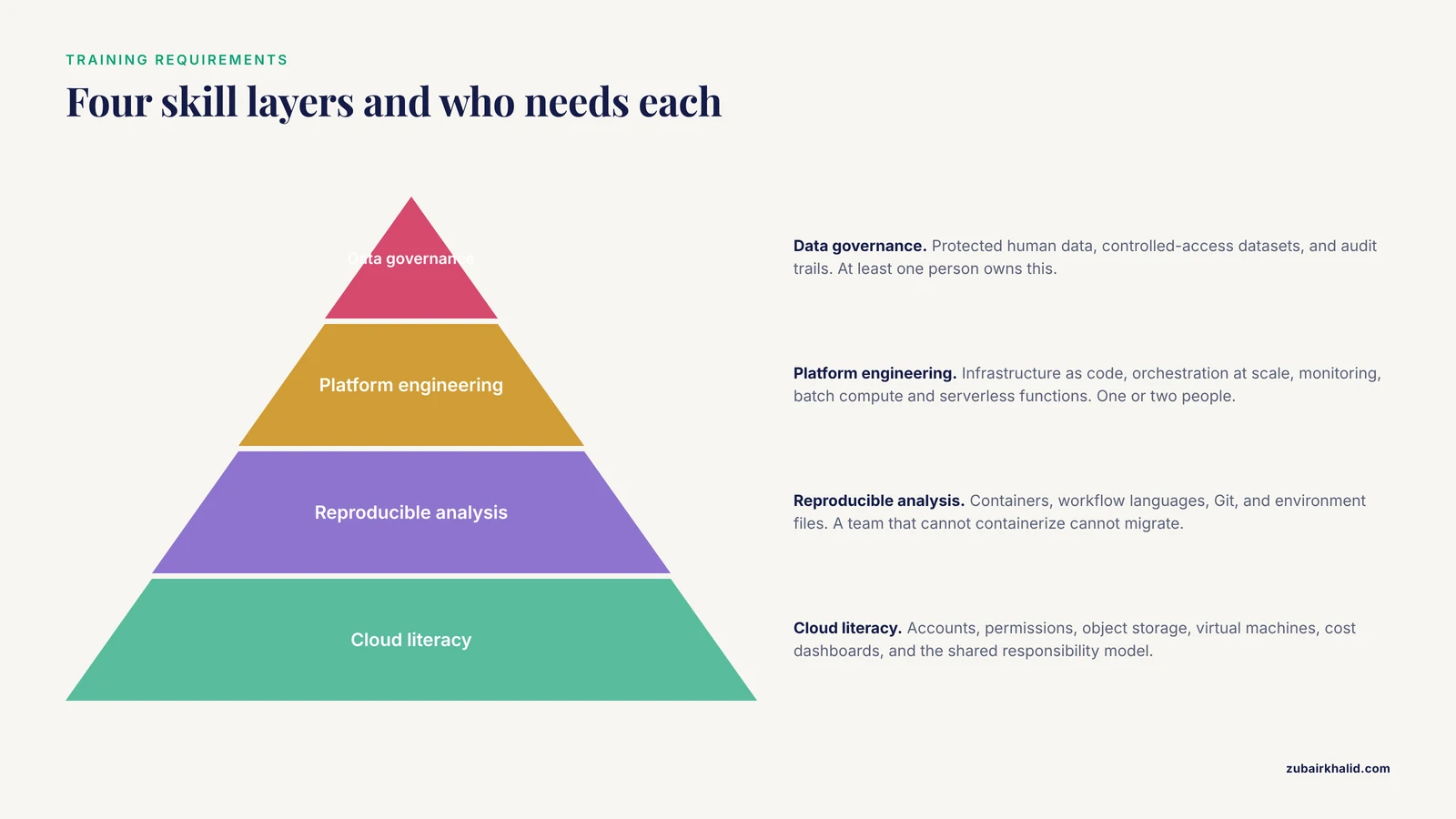
The skills split into four layers. Most team members need the first two. One or two people should master the second and third. Leadership needs the fourth.
Layer 1, cloud literacy. Understand accounts, permissions, object storage, virtual machines, cost dashboards, and the shared responsibility model for security. This is foundational knowledge covered by every major vendor's entry certification.
Layer 2, reproducible analysis. Containers (Docker or Singularity/Apptainer), workflow languages, version control with Git, and environment files. A team that cannot containerize cannot migrate, because the whole value of the cloud is that an analysis can run anywhere with identical results [6][9].
Layer 3, platform engineering. Infrastructure as code, pipeline orchestration at scale, monitoring, and integration of services such as batch compute and serverless functions. Federated learning tools illustrate the direction of travel, where a Python command-line tool orchestrates distributed virtual machines to automate privacy-preserving model training across sites and slots into standard Snakemake pipelines [10].
Layer 4, data governance. Handling protected human data, controlled-access datasets, and audit trails. Large-scale genomic platforms such as the All of Us Researcher Workbench are built around cloud environments precisely so researchers can analyze sensitive data within governed spaces rather than downloading it [7].
A realistic inventory exercise: list every recurring analysis your team performs, then label each as trivially portable, portable with rework, or dependent on local hardware. That list becomes your training syllabus, because people learn fastest when the exercises are their own real work.
The State of Available Training, and Why You Should Build Your Own Program
Before designing internal training, know what the external market actually offers. A structured survey within a global pathogen genomics consortium analyzed 81 training courses across 17 countries and found a field weighted toward beginners and short formats. Fifty-two percent of courses targeted academic or research audiences and 46 percent targeted public health professionals. Beginner-level courses made up 58 percent of offerings while only 6 percent were classified as advanced. Bioinformatics or genomic data analysis appeared in 72 percent of courses, but specialized topics such as biostatistics and systems administration were rare. Most concerning for employers, 38 percent of courses included no structured assessment at all, and only 7 percent used quizzes or exams [11].
Two conclusions follow. First, external courses are excellent for onboarding but will not produce your advanced engineers, because advanced offerings are scarce [11]. Second, ungraded training produces unmeasured competence. Build short practical assessments into your internal program, even simple ones, so you know who can actually launch a pipeline under budget constraints and who has only watched a webinar.
A Step-by-Step Roadmap for Training Your Bioinformatics Team for Cloud Migration
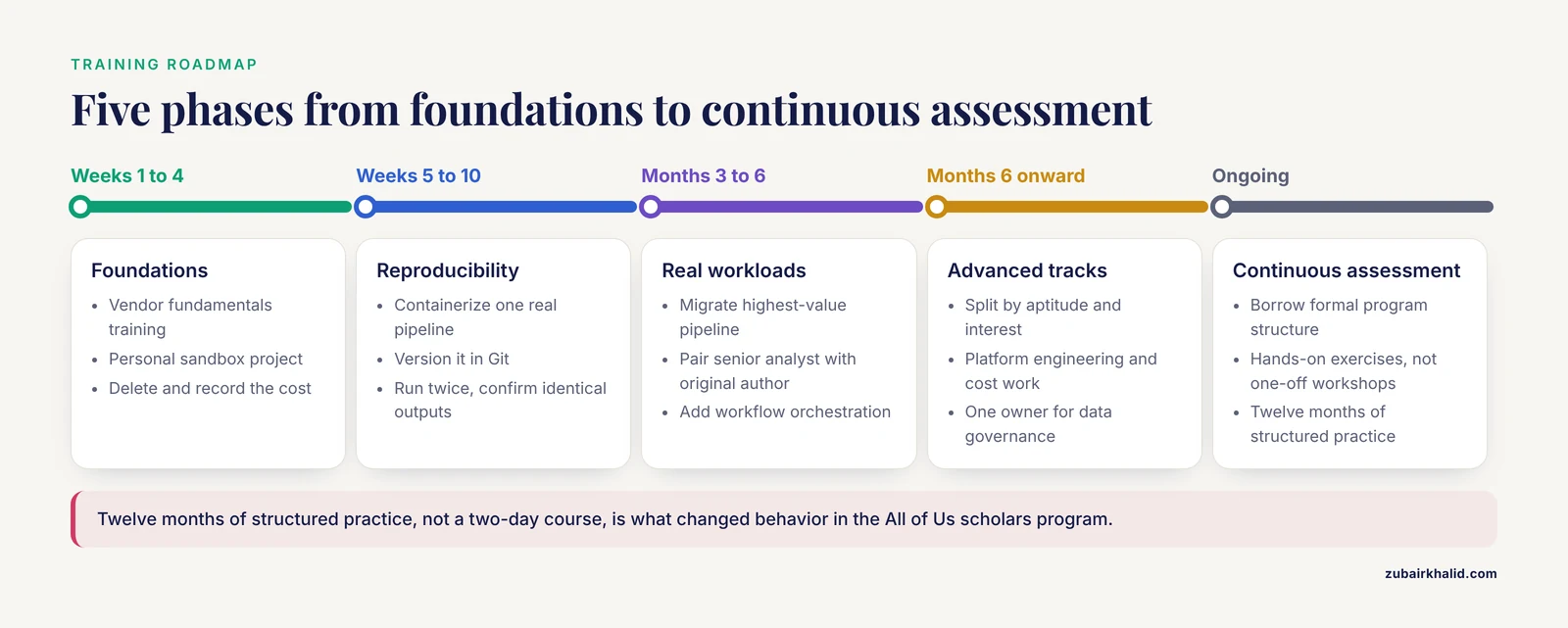
Phase 1, Foundations (weeks 1 to 4)
Everyone completes vendor fundamentals training and builds a personal sandbox project. A good first exercise with concrete numbers: provision one small virtual machine, install a standard RNA-seq alignment tool, process a small public test dataset, then delete everything and write down what it cost. The goal is not the analysis. The goal is that every team member has personally felt the relationship between compute choices and billing.
Phase 2, Reproducibility (weeks 5 to 10)
Containerize one real pipeline from your team's workload. Version it in Git. Then run it twice, in two different accounts, and confirm identical outputs. Data challenges that require cloud-ready submissions established this practice as the standard for credible multi-site benchmarking [9], and your internal quality bar should match it.
Phase 3, Real Workloads (months 3 to 6)
Migrate your highest-value recurring pipeline. Pair a senior analyst with the person who wrote the original code, since institutional knowledge lives in comments and side scripts that documentation misses. Introduce workflow orchestration so the migrated pipeline is more automated on the cloud than it ever was locally. Teams that adopt orchestration gain the ability to chain tasks across machines and reuse the logic in future projects, which is the pattern demonstrated by federated orchestration tools that automate multi-client workflows and integrate with established pipeline managers [10].
Phase 4, Advanced Tracks (months 6 onward)
Split the team by aptitude and interest. Some analysts should go deeper on platform engineering and cost optimization. Others should go deeper on scalable analytical frameworks, learning tools like Hail and Jupyter-based environments used for population-scale genomics in the All of Us program [7]. At least one person should own data governance, including controlled-access handling.
Phase 5, Continuous Assessment
Borrow the structure of formal training programs rather than the one-off workshop model. The Baylor College of Medicine All of Us Biomedical Researcher Scholars Program runs a year-long curriculum that begins with an in-person computational boot camp and then sustains practice through hands-on exercises covering data preparation, quality control, association testing, and result interpretation, with participants finishing able to conduct and interpret a full GWAS [7]. Twelve months of structured practice, not a two-day course, is what changed behavior in that program. Plan accordingly.
AWS Genomics and the Platform Landscape
When people say "AWS genomics," they usually mean one of two things. The first is Amazon's genomics-focused service offerings and partner ecosystem, which include managed batch compute and storage tiers suited to sequencing pipelines. The second, broader meaning is the general pattern of running genomics work on any large cloud provider. Your team should learn concepts on one provider and recognize that the concepts transfer.
Beyond raw infrastructure, a mature ecosystem of cloud-hosted scientific platforms has emerged, and part of training is knowing when to use one instead of building from scratch:
- Cancer Genomics Cloud, an NCI-funded resource that hosts collaborative projects with managed compute from providers such as Amazon Web Services and Google Cloud Platform, paired with analysis frameworks like pyCERR for radiological imaging and radiomics [6].
- CZ ID, an open-access, cloud-based platform for metagenomic and whole-genome sequencing analysis, including an antimicrobial resistance module built on the Comprehensive Antibiotic Resistance Database [8].
- The All of Us Researcher Workbench, a cloud research environment providing controlled access to large-scale genomic data with Jupyter and Hail support [7].
- Emerging domain platforms such as cloud-based therapeutic peptide screening systems that combine language models with curated datasets and high-throughput modules covering dozens of prediction tasks [12].
A useful training exercise is a platform bake-off. Give two subteams the same biological question, have one solve it on raw cloud infrastructure and one on a hosted platform, then compare cost, time, and reproducibility. The lesson that emerges is almost always the same, that hosted platforms win for standard questions and custom infrastructure wins for genuinely novel ones.
The Careers Angle: How to Become a Cloud Bioinformatician
For individuals asking how to become bioinformatics cloud training graduates, meaning how to enter this specialty, the path is convergent rather than linear.
Entry requirements. Most practitioners hold a bachelor's or master's degree in bioinformatics, computational biology, computer science, or a quantitative life science. A PhD matters for research-track roles at universities and in drug discovery, less for infrastructure and production pipeline roles. What actually differentiates candidates is a portfolio: a public repository containing a containerized, workflow-managed analysis that runs on a cloud provider from a single command is worth more in interviews than any certificate.
Bioinformatics cloud training requirements in practice. Employers look for four demonstrable things, which are Python or R fluency, comfort with a workflow manager, a containerized project the candidate can explain line by line, and evidence of cost awareness, such as a project README that states what an analysis run costs.
Salary expectations. Here an honest caveat matters. Compensation in this field spans an enormous range because the title "bioinformatician" covers jobs from research-support programming to enterprise cloud architecture, and no single sourced figure usefully describes it. What is reliably true from the structure of the field is that responsibilities move toward infrastructure engineering, compensation moves toward the infrastructure side of the market, and candidates who can speak both biology and platform engineering negotiate from the scarce side of the supply curve. Rather than quoting unsourced numbers, check current postings for your specific title and region, because the variance across titles exceeds the variance across years.
Advancement. Typical progression runs from analyst to senior analyst to team lead, with branch points toward platform engineering, data governance, or scientific leadership. Adjacent roles include research software engineer, cloud solutions architect for a life science vendor, and computational biologist positions inside pharmaceutical companies where pipeline ownership, not discovery analysis, is the job.
Cost Awareness and Environmental Sustainability
Two accounting concerns belong in your training curriculum because both are now part of professional practice. The first is financial. Every launched instance is a purchase, and unattended jobs are silent spending. Train analysts to check cost dashboards as routinely as they check pipeline logs.
The second is environmental, and the literature on this is maturing quickly. A scoping review of artificial intelligence in radiology identified 13 eligible studies and found four recurring themes, which were energy consumption, appearing in 10 studies, carbon footprint in 6, computational resources in 9, and water consumption in 2, with reported metrics including CO2-equivalent emissions and energy demands alongside strategies to mitigate impact [3]. Those concerns transfer directly to large-scale bioinformatics, where a genome-wide analysis and a deep-learning training run have similar compute profiles to medical imaging workloads. Teams increasingly report the compute footprint of analyses alongside their results, and training your team to think in those terms now avoids retrofitting later.
Common Mistakes and Limitations
Mistake 1, treating training as an event. A workshop creates familiarity. Competence comes from repeated practice on real work over months, which is the model used by successful year-long programs [7].
Mistake 2, migrating before containerizing. If the pipeline only runs on one person's machine with undocumented library versions, moving it to the cloud recreates the same fragility with a monthly bill attached. Containerize first.
Mistake 3, sending everyone to the same course. The external training market skews heavily toward beginner content, with advanced courses making up only 6 percent of surveyed offerings [11]. Budget accordingly and develop advanced material internally.
Mistake 4, skipping assessments. With 38 percent of surveyed external courses containing no structured assessment [11], assuming a certificate means competence is a real risk. Test skills with small graded exercises.
Mistake 5, ignoring data governance until late. Controlled-access human data cannot simply be uploaded to the cheapest storage bucket. Governance constraints shape architecture, and teams that learn this late redesign expensively. Governed cloud workspaces exist precisely for this reason.
Mistake 6, assuming the cloud fixes underlying infrastructure gaps. Capacity-building efforts in Africa showed that networks still needed to diagnose network performance and roll out data transfer tooling before analysis could scale [5]. The cloud moves where the computers are. It does not repair a slow institutional internet connection.
A limitation to state plainly. This article addresses team training and career planning at a general level. Individual career decisions, specific hiring evaluations, and institution-specific compliance requirements need input from your own advisors, regulators, and legal counsel.
Who Thrives in Cloud Bioinformatics and Who Does Not
Thriving profiles share a trait, which is enjoyment of engineering as much as biology. People who like making systems that run unattended, who get satisfaction from a clean retry log, and who treat a cost report like a puzzle tend to flourish. Scientists who experience compute as an interruption to the actual research, who want their environment stable and invisible, may be happier as domain analysts served by cloud infrastructure than as the people building it. Both roles are essential. Training programs fail when they push everyone toward the same track.
Concrete Next Steps
- Inventory your recurring analyses and classify each by migration difficulty.
- Assign every team member a vendor fundamentals course and a sandbox budget.
- Containerize your single most important pipeline and version it in Git.
- Write a one-page data governance policy before the first human dataset touches the cloud.
- Identify your hosted-platform overlaps and evaluate existing services before building equivalents [6].
- Build a monthly internal demo where someone presents a migrated pipeline, its cost, and its runtime.
- For individuals, publish one containerized project publicly. It is the strongest credential the field currently recognizes.
Frequently Asked Questions
Do I need a graduate degree to work in cloud bioinformatics?
No. A bachelor's or master's degree in bioinformatics, computer science, or a quantitative life science is common, and a portfolio of containerized, reproducible cloud projects often outweighs credentials in hiring.
Which cloud platform should our team learn first?
Choose the one your institution or collaborators already use, because concepts such as storage, permissions, and batch compute transfer between providers. The scientific platforms you may connect to, such as the Cancer Genomics Cloud, run on hardware from multiple providers including Amazon Web Services and Google Cloud Platform [6].
How long does team training for cloud migration take?
Plan for six months to a year of structured, assessed practice. Year-long programs with a boot camp start followed by sustained hands-on work have produced researchers who independently run large-scale analyses [7].
Will cloud migration eliminate bioinformatics jobs?
No. It changes the job from operating local servers to engineering reproducible cloud systems, and published frameworks across genomics and proteomics increasingly assume cloud delivery, which increases rather than decreases demand for trained people [1][4].
What is the difference between cloud bioinformatics and high-performance computing?
Both run large analyses. Cloud resources are rented on demand from shared provider infrastructure with per-use billing, while traditional HPC clusters are owned or shared institutional systems with job schedulers. Many teams use both.
Do wet-lab scientists need cloud training too?
A basic level helps. Collaboration between computational and laboratory scientists depends on shared understanding of how data moves and where analyses run, a need highlighted in virus bioinformatics recommendations for integrated training [2].
What certifications help most in this field?
Vendor fundamentals certifications open doors, but employers weight demonstrated projects more heavily. A public repository showing a workflow-managed, containerized pipeline that runs on cloud infrastructure is the strongest practical credential.
How do we keep genomic data private in the cloud?
Use governed, controlled-access cloud workspaces designed for sensitive human data rather than open storage [7], and consider privacy-preserving approaches such as federated learning, which trains models across sites without pooling the underlying data [10].
Sources
- Advancements in AI for Computational Biology and Bioinformatics: A Comprehensive Review.
- A new era of virus bioinformatics.
- Exploring environmental sustainability of artificial intelligence in radiology: A scoping review.
- Tesorai Search: Cloud-based Database Search Engine Boosts Identifications for Mass Spectrometry Proteomics With a Pretrained Peptide-spectrum Deep-learning Model.
- Development of Bioinformatics Infrastructure for Genomics Research.
- Artificial intelligence apps for medical image analysis using pyCERR and cancer genomics cloud.
- Implementing a training resource for large-scale genomic data analysis in the All of Us Researcher Workbench.
- Simultaneous detection of pathogens and antimicrobial resistance genes with the open source, cloud-based, CZ ID platform.
- Reproducible biomedical benchmarking in the cloud: lessons from crowd-sourced data challenges.
- Fedflow: cloud orchestration for federated learning with the FeatureCloud platform.
- Mapping pathogen genomics training provision: a structured analysis within a global consortium network.
- PepPharmaHub: a cloud-based platform integrating multimodel language architectures with curated data resources for therapeutic peptide discovery.